
Developmental Dynamics: Tracheal Development
Bringing people and ideas together to fund, conduct, and share transformative science.
Our grants advance knowledge and strengthen connections between science and society.
Discover the latest news, research, and updates.
We convene scientists, mathematicians, and thinkers to share ideas and explore new questions.
Founded by Jim and Marilyn Simons, we’re a private philanthropy advancing mathematics and basic science.
Work with us on the frontier of basic science research.
The Flatiron Institute is a research center that uses computational science to advance fields like physics, biology, and astronomy.
Search
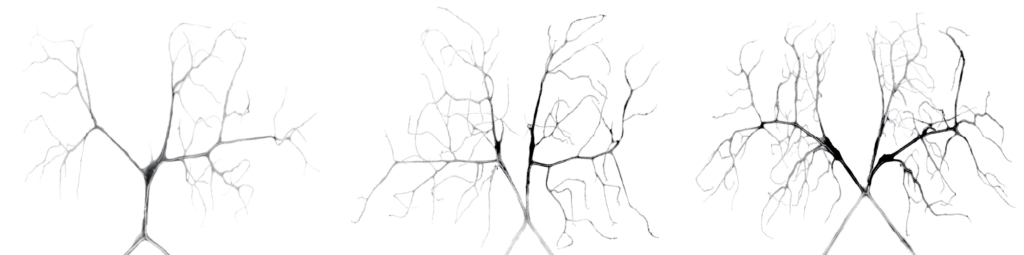
In Drosophila larvae, the tracheal system is a network of gas-filled tubes, serving to exchange gases with ambient air which enters through spiracles and then diffuses across highly branched terminal cells. During embryogenesis, each tracheal branch forms from a small number of progenitor cells, which adopt three different cell fates through a combination of Ras/MAPK, Wnt/Wingless, Notch, and BMP/Dpp signaling, become motile, and undergo large morphological changes. One cell type, the terminal cell, becomes increasingly branched and adapts to the needs of the surrounding tissue. This process serves as a powerful single-cell model for the formation of vasculature. Terminal cell fate specification is sensitive to the levels of FGF ligand, and under perturbations of this pathway, partial penetrance and cryptic variation are observed across different tracheal branches. Our live imaging of this process allows for time-resolved observations of these important phenomena. With experimental measurements and mathematical models we aim to understand the cell fate decision making process and the growth and morphological changes of tracheal branches. The tracheal system is therefore a uniquely tractable place to study cell fate decision making, partial penetrance and cryptic variation, single cell morphogenesis, and the formation of biological transportation networks.