A grid of evenly spaced, small white dots arranged in a circular pattern on a light gray background. The dots gradually fade out toward the edges.

Biological Transport and Networks: Continuum Modeling

How does the structure of a network shape transport, and how does transport reshape the network? We develop mathematical models and computational tools to investigate these questions.

From Discrete Networks to Continuum Models
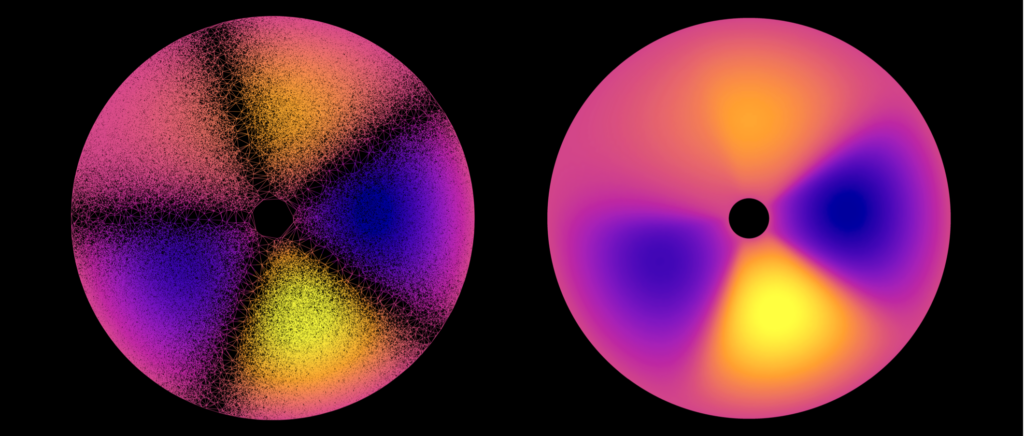
Two circular data visualizations against a black background, one showing a mesh grid and the other a smooth gradient, both depicting a colorful pattern of pink, orange, yellow, and blue regions around a central hole.
An eigenmode on a spatially varying annular network (left) and its continuum approximation (right).

Dense networks can contain far more individual connections than are practical to model one by one. We develop a continuum-limit framework that replaces equations along the edges of a network with a partial differential equation on the space it occupies.

The effective conductivity, capacity and vertex density follow from the network’s geometry and microscopic properties. This links local structure to large-scale diffusion and wave propagation, allowing networks with different architectures to be studied within a common description.

How Transport Networks Form and Adapt
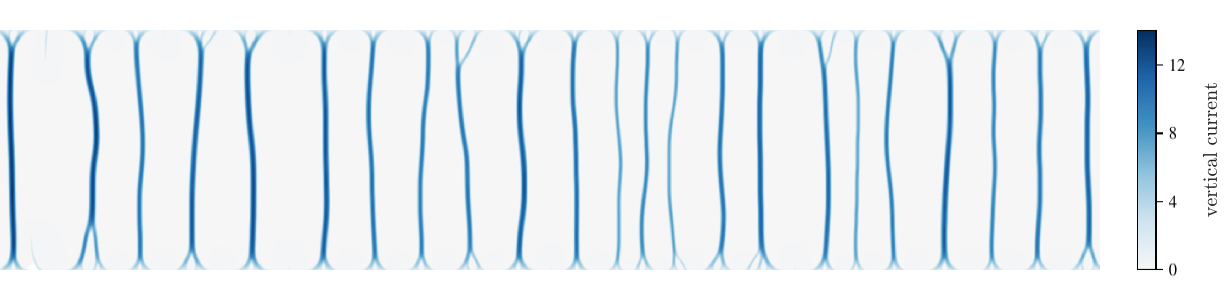
A heatmap showing vertical current, represented by blue, mostly parallel lines of varying intensity against a light background, with a scale ranging from 0 to 12.
Flow concentrates into channels in a simulation of an adaptive transport medium (central detail). Color shows vertical current.

In adaptive transport systems, flow changes the material carrying it, and those changes redirect the flow. We study this feedback using a continuum model in which conductivity evolves as a tensor field, describing how easily fluid moves in different directions.

A finite-wavelength instability selects a preferred length scale at onset. Analysis and simulations show how conducting structures emerge from a homogeneous base state, and how channel structure and conductivity scale with the control parameter (analogous to a Rayleigh number in thermal convection).

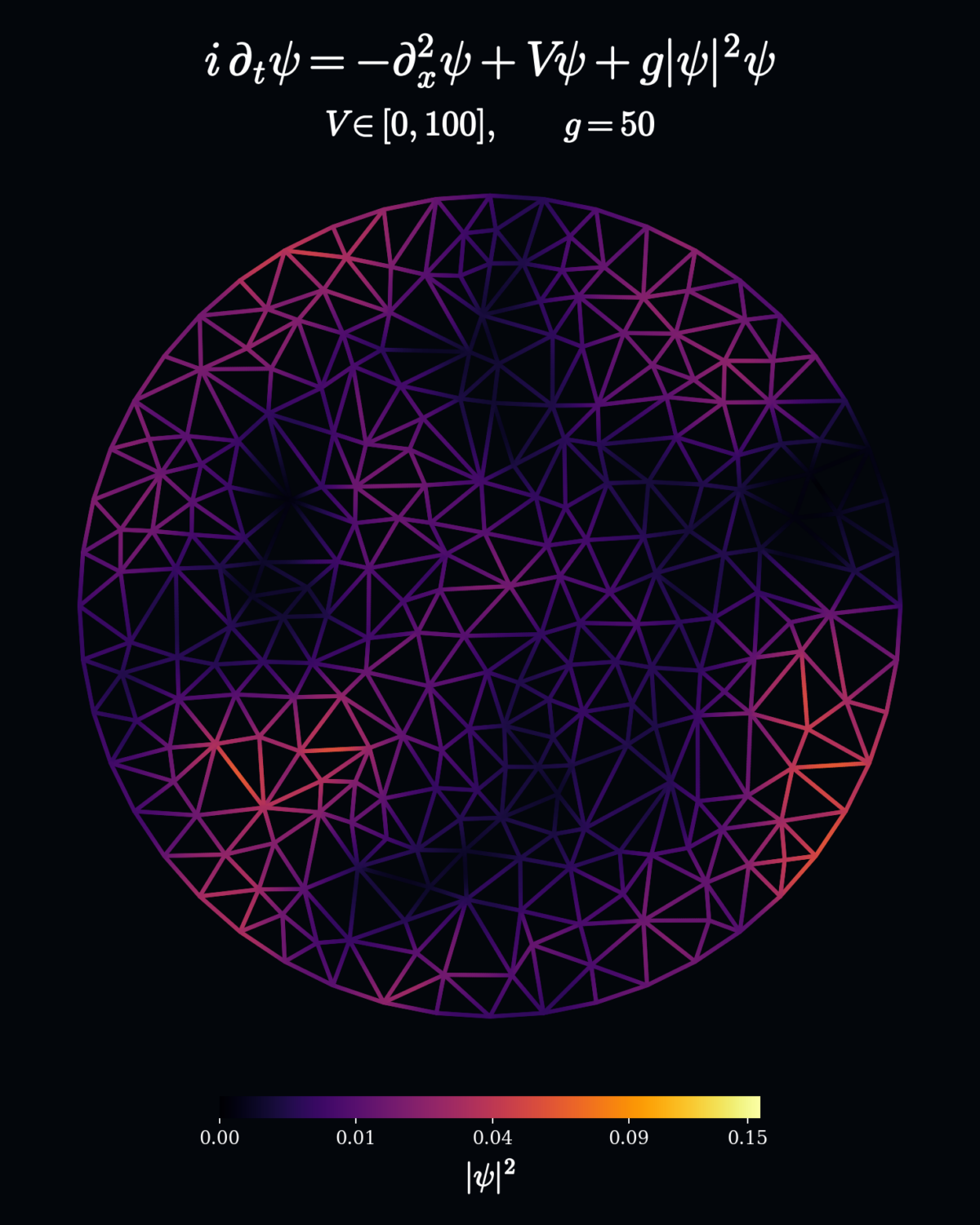
A circular domain subdivided into a triangular mesh, colored by a gradient representing the magnitude of a wave function, shown below the governing nonlinear Schrödinger equation and parameters.
A snapshot of nonlinear wave evolution on a 753-edge network. Color shows the squared amplitude.

Computing Dynamics on Networks

Transport and wave processes on networks require equations along each connection together with conditions at junctions. We are developing a distributed spectral framework, built on Dedalus, for formulating and solving these coupled problems.

The framework combines high-order discretization on individual edges with parallel solvers on subgraphs. Applications include heterogeneous diffusion, dynamic storage at junctions, network eigenmodes and nonlinear wave propagation. These examples connect mathematical models to simulations on complex networks.