Simons Foundation Awards 4 New Scientific Software Research Faculty Fellowships
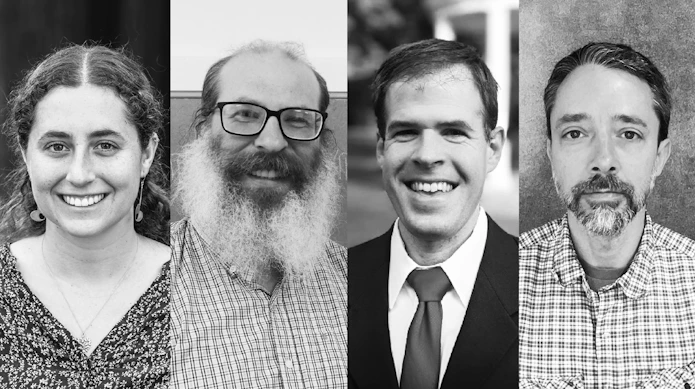
The Simons Foundation’s Mathematics & Physical Sciences division has awarded four new Scientific Software Research Faculty Fellowships.
The Scientific Software Research Faculty Fellowships help institutions establish new positions, providing the fellows’ home institutions with five years of salary support for the awardee’s academic-year salary and fringe benefits. These benefits cover 100 percent of a fellow’s salary for the first two years and 50 percent for the remaining three years. Each fellowship also provides an annual $50,000 research allowance to each awardee. All fellowships are funded by Simons Foundation International and administered by the Simons Foundation.
The four new fellows are:
Sarah Blunt
Planet Formation & Evolution Through a Statistical Lens
University of Colorado Boulder
Sarah Blunt is an astrostatistician and assistant professor in the Department of Astrophysical and Planetary Sciences at the University of Colorado Boulder. Her software, particularly orbitize!, is widely used in the exoplanet and binary star communities. At Boulder, she will work on several projects supporting research in astrometric, radial velocity and direct imaging exoplanet characterization, particularly focusing on tools for modeling exoplanet orbits and mitigating stellar variability.
Douglas A. Torrance
Advancing Macaulay2 for the Computational Algebraic Geometry Community
Georgia Institute of Technology (Georgia Tech)
Douglas A. Torrance is a computational algebraic geometer and commutative algebraist whose research focuses on secant varieties and tensor decomposition. At Georgia Tech, he will continue development of Macaulay2, a widely used software system for research in algebraic geometry and commutative algebra. His work will focus on improving performance and interoperability with other mathematical software, expanding functionality, and making the system more accessible to new users. These efforts aim to strengthen Macaulay2 as a central tool for researchers while fostering a broader and more inclusive community of contributors.
David Wells
Enabling Simulations of Realistic Cardiac Dynamics and Biomedical Devices by Enhancing Existing Scientific Software
University of North Carolina at Chapel Hill
David Wells is a research assistant professor in the Department of Mathematics at the University of North Carolina at Chapel Hill (UNC). At UNC, he combines clinical data from the School of Medicine with scientific computing to solve important cardiovascular dynamics problems. A major focus of this work is the development of new numerical methods to effectively simulate valve repair and replacement surgeries. To achieve this end, he is a principal developer of deal.II, a computational science library used in applications ranging from microfluidics to planetary formation. In addition, he is a principal developer of IBAMR, a framework for developing applications that simulate fluid-structure interaction (FSI) problems with the immersed boundary (IB) method.
Kyle Westfall
Community-Focused Data Reduction and Analysis Tools for Astronomical Spectroscopy
University of California, Santa Cruz
Kyle Westfall is an assistant researcher at the University of California Observatories (UCO) on the campus of the University of California, Santa Cruz. He is an expert in galaxy evolution, studying the relationship between galaxy disk dynamics and key evolutionary metrics, such as star-formation rates and stellar-population properties. He also leads multiple software development projects focused on processing and analyzing spectroscopic data from astronomical telescopes, and he develops new instrumentation for telescopes at the Lick and W. M. Keck Observatories.


