Quantum Effects Go Macro: Collaboration Unravels the Ultra-Quantum Realm

If you shrank yourself down to the scale of an atom, the world would become a curious place. In this quantum realm, particles can be in two places at once, electrons can be connected regardless of distance, and fluids can flow without resistance. In other words, physics at such scales behaves completely differently than at the scales we normally experience.
Yet recent discoveries have shown that sometimes microscopic quantum phenomena can leak into the everyday. These findings have launched interest in ultra-quantum matter — the materials that show these large-scale quantum behaviors, which have the potential to revolutionize future technologies, such as superconductors and quantum computers.
With its wide-ranging implications, ultra-quantum matter has drawn the interest of physicists from diverse backgrounds, including high-energy, quantum-information and condensed matter physics. In recent years, physicists from these different backgrounds have realized that some of the specialized projects they have been working on are actually probing the same core questions.
“It turned out that we were just using different language or different techniques,” says theoretical physicist Ashvin Vishwanath of Harvard University. “We found that some of the barriers we were up against were artificial, and we could benefit from just talking to each other.”
Following that realization, Vishwanath and a group of researchers formed the Simons Collaboration on Ultra-Quantum Matter. Launched in 2019 with 17 theoretical physicists and dozens of postdoctoral researchers and graduate students from around the world, the collaboration is part of the Simons Foundation’s efforts to boost research into fundamental problems in mathematics, theoretical physics and theoretical computer science.
“We’ve found that because of the specialization in physics, people don’t interact enough across disciplines,” says theoretical physicist Nathan Seiberg of the Institute for Advanced Study, who joined the collaboration in 2019. “I think what this collaboration demonstrates very clearly is that putting together people and allowing for more interdisciplinary work is the future of physics.”

Ashvin Vishwanath directs the Simons Collaboration on Ultra-Quantum Matter.
Credit: Kris Snibbe/Harvard University

Xie Chen presented a lecture series on “Duality in the Topological Holography Framework” during a 2024 Summer School jointly organized by the Simons Collaboration on Ultra-Quantum Matter, the Institute for Advanced Study and the Princeton Center for Theoretical Science.
Credit: Andrea Kane, IAS

Andreas Karch and Nathan Seiberg at the collaboration’s 2024 Summer School.
Credit: Andrea Kane, IAS

Two members of the Simons Collaboration on Ultra-Quantum Matter chat during one of the collaboration’s meetings.
Credit: Andrea Kane, IAS

Participants listen to a talk during the collaboration’s 2024 Summer school.
Credit: Andrea Kane, IAS
Ashvin Vishwanath directs the Simons Collaboration on Ultra-Quantum Matter.
Credit: Kris Snibbe/Harvard University
Long before the collaboration, one of the first discoveries to bridge the gap between quantum scales and our everyday world was the quantum Hall effect, which occurs when electrons are cooled to extremely low temperatures and begin to behave oddly in the presence of strong magnetic fields. The findings, which garnered a Nobel Prize and serve as a basis for quantum computing, showed scientists that under the right circumstances, quantum behaviors emerge in a group of particles where they otherwise wouldn’t be expected.
“That these amazing collective properties can emerge had a major impact on physics,” Vishwanath says. “It makes you realize, some of the fundamental assumptions you have about the building blocks of nature are not correct.”
Since its inception, the collaboration has worked to better understand the implications of the quantum Hall effect and other fundamental aspects of ultra-quantum matter. The collaboration has taken huge steps in studies of symmetry, or how systems can be changed while remaining the same, which aids in simplifying complex problems. Fresh insights have also been made into new phases of matter that go well beyond the gas-liquid-solid trio we experience in our day-to-day lives. These phases host exotic excitations with names like anyons and fractons.
While much of ultra-quantum matter began as theoretical prediction, experimental connections are growing rapidly. One of the most exciting recent developments has come from moiré materials. These are created by stacking sheets of material, such as graphene, that can be as thin as a single atom. Each layer is slightly rotated, creating geometries that reveal a rich landscape of ultra-quantum phases, several of which were first predicted theoretically.
While all members of the collaboration are theoretical physicists, some have been working with external experimental groups to test their theories. “By collaborating with experimentalists, we were able to create a new type of quantum computer that uses non-Abelian anyons. These are particles that remember their trajectories — they have a kind of memory,” Vishwanath says. “We were able to create them in a lab with theory that was entirely developed during this collaboration.”
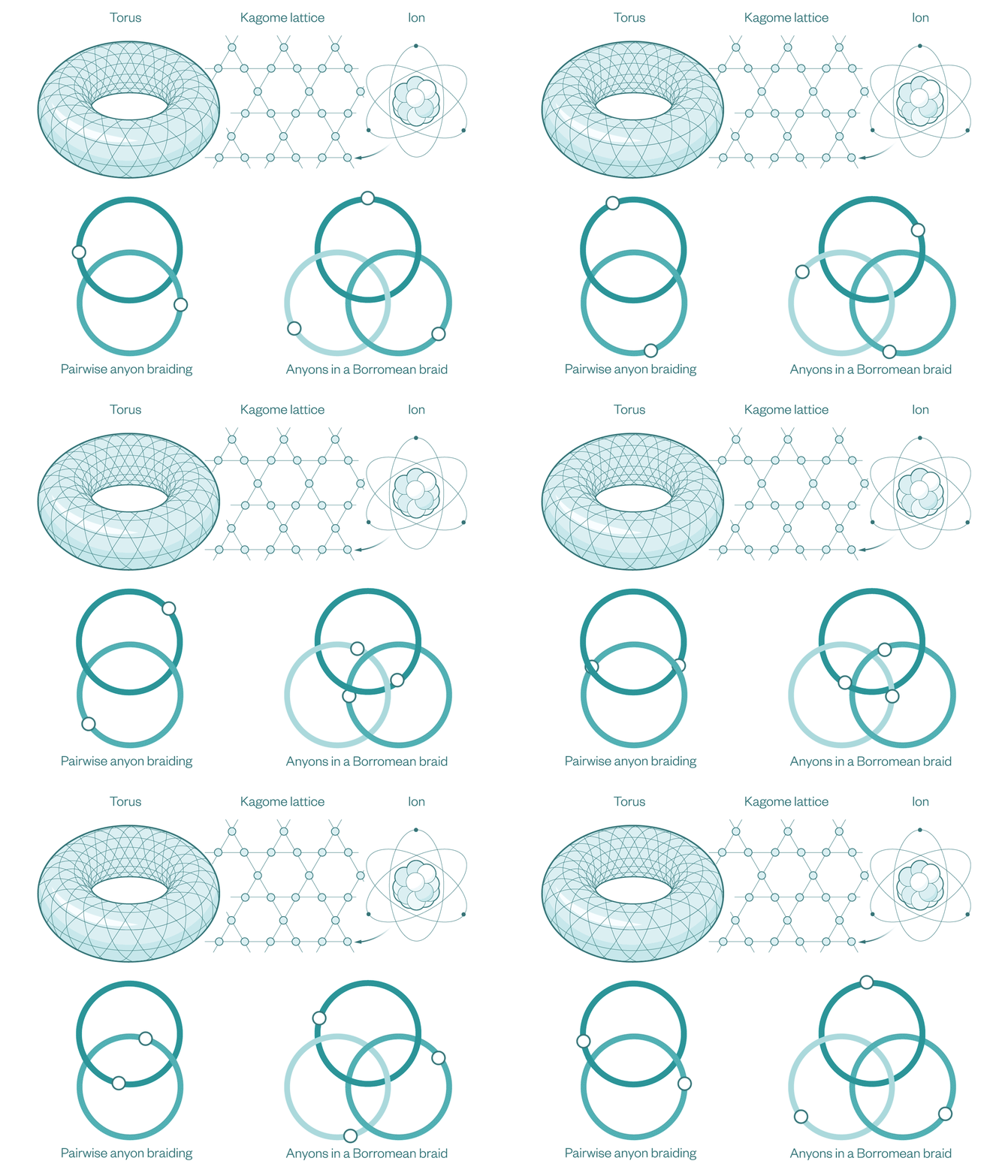
Much of the collaboration’s work has focused on anyons, Vishwanath says, leading to breakthroughs in three-dimensional models of anyons. Some of that work has also benefited the study of certain types of metals whose particles interact strongly in a quantum mechanical way. The advances in understanding these metals could ultimately help researchers solve long-standing issues in the fundamental theories of metals, which underlie scientists’ understanding of superconductors.
“There have been a lot of opportunities for different subfields to come together,” Vishwanath says. “We’ve benefited both from zooming out and having a more conceptual picture of everything we’re looking at and being able to delve into the details.”
In addition to the direct results, a major accomplishment of the collaboration has been the fact that researchers were finally able to sit down together to develop translations between the mathematical languages they used to study ultra-quantum matter.
“As we talked, we learned there are some things that directly translate — think of ‘elevator’ in America versus ‘lift’ in Britain,” says theoretical physicist Shu-Heng Shao of the Massachusetts Institute of Technology, who joined the collaboration in 2019 as a postdoctoral researcher. “But in other cases, there are things that have no parallel, and these are the things where we can really benefit from being multilingual.”
As a high-energy physicist, Shao was trained to approach problems from a certain perspective; for example, he envisioned the fabric of space-time — the mathematical framework of the universe — as a continuum. But from condensed matter physicists in the collaboration, Shao learned that other perspectives — namely, thinking of space-time as an array of discrete units — could reveal information his perspective lacked.
Combining approaches and perspectives has become a mainstay of Shao’s research today. In 2026, Shao won the New Horizons Prize in Physics in part for his advances in the study of the symmetry of ultra-quantum matter from the perspectives of quantum field theory, particle physics and condensed matter physics. Through the collaboration, Shao used concepts of symmetries in quantum phases of matter to solve a long-standing puzzle in quantum electrodynamics.
“Many of my projects would not have been possible without the influence of this collaboration,” Shao says.
Another keystone of the collaboration, many agree, is the tight working community that has formed. The collaboration hosts annual meetings as well as many smaller meetings, summer schools and workshops. The gatherings are often open to scientists outside the collaboration to further foster the flow of new ideas.
“These meetings are incredibly valuable to me,” says theoretical physicist Xie Chen, a collaborator from the California Institute of Technology. “By meeting and talking with others, I can get the most useful feedback, and it helps me shape my ideas.”
“The collaboration really feels like a big family,” Shao adds. “Everyone is very open to learning new things.”
After seven years, the collaboration is finally coming to an end. However, collaborations among high-energy, quantum-information and condensed matter physicists are only beginning.
“I think what is going to be one of the lasting legacies of the collaboration is the unification of topics that people thought of as being different subfields, which really have these very deep connections,” Vishwanath says. “There are many graduate students who grew up out of this collaboration that are now fluent in the different languages and approaches. It’s an exciting time.”


