Computational Biology: Biological Transport and Networks
We integrate computation, theory and experimental data to decipher the inner workings of living processes.
About
Areas of Focus
Vascular Flows
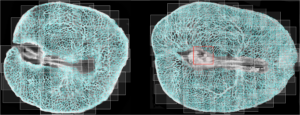 The embryonic yolk sac provides a unique window into the emergence of blood flow and the early development of vascular networks. Using high-speed time-lapse microscopy, we extract vessel centerlines, construct attributed graphs, and infer time-resolved flow fields across developmental stages. These measurements reveal how pulsatile forcing and local hemodynamic variability shape the remodeling of the vascular plexus. By linking experimental data with physics-based models of network adaptation, we aim to uncover how mechanical and geometric cues drive coordinated vascular growth.
Access the preprint, code, and dataset.
Continuum Modeling
Biological transport networks—such as blood vessels, plant vasculature, or neuronal networks—are naturally modeled as metric graphs where edges carry flow or diffusive signals and nodes enforce conservation laws. These high-density networks encode effective material and functional properties. To investigate how these properties emerge, we develop a continuum-limit framework in the dense vertex limit as edge lengths shrink to 0. This replaces edgewise differential equations with a coarse-grained partial differential equation (PDE) defined on the continuous space occupied by the network. This framework captures how real-world, space-filling networks operate simultaneously across system-wide and local scales, using the continuum as a feature.

The derivation naturally introduces an edge-conductivity tensor, an edge-capacity function, and a vertex number density, which together describe how each microscopic patch of the graph contributes to macroscopic behavior. All macroscopic parameters are computed from first principles via a systematic discrete-to-continuous homogenization, revealing an anomalous effective embedding dimension arising from the homogenized diffusivity \(d_{eff}\).
Access the preprint “A continuum limit for dense spatial networks.”

Neuronal Development
 Biological transport systems — such as neuronal and vascular networks — are remarkable in their ability to build themselves. These systems grow and reshape through the relocation and consumption of mass, often relying on the very transport pathways they are creating. However, this dependence of growth on the transport of building material is frequently overlooked in self-organizing growth models.
Our project develops a one-dimensional transport network model that links material flow to network growth and retraction. By modeling tip growth as dependent on local concentrations of transported material, we can simulate the dynamic feedback between transport and structure.
Inspired by the active processes of neuronal development, our work explores how local material delivery and recycling shape evolving networks. In collaboration with CCBx and CCB Scope, we are testing our theoretical predictions against the observed growth trajectories of real neurons.
Placental Morphogenesis
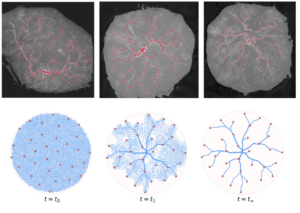 The placenta is a transient organ, yet an indispensable one, as it is the primary interface between a mother and a developing fetus.Abnormal placental chorionic vasculature correlates with a variety of complications for both mother and child, including preeclampsia, gestational diabetes, and predisposition to autism spectrum disorders in the developing child. Thus far, placental chorionic vascular development has been studied mainly observationally, preventing researchers from revealing the mechanisms behind correlations to disease.We frame the development of the placental chorionic plate vasculature in terms of a reduced-order parameter mechanistic model, which depends primarily on the ratio of the placenta growth rate and the vessel growth rate. We use microCT scans of healthy full-term placentas to constrain the model parameters and discuss what this mechanistic model means for disease conditions such as fetal growth restriction.
Video Highlight
People
Sidney Holden
Flatiron Research Fellow, Center for Computational Biology
Eleni Katifori
Senior Research Scientist, Center for Computational Biology
Alex Mayer
Flatiron Research Fellow, Center for Computational Biology
Stanisław Żukowski
Flatiron Research Fellow, Center for Computational Biology