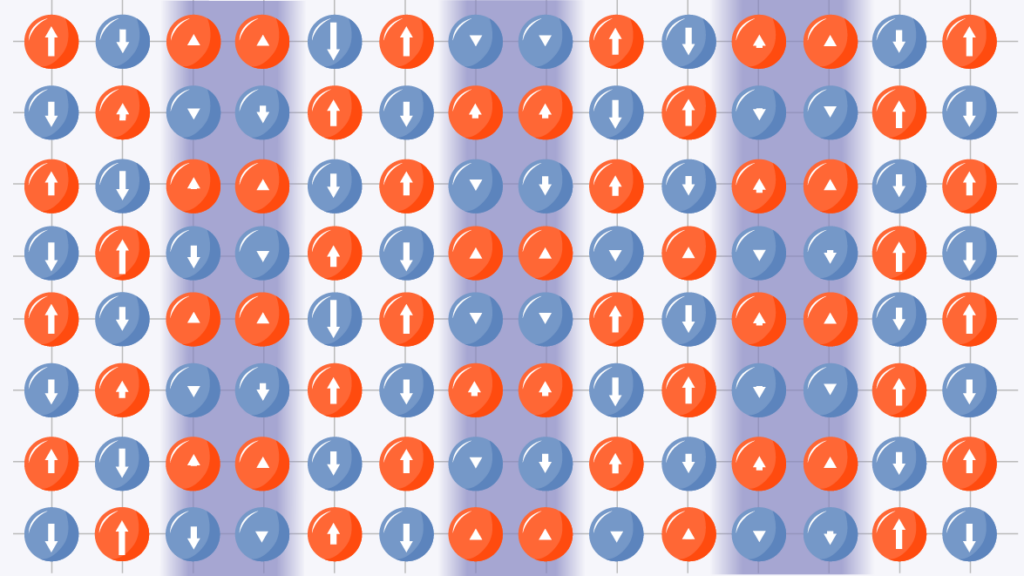
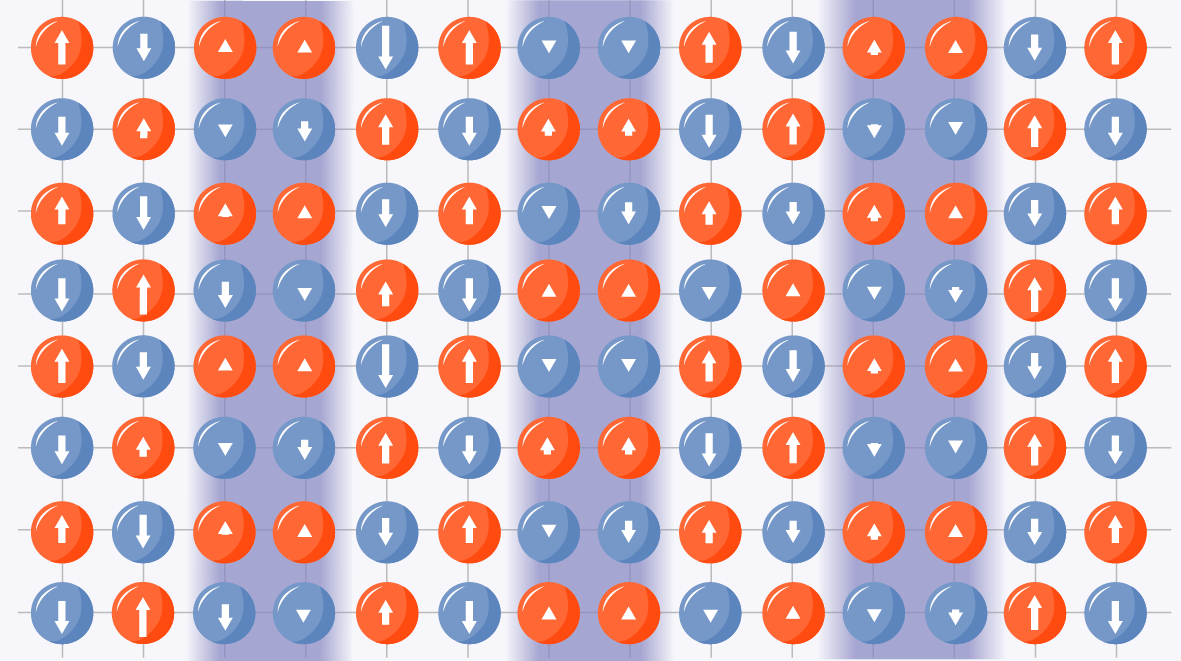
You can imagine a cuprate as a lasagna of copper oxide layers alternating with layers of other ions. (The name “cuprate” comes from the Latin word for copper.) Superconductivity arises when electricity flows with no resistance through the copper oxide layers. The simplest version of the 2D Hubbard model uses only two terms to picture each layer as a chessboard where electrons can hop north, south, east and west.
“When I started working on the Hubbard model in the early days of high-temperature superconductivity, we thought that once we got the pure model simulated on a small ‘chessboard,’ we would totally understand superconductivity,” says study co-author Steven White, a professor at the University of California, Irvine. “But as we developed the techniques, we found that the Hubbard model was much more complicated than we thought.”
Quantum mechanics creates that complexity: The layers are inhabited by electrons, each with either an up or a down spin. The electrons can become entangled. This entanglement means the electrons can’t be treated separately even when far apart, making them incredibly difficult to simulate on a computer.
“Although the Hubbard model can be written down as an equation taking only a line or two of text, because it is applied to hundreds of atoms interacting through the strange laws of quantum mechanics, one could simulate it on a computer as large as the earth for thousands of years and still not be able to get the right answers,” White says.
Shortcuts are needed to deal with that level of complexity — and such shortcuts are the researchers’ specialty. In the ’90s, White and Zhang separately developed now renowned techniques that cut computing time down exponentially. To deal with the enormously complicated model that comes from adding the diagonal hop, the researchers married those two techniques. One technique thinks of the electrons more like particles; the other emphasizes their wavelike structure.
“The big thing about the combination is that the one is strong where the other is weak,” says Schollwöck. “We could make a ‘handshake’ in a certain area where they both work, certifying one method using the other, and then explore the unknown where only one of them works.” Such a collaborative multimethod approach is the legacy of the Simons Collaboration on the Many Electron Problem, which included many CCQ scientists, he says.
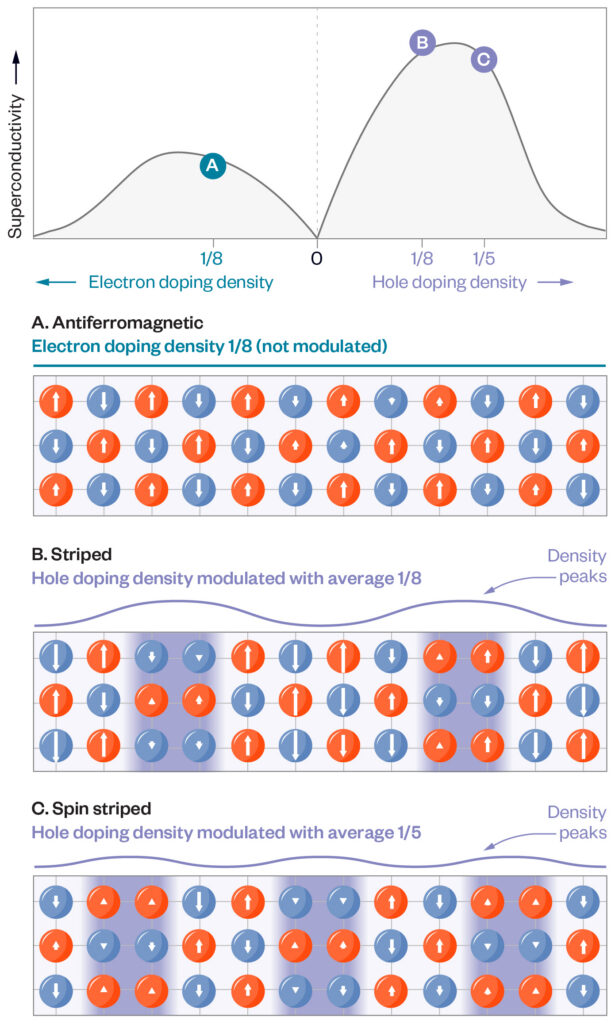
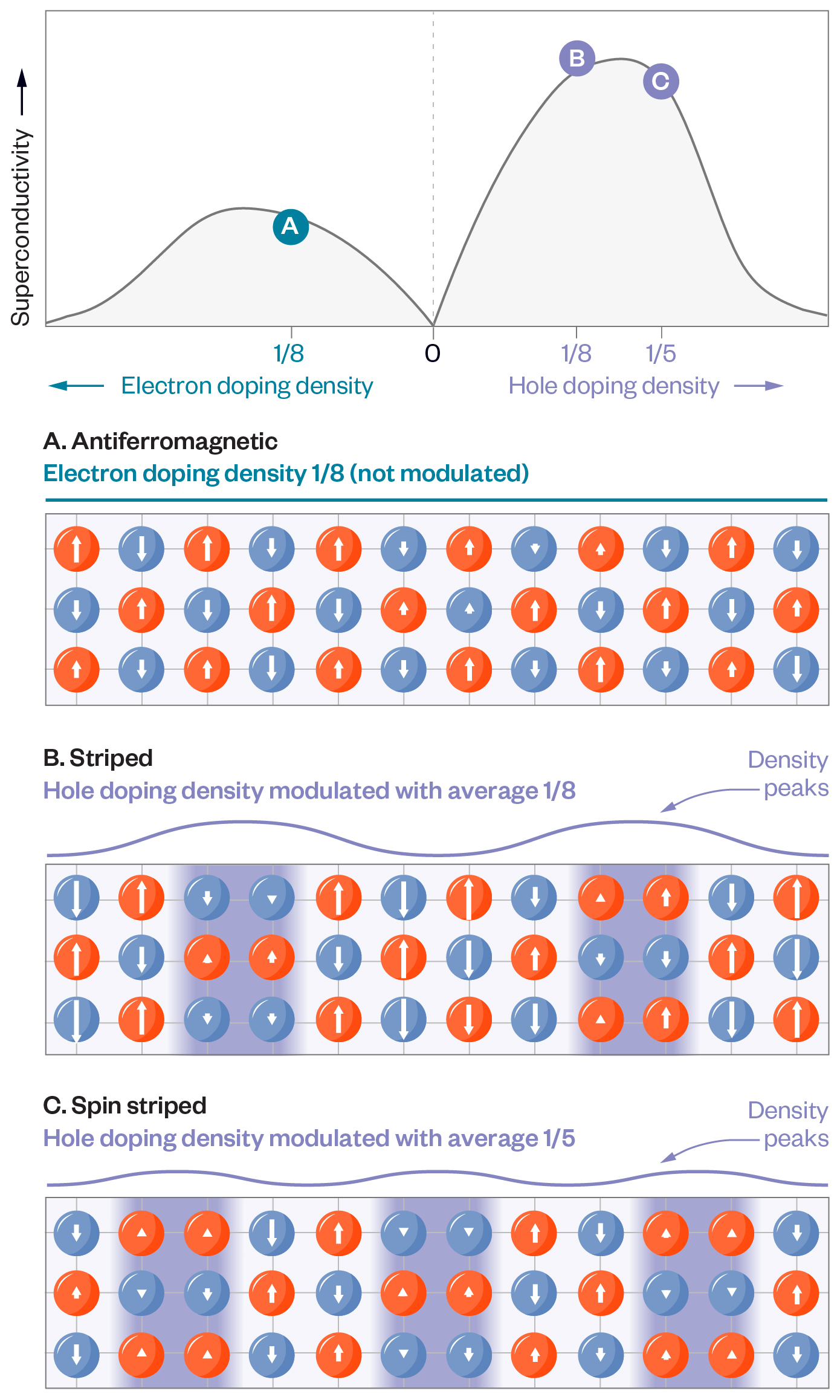
Besides the quantum mechanical rules for movement, the number of electrons on the chessboard affects the physics of the model. For many years, physicists have known that when there is the same number of electrons as spaces on the board, the electrons form a stable checkerboard pattern of alternating up-and-down spins. This setup isn’t superconductive — in fact, it isn’t conductive at all. Cuprates therefore require a change in the number of electrons.
In the earlier work by Zhang and his colleagues with the simplest Hubbard model, adding or removing electrons didn’t result in superconductivity. Instead, the stable checkerboard turned into a striped pattern, with stripes consisting of either lines with extra electrons or lines with holes left by the removed electrons.
However, when the researchers added the diagonal hop factor to the Hubbard model, the stripes became only partially filled, and superconductivity emerged. Furthermore, the outcome roughly matched experimental results on cuprate properties.