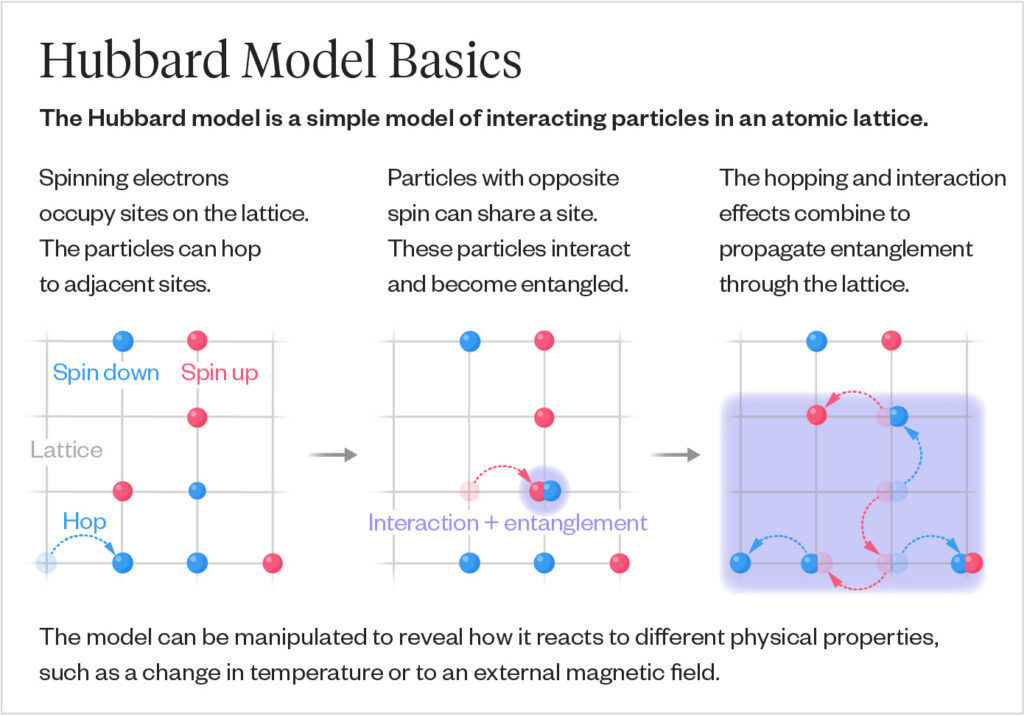
The idea behind the Greiner group’s research was to build a machine that could quantum mechanically — rather than classically — simulate the physics of the Hubbard model. In the absence of full-fledged quantum computers, which are still very much in development, the Harvard physicists sought to build a “quantum simulator” that could realize a wide range of Hubbard models. The lab’s collaborators at the CCQ, who are doing state-of-the-art numerical simulations on supercomputers, would then be able for the first time to compare those calculations with real-life experiments.
A breakthrough was needed to realize this goal, though: The team had to significantly lower the temperature in the quantum simulations — a goal that research groups worldwide have pursued over the last 10 years, initially without much success.
“Cuprate high-temperature superconductors become superconducting at about minus 170 degrees Celsius, or minus 250 degrees Fahrenheit,” Greiner explains. “Quantum simulations of the Hubbard model so far were not cold enough to reach those temperatures. Our new method enables a fivefold reduction in temperature, which makes it possible for the first time to simulate materials far below room temperature, where new physics is expected to occur, and simulations on classical computers become extremely difficult. This is a huge breakthrough that research groups worldwide have been working toward for nearly 20 years.”
Egg Carton Made of Lasers
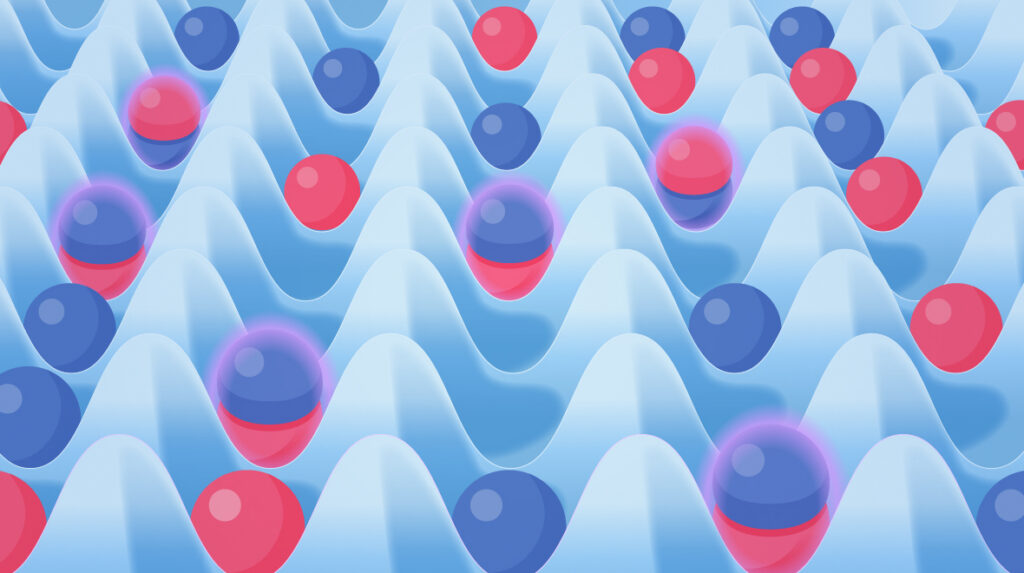
In an ultra-high vacuum inside a glass chamber surrounded by powerful magnetic coils, the team cooled hundreds of lithium-6 atoms to nanokelvin temperatures — just hundreds of billionths of a degree above absolute zero. (Lithium-6 atoms, like electrons, are fermions. That allows the atoms to serve as a stand-in for how electrons behave.) Using programmable, ultra-precise lasers and digital micromirrors, the researchers trapped atoms in a grid of light called an optical lattice, a little like marbles in a 2D laser-made egg carton.
“The periodic modulation of the laser intensity forms a square optical lattice for the atoms to move and interact with each other, resembling electrons in a two-dimensional crystalline lattice,” says study lead author Muqing Xu, a postdoctoral fellow at Harvard. “The atoms in optical lattices realize the Hubbard model with virtual perfection.”
Xu says the team used quantum gas microscopy — a bit like a high-tech magnifying glass for atoms — to see individual atoms and control them with laser light. “Arbitrary laser intensity can be applied to individual atoms at will, just like projecting a movie onto a screen,” he says. “For measurement, we excite the atoms to emit photons. The fluorescence is collected by the objective onto a highly sensitive camera for us to see individual atoms at a lattice-site–resolved level.”
The new techniques enabled the researchers to change the shape of the grid without disturbing or adding heat to the system. This reshaping caused the atoms to squeeze together into a band insulator, a state where two atoms sit tightly in each spot of the grid, simultaneously pushing heat into a reservoir. Then the system was disconnected from the reservoir and expanded, locally splitting each spot into two. This splitting doubled the number of spots on the grid, allowing the atoms to spread out and making the system even cooler.
Successfully realizing this cooling method (originally suggested in a 2009 paper co-authored by CCQ Director Antoine Georges) was the experimental breakthrough that enabled the researchers to reach unprecedentedly low temperatures, opening the door to the study of exotic quantum physics.
CCQ research fellow Chunhan Feng and Zhang performed cutting-edge computations to confirm the laboratory results, using an approach they developed rooted in random sampling, called auxiliary-field quantum Monte Carlo. “Couple this new breakthrough with the recent progress from computation, where many advances have been achieved through algorithmic development and collaborations, with many such activities tied to CCQ, and we have some truly exciting prospects,” Zhang says.