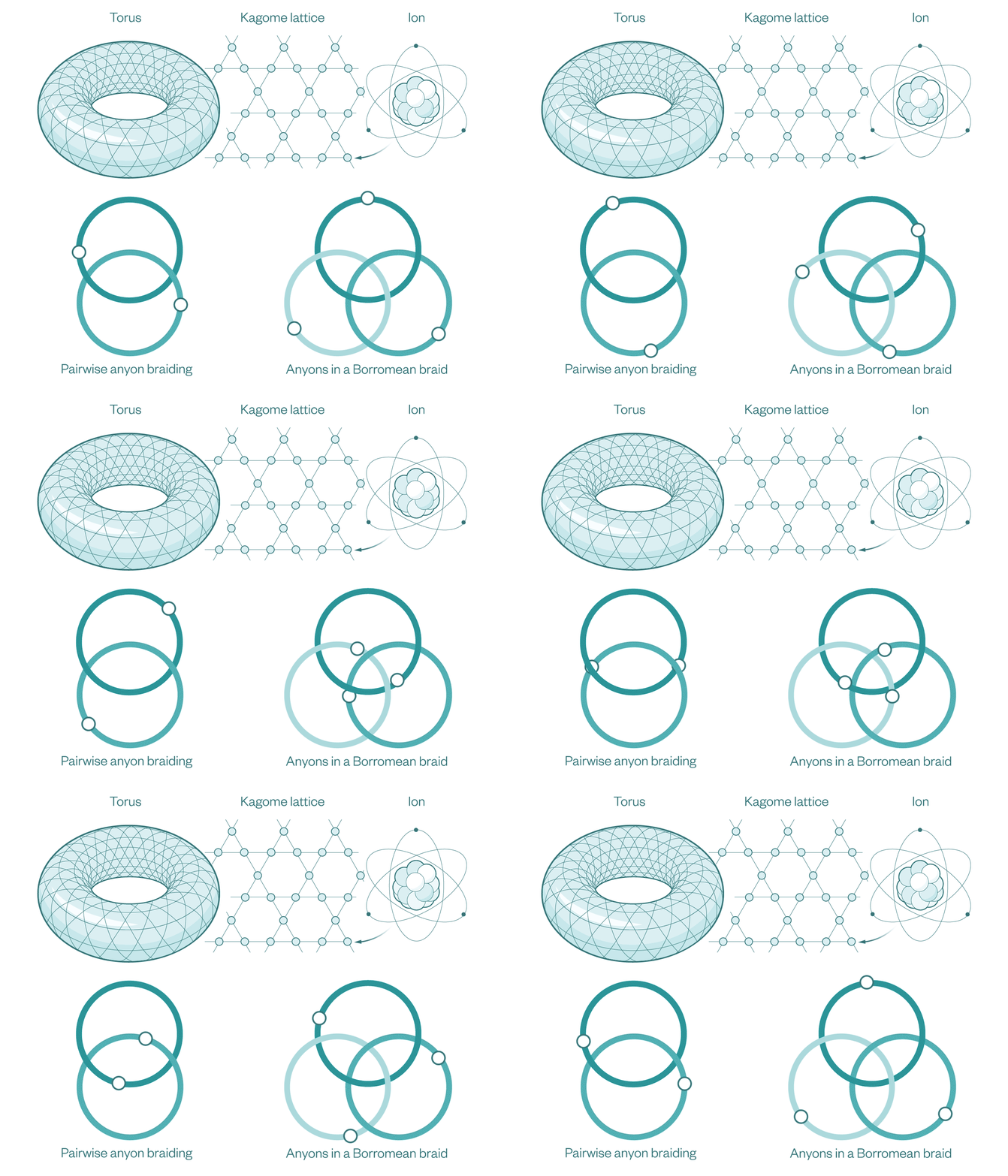
Much of the collaboration’s work has focused on anyons, Vishwanath says, leading to breakthroughs in three-dimensional models of anyons. Some of that work has also benefited the study of certain types of metals whose particles interact strongly in a quantum mechanical way. The advances in understanding these metals could ultimately help researchers solve long-standing issues in the fundamental theories of metals, which underlie scientists’ understanding of superconductors.
“There have been a lot of opportunities for different subfields to come together,” Vishwanath says. “We’ve benefited both from zooming out and having a more conceptual picture of everything we’re looking at and being able to delve into the details.”
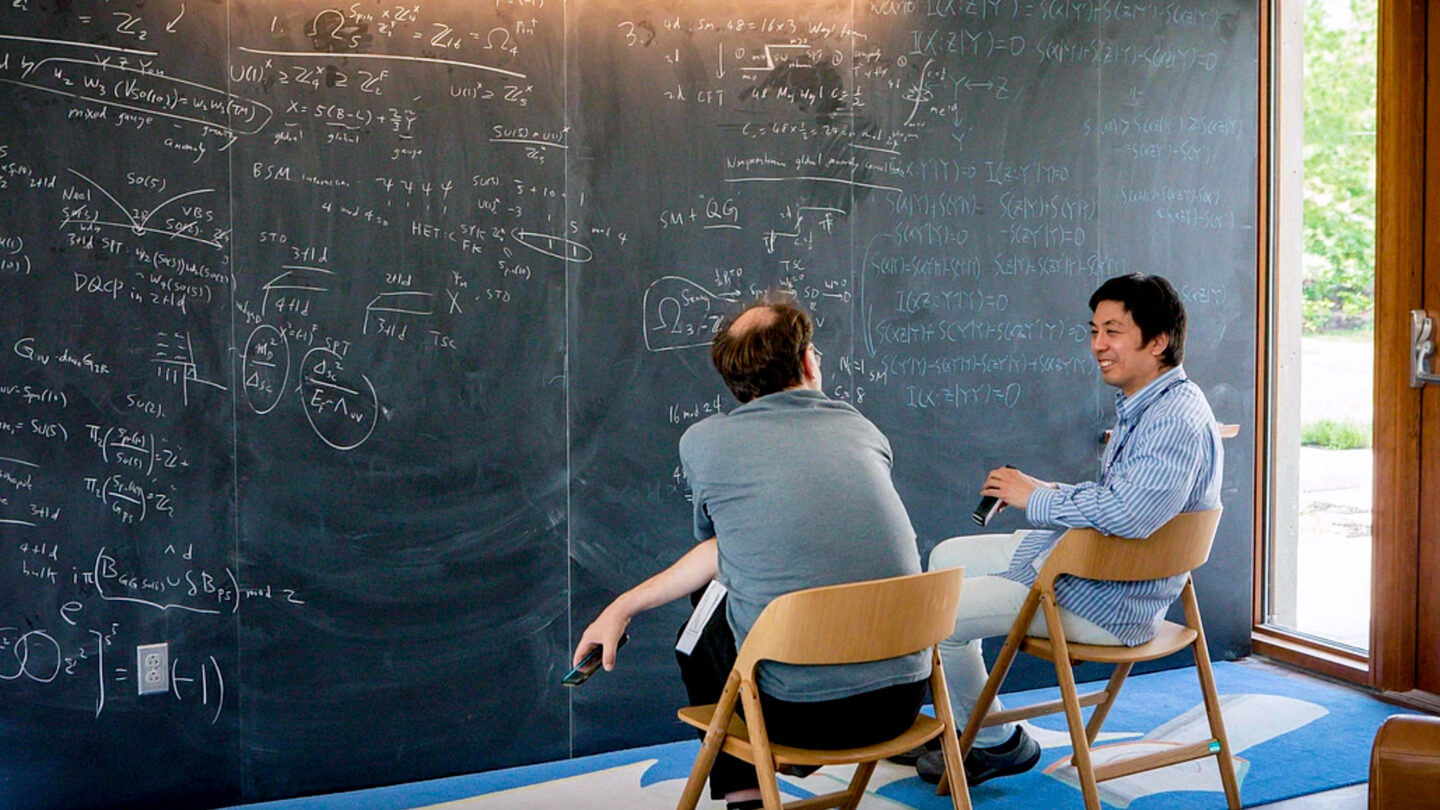
In addition to the direct results, a major accomplishment of the collaboration has been the fact that researchers were finally able to sit down together to develop translations between the mathematical languages they used to study ultra-quantum matter.
“As we talked, we learned there are some things that directly translate — think of ‘elevator’ in America versus ‘lift’ in Britain,” says theoretical physicist Shu-Heng Shao of the Massachusetts Institute of Technology, who joined the collaboration in 2019 as a postdoctoral researcher. “But in other cases, there are things that have no parallel, and these are the things where we can really benefit from being multilingual.”
As a high-energy physicist, Shao was trained to approach problems from a certain perspective; for example, he envisioned the fabric of space-time — the mathematical framework of the universe — as a continuum. But from condensed matter physicists in the collaboration, Shao learned that other perspectives — namely, thinking of space-time as an array of discrete units — could reveal information his perspective lacked.
Combining approaches and perspectives has become a mainstay of Shao’s research today. In 2026, Shao won the New Horizons Prize in Physics in part for his advances in the study of the symmetry of ultra-quantum matter from the perspectives of quantum field theory, particle physics and condensed matter physics. Through the collaboration, Shao used concepts of symmetries in quantum phases of matter to solve a long-standing puzzle in quantum electrodynamics.
“Many of my projects would not have been possible without the influence of this collaboration,” Shao says.