Simons Collaboration on Algorithms and Geometry 2015 Annual Meeting
Conference
When
-
All Day
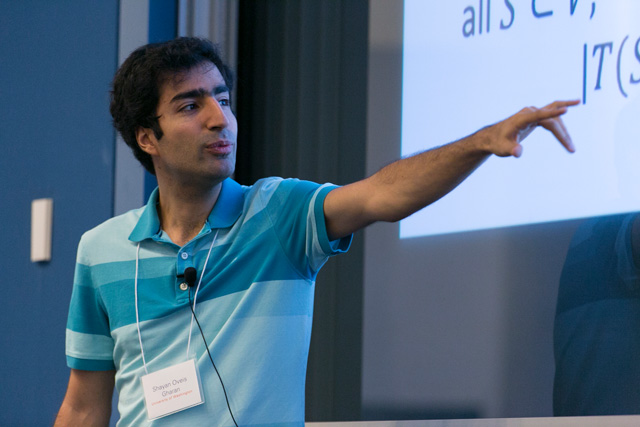



Shayan Oveis Gharan is an assistant professor of computer science and engineering at the University of Washington. He received his Ph.D. from the Department of Management Science and Engineering at Stanford University in 2013. Before joining the University of Washington, he spent one and a half years as a postdoctoral Miller fellow at the University of California, Berkeley, where his host was Umesh Vazirani. His main research includes design and analysis of algorithms, graph theory and applied probability. In the past, he has received several awards for his works on the traveling salesman problem.

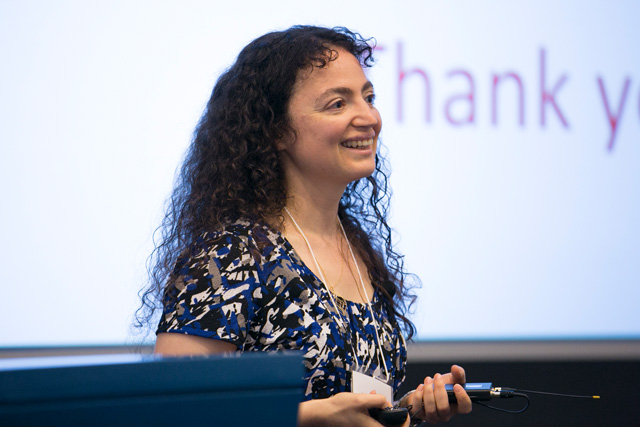
Julia Chuzhoy is an associate professor at the Toyota Technological Institute at Chicago (TTIC). She received her Ph.D. in computer science from the Technion – Israel Institute of Technology in 2004 and spent several years as a postdoc at MIT, University of Pennsylvania and Institute for Advanced Study before joining TTIC in 2007. Her research area is theoretical computer science with the main emphasis on the design and analysis of approximation algorithms for NP-hard problems.

David Steurer is an assistant professor in the department of computer science at Cornell University. Steurer received his Ph.D. from Princeton University and was a postdoctoral researcher at Microsoft Research New England for two years before joining Cornell University. He is the recipient of the 2010 FOCS Best Paper Award, the 2011 ACM Doctoral Dissertation Award Honorable Mention, an NSF CAREER Award and an Alfred P. Sloan Research Fellowship. He investigates the power and limitations of efficient algorithms for optimization problems that are at the heart of computer science and its applications. A focus of his work has been the unique games conjectures whose resolution — no matter in which direction — promises new insights into the capabilities of efficient algorithms. As part of an approach to resolve this conjecture, Steurer studies provable guarantees of the sum-of-squares method, a compelling meta-algorithm that applies to a wide-range of problems and has the potential to unify the design of efficient algorithms for difficult optimization problems.

Ronen Eldan received his Ph.D. in pure mathematics from Tel Aviv University in 2012 under the supervision of Bo’az Klartag and Vitali Milman, specializing in high dimensional convex geometry, probability theory and computational geometry. After spending two years as a postdoc in the theory groups at Microsoft Research Redmond and the University of Washington, he has recently joined the mathematics department at the Weizmann Institute of Science. His research mainly involves high-dimensional problems of a probabilistic or geometric nature. In particular, he has recently focused on finding ways to apply tools from the theory of stochastic calculus to prove geometric results. Some of his favorite problems are the hyperplane conjecture (or slicing problem), the Gaussian correlation conjecture and the Kannan–Lovász–Simonovits conjecture.

Santosh Vempala is a distinguished professor of computer science at Georgia Tech. His research interests are primarily in algorithms, randomness, high-dimensional geometry and spectral methods. He got his Ph.D. from Carnegie Mellon University in 1997, advised by Avrim Blum, and was in the math department at MIT until 2006 except for a year as a Miller Fellow at the University of California, Berkeley. He has written two books, The Random Projection Method (2004) and Spectral Algorithms (with Ravi Kannan, 2009), and continues to get unreasonably excited when a phenomenon that appears complex from one perspective turns out to be simple from another.
 Amit Singer is a professor of mathematics and a member of the executive committee of the Program in Applied and Computational Mathematics (PACM) at Princeton University. He joined Princeton as an assistant professor in 2008. From 2005 to 2008 he was a Gibbs Assistant Professor in Applied Mathematics at the Department of Mathematics, Yale University.
Singer received his B.Sc. degree in Physics and Mathematics and his Ph.D. degree in applied mathematics from Tel Aviv University, Israel, in 1997 and 2005, respectively. He was awarded the Moore Investigator in Data-Driven Discovery Award (2014), the Simons Investigator Award (2012), the Presidential Early Career Award for Scientists and Engineers (2010), the Alfred P. Sloan Research Fellowship (2010) and the Haim Nessyahu Prize in Mathematics (2007). His current research in applied mathematics focuses on theoretical and computational aspects of data science, and on developing computational methods for structural biology.
More Events
2026 MPS Annual Meeting
ConferenceOctober 15–16, 2026
October 22–23, 2026
November 5–6, 2026
Speakers
Ofer Aharony, Aleksey Cherman, Gabriel Cuomo SISSA, Davide Gaiotto, Jaume Gomis, + 3 more