A Treasure-Hunting Game Offers Clues to Perception in Autism
Featuring
-

Benjamin Scott
SFARI Investigator
-

Helen Tager-Flusberg
Past, SFARI Investigator
Bringing people and ideas together to fund, conduct, and share transformative science.
Our grants advance knowledge and strengthen connections between science and society.
Discover the latest news, research, and updates.
We convene scientists, mathematicians, and thinkers to share ideas and explore new questions.
Founded by Jim and Marilyn Simons, we’re a private philanthropy advancing mathematics and basic science.
Work with us on the frontier of basic science research.
The Flatiron Institute is a research center that uses computational science to advance fields like physics, biology, and astronomy.
Search
SFARI Investigator
Past, SFARI Investigator
Previous research suggests that people with autism perceive sensory information differently than others do1. For example, studies have shown that although those with autism can notice a single faint visual cue as well as their peers, they have more trouble piecing together information that arrives bit by bit, for example judging which way a scattering of dots is drifting when only some of them move together2,3.
Most of this previous work, however, has relied on small sample sizes and excluded people with autism who have intellectual disability or limited language4. Although harder to study, this group has the greatest clinical need and could benefit the most from research on perceptual differences5. Now, a study in Science Advances from SFARI Investigators Benjamin Scott and Helen Tager-Flusberg, along with Joseph McGuire of Boston University, and their colleagues introduces an online video game called GEODE that teaches its rules through trial and error rather than through spoken instructions, making it accessible to people with autism typically excluded from perception studies.
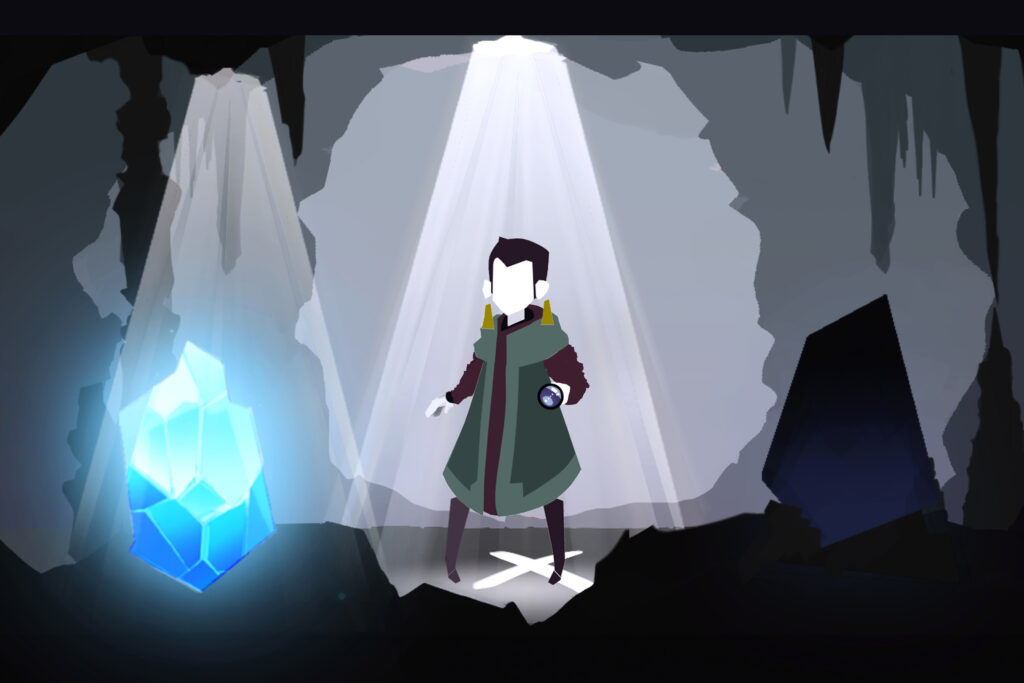
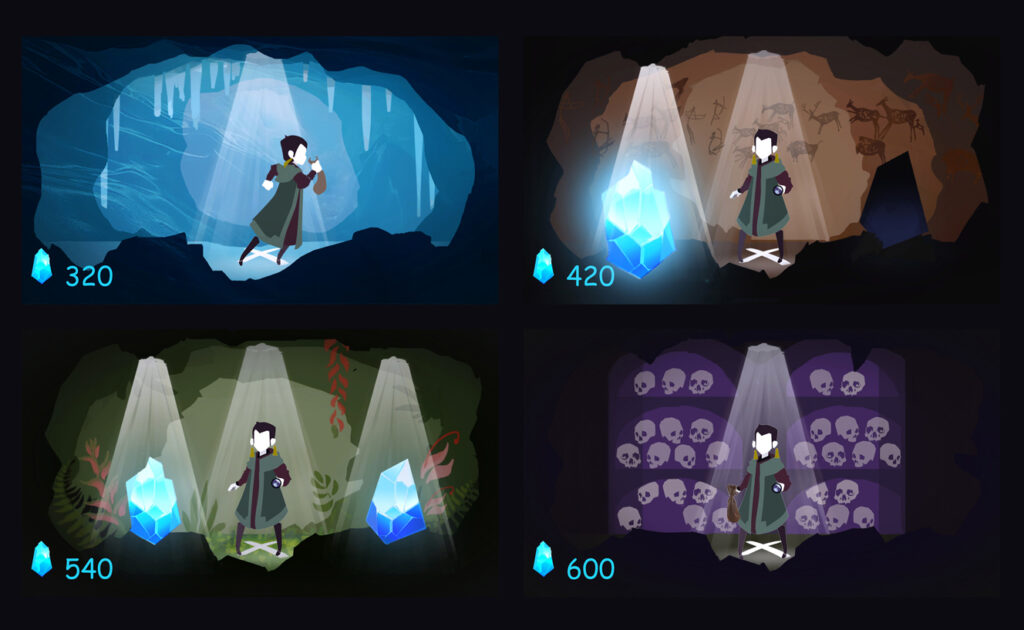
GEODE takes its inspiration from a task originally designed to study how rats gather evidence before making a choice. In that task, the rodents watched two small lights, one to the left and one to the right, flash briefly at random times. They learned to pick the side that flashed more, which required keeping a running tally6. The GEODE game keeps this structure, but replaces the flashes with gems in a treasure-hunting quest spanning 10 levels.
In total, 308 adolescents ages 11 to 17 played GEODE, including 212 participants with autism and 96 of their unaffected siblings. In most cases, parents also rated their child’s adaptive functioning, a measure of everyday skills such as communicating, socializing and self-care. The majority of players across groups finished the game with scores above what random guessing would yield. That included more than three-quarters of players with autism5.
Players with autism and their siblings performed comparably during 10 easy practice rounds, in which far more gems appeared on one side than on the other. After that, the gem counts on the two sides grew more similar. Players with autism took longer to improve and leveled off at a slightly lower accuracy rate than their siblings. Those with lower adaptive scores, and thus greater support needs, fell furthest behind.
A closer look at players’ choices showed that both groups counted gems throughout each round, not just at the beginning or end. However, players with autism appeared to track the counts less closely, especially among those with lower adaptive scores. They also performed less accurately than their siblings both when the two sides were nearly tied and when many gems appeared overall.
To find out why, the researchers used a mathematical model to estimate each player’s integration noise, a measure of how quickly their running count lost precision as gems added up. Players with autism showed more integration noise than their siblings, and those with greater support needs showed the most. Adding similar noise to artificial neural networks learning the game made them learn more slowly and less accurately, mirroring the players with autism.
Across all players, higher integration noise was linked to lower adaptive scores. Among a small subset of players with autism who shared a matching adaptive score with their sibling, the game differences were no longer significant. The authors suggest that integration noise may track everyday functioning more closely than an autism diagnosis alone.
The researchers caution that their model does not point to specific brain circuits. Integration noise could stem from lapses in attention, difficulty keeping the running total in mind or the brain encoding each gem less reliably. It also may not be unique to autism.
More broadly, this work demonstrated that, with the right platform, people with autism who experience high support needs can take part in precise perception experiments. Given that players’ results tracked their everyday adaptive skills, such games might one day help show how individuals respond to interventions. The study’s online format also lets it reach far larger numbers of participants. Given that rats can perform a similar task, further animal studies may also help pinpoint the brain circuits behind integration noise, eventually paving the way for new interventions.
This study was performed through Research Match leveraging participants from SPARK.