Bringing people and ideas together to fund, conduct, and share transformative science.
Our grants advance knowledge and strengthen connections between science and society.
Discover the latest news, research, and updates.
We convene scientists, mathematicians, and thinkers to share ideas and explore new questions.
Founded by Jim and Marilyn Simons, we’re a private philanthropy advancing mathematics and basic science.
Work with us on the frontier of basic science research.
The Flatiron Institute is a research center that uses computational science to advance fields like physics, biology, and astronomy.
Search
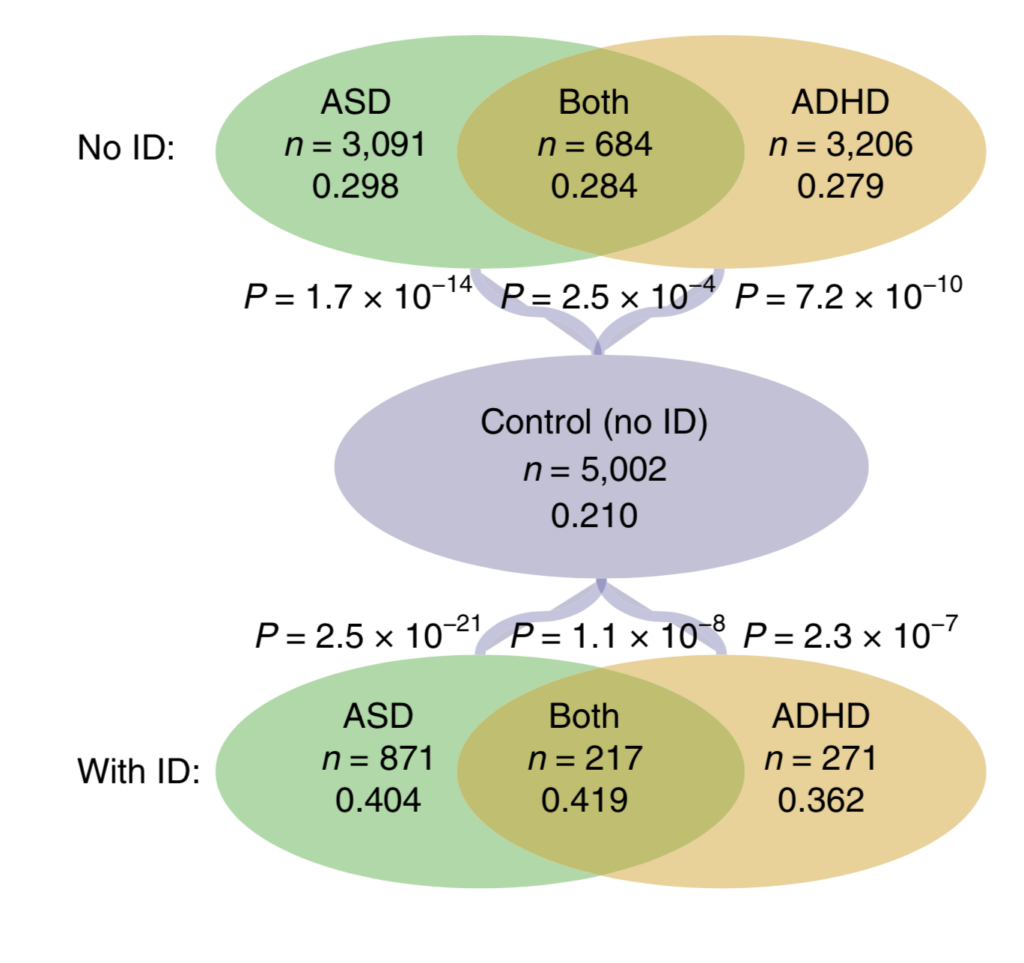
Mark Daly and colleagues used an exome sequencing data set of ASD and ADHD to identify a similar profile of rare protein-truncating variants in each disorder.

SFARI Investigator
A number of connections have been reported between autism spectrum disorder (ASD) and attention deficit hyperactivity disorder (ADHD). These include phenotypic overlap of the two disorders, predisposition to ADHD in family members where one child has an ASD diagnosis and genetic correlations between the two in well-powered genome-wide association studies. A new study now provides evidence of a highly similar burden of rare protein-truncating variants in each disorder.
The work described in the new paper was supported in part by a SFARI Research Award to SFARI Investigator Mark Daly and was conducted in collaboration with the Danish Neonatal Screening Biobank (DNSB) and the associated Danish iPSYCH research initiative. The authors carried out exome sequencing of DNA extracted from archived dried blood samples stored in the DNSB, which had been matched to psychiatric diagnosis by the Danish Psychiatric Central Research Register. In total, they produced an exome data set of nearly 4,000 cases of ASD, 900 with ASD and ADHD, 3,400 with ADHD, and 5,000 controls. Comparisons of the rate of rare protein-truncating variants (PTVs) in ‘constrained’ genes — genes mutated infrequently in population controls — identified a similarly increased burden of PTVs in ASD and ADHD cases. The increased burden was similar to that reported for ASD in analyses of the Simons Simplex Collection and Autism Sequencing Consortium.
Additional analyses showed that the similarity in the burden of rare PTVs in ASD and ADHD extends beyond the number of such variants to the particular genes that are mutated, with the gene sets mutated in each disorder being statistically indistinguishable. In light of this finding, the authors suggest that cross-disorder rare-variant studies may be the most efficient design for future gene discovery efforts.

