Binocular Rivalry: A Noninvasive Biomarker of Inhibitory Signaling in the Brain?
Featuring
-

Caroline Robertson
SFARI Investigator
Bringing people and ideas together to fund, conduct, and share transformative science.
Our grants advance knowledge and strengthen connections between science and society.
Discover the latest news, research, and updates.
We convene scientists, mathematicians, and thinkers to share ideas and explore new questions.
Founded by Jim and Marilyn Simons, we’re a private philanthropy advancing mathematics and basic science.
Work with us on the frontier of basic science research.
The Flatiron Institute is a research center that uses computational science to advance fields like physics, biology, and astronomy.
Search
Caroline Robertson and colleagues developed a novel paradigm that provided direct neural evidence for slower binocular rivalry in autism. They also demonstrated a causal link between GABAergic inhibition and rivalry in neurotypical individuals, suggesting that this tool may serve as a noninvasive marker of inhibitory signaling in the brain.
SFARI Investigator
SFARI Investigator Caroline Robertson and colleagues have previously shown that individuals with autism spectrum disorder (ASD) report slower rates of binocular rivalry (Robertson et al., J. Neurosci., 2013), a visual process in which different images presented to each eye vie for awareness. This alternating perception is thought to reflect the balance of neural excitation and inhibition, which is deemed to be altered in ASD (Rubenstein and Merzenich, Genes Brain Behav., 2003). However, direct evidence causally implicating inhibitory signaling in the dynamics of binocular rivalry is currently lacking.
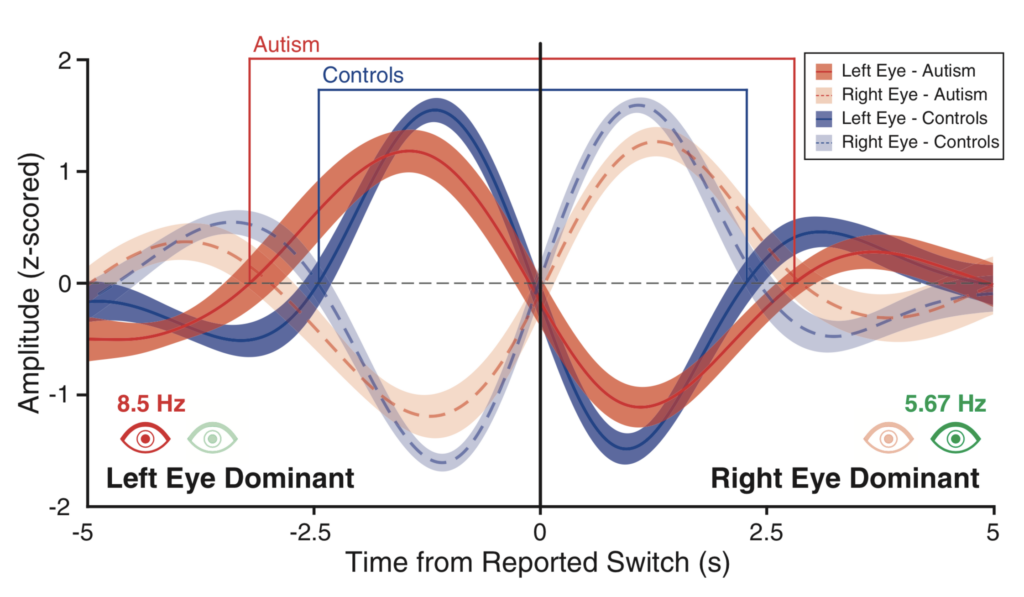
Two new SFARI-funded studies from the Robertson lab provide new mechanistic insights into this visual phenomenon. In the first study, the authors recorded neural responses to different frequency-tagged images that were shown to each eye and found that the average duration of one span of binocular rivalry was longer for individuals with ASD compared to neurotypical individuals. This study replicated their prior behavioral findings of slower rivalry in ASD and provided new, direct neural evidence (using an electroencephalographical measure) for these differences in rivalry.
The second study used a pharmacological approach to demonstrate a causal link between GABAergic inhibition and binocular rivalry dynamics in neurotypical individuals. Robertson and collaborators administered two different drugs that increase GABAergic inhibition in the brain, clobazam (a GABAA modulator) and arbaclofen (a GABAB agonist) to neurotypical volunteers and found that increased GABAergic inhibition was associated with increased perceptual suppression of the two images presented. This result is consistent with previous evidence that neurotypical individuals with higher levels of GABA in the visual cortex (as measured by magnetic resonance spectroscopy) show increased perceptual suppression (Robertson et al., Curr. Biol., 2016).
Together, these findings suggest that rivalry may serve as a noninvasive biomarker of inhibitory signaling in the brain. This paradigm may be particularly well suited for use in cross-species research as well as studies of preverbal infants or older individuals who are nonverbal.

