Bringing people and ideas together to fund, conduct, and share transformative science.
Our grants advance knowledge and strengthen connections between science and society.
Discover the latest news, research, and updates.
We convene scientists, mathematicians, and thinkers to share ideas and explore new questions.
Founded by Jim and Marilyn Simons, we’re a private philanthropy advancing mathematics and basic science.
Work with us on the frontier of basic science research.
The Flatiron Institute is a research center that uses computational science to advance fields like physics, biology, and astronomy.
Search
Mark Zylka and colleagues generated single-cell RNA-seq data from wild-type mouse cortex during early development and demonstrated how such a resource can be used to identify putative brain disorder subtypes based on expression profiles.
Transcriptional studies suggest that autism spectrum disorder (ASD), while encompassing a large number of distinct causal gene mutations, has some level of common molecular underpinning (e.g., Voineagu et al., Nature, 2011; Parikshak et al., Nature, 2016).
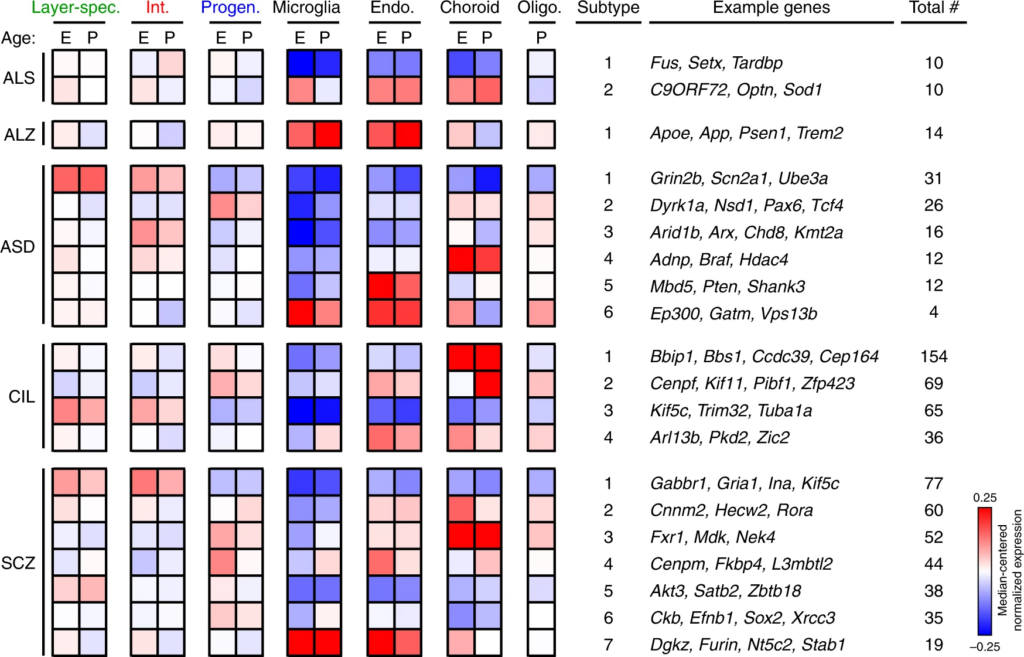
In a recent study, funded in part by a SFARI Research Award, Mark Zylka and colleagues have provided further insights into this potentially shared molecular pathology. Using single-cell RNA-seq data from wild-type mouse cerebral cortex at embryonic day 14.5 and at birth, the authors developed a catalog of cell-type specific gene expression patterns across distinct cortical layers.
They then went on to use this resource to demonstrate the existence of multiple ASD subtypes characterized by patterns of gene expression that highlight particular cell types and molecular pathways, broadly overlapping with synaptic transmission and transcriptional regulation. The successful identification of clinical subtypes of ciliopathies by mapping patterns of ciliopathy-associated gene expression holds out the prospect that similar analyses will be productive in ASD.
Researchers who are interested in exploring this resource can do so via a web-based platform built by the Zylka lab. Users can search for individual genes and explore cell type and age-specific expression patterns.

