Bringing people and ideas together to fund, conduct, and share transformative science.
Our grants advance knowledge and strengthen connections between science and society.
Discover the latest news, research, and updates.
We convene scientists, mathematicians, and thinkers to share ideas and explore new questions.
Founded by Jim and Marilyn Simons, we’re a private philanthropy advancing mathematics and basic science.
Work with us on the frontier of basic science research.
The Flatiron Institute is a research center that uses computational science to advance fields like physics, biology, and astronomy.
Search
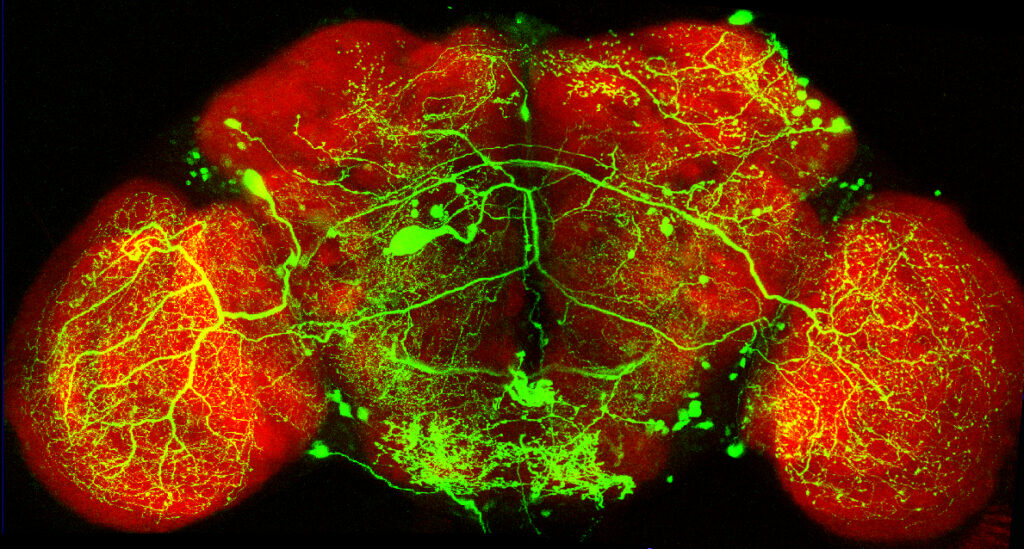
The animal models module of SFARI Gene has recently been expanded to include two new species: Drosophila melanogaster and Danio rerio. As of now, the database lists 55 genes for Drosophila models and 24 genes for zebrafish models, in addition to several models induced by biological or chemical agents.
SFARI is pleased to announce an expansion of the SFARI Gene animal models module to include Drosophila melanogaster and Danio rerio.
Although still not as frequently used as mice to study autism, flies and zebrafish have notable advantages that are increasingly being exploited in autism research. As of now, the database lists 55 genes for Drosophila models and 24 genes for zebrafish models (Table 1), in addition to several models induced by biological or chemical agents. All are expertly curated by the staff at MindSpec Inc. and include annotations of the genetic mutation/inducer, descriptions of accompanying phenotypes and reports of phenotypic rescues where appropriate.
Each gene may have been studied in multiple ways, with each getting a separate line in the database (for example, there are 56 different Drosophila models of Fmr1). The complete list for each species alone can be obtained by typing the name of the species in the search bar on any of the animal models’ module pages.
New fly and fish models will be included in every quarterly update of the database and will be highlighted on the SFARI Gene news page.
.tg {border-collapse:collapse;border-spacing:0;border-color:#aaa;border:none;}.tg td{padding:10px 5px;border-style:solid;border-width:0px;overflow:hidden;word-break:normal;border-color:#aaa;color:#333;background-color:#fff;} .tg th{padding:10px 5px;border-style:solid;border-width:0px;overflow:hidden;word-break:normal;border-color:#aaa;color:#000000;background-color:#ffc107;} .tg .tg-baqh{text-align:center;vertical-align:top} .tg .tg-97eb{background-color:#ffc107;color:#000000;text-align:center;vertical-align:top} @media screen and (max-width: 100%) {.tg {width: auto !important;}.tg col {width: auto !important;}.tg-wrap {overflow-x: auto;-webkit-overflow-scrolling: touch;}}
Table 1. High-confidence autism risk genes (i.e., category 1 according to the SFARI Gene scoring criteria) for which Drosophila and zebrafish models are available and currently listed in the SFARI Gene animal models database.