Exome Sequencing Identifies New ASD Risk Genes
Featuring
-

Joseph Buxbaum
SFARI Investigator
Bringing people and ideas together to fund, conduct, and share transformative science.
Our grants advance knowledge and strengthen connections between science and society.
Discover the latest news, research, and updates.
We convene scientists, mathematicians, and thinkers to share ideas and explore new questions.
Founded by Jim and Marilyn Simons, we’re a private philanthropy advancing mathematics and basic science.
Work with us on the frontier of basic science research.
The Flatiron Institute is a research center that uses computational science to advance fields like physics, biology, and astronomy.
Search
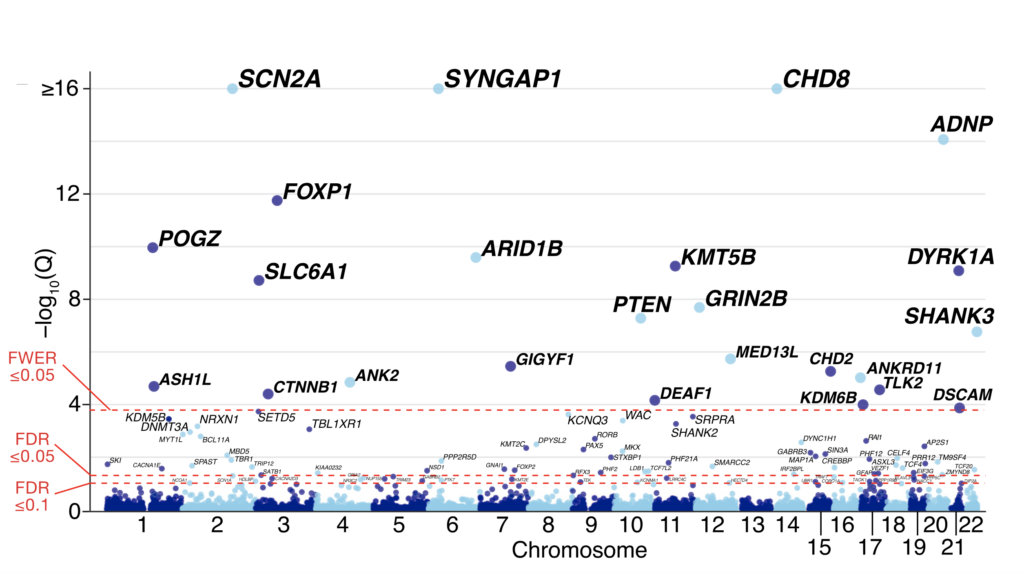
Joseph Buxbaum and colleagues in the Autism Sequencing Consortium reported the largest exome sequencing study of ASD to date, identifying 102 risk genes at a false discovery rate of 0.1 or less.
SFARI Investigator
It has been well established that the exome sequencing of a larger number of DNA samples from individuals ascertained for autism spectrum disorder (ASD) should identify additional risk genes. A study facilitated by the Autism Sequencing Consortium (ASC) offers the most expansive view yet of the landscape of autism risk genes and identifies a set of characteristics that define them.
The work was a large collaborative effort that was supported by multiple funding sources, including a Research Award to SFARI Investigators Stephan Sanders, Matthew State, Bernie Devlin and Kathryn Roeder, and a separate Research Award to SFARI Investigator Michael Talkowski. All told, the ASC analyzed more than 35,000 exomes, including nearly 12,000 with ASD from the Simons Simplex Collection, the Danish iPSYCH study and a range of newly sequenced cases and controls. Using an enhanced version of their previously developed TADA (transmission and de novo association) model they identified 102 genes to be associated at a false discovery rate cutoff of 0.1. The authors followed up with a series of analyses defining the degree to which risk genes are targets of protein-truncating variants or missense variants, and whether mutations in each gene more frequently occur in individuals ascertained for ASD or severe neurodevelopmental disorders (the latter finding has generated some debate). Confirming and extending previous findings, the authors showed that the risk genes generally cluster in groups affecting gene expression or neuronal communication and are enriched in both maturing excitatory and inhibitory neurons.
The Broad Institute is hosting a searchable browser for all ASC exome data, including a catalog of different classes of mutation in each gene in cases and controls, as well as gene constraint metrics from gnomAD and ExAC.

