Foundation Announces the Simons Collaboration on Confinement and QCD Strings
Featuring
-

Igor Klebanov
Director, Simons Collaboration on Confinement and QCD Strings
Bringing people and ideas together to fund, conduct, and share transformative science.
Our grants advance knowledge and strengthen connections between science and society.
Discover the latest news, research, and updates.
We convene scientists, mathematicians, and thinkers to share ideas and explore new questions.
Founded by Jim and Marilyn Simons, we’re a private philanthropy advancing mathematics and basic science.
Work with us on the frontier of basic science research.
The Flatiron Institute is a research center that uses computational science to advance fields like physics, biology, and astronomy.
Search
Director, Simons Collaboration on Confinement and QCD Strings
The Simons Foundation is pleased to announce the establishment of the Simons Collaboration on Confinement and QCD Strings, directed by Igor Klebanov of Princeton University.
Quantum chromodynamics (QCD) provides the fundamental description of the strong nuclear force and is a key component of the Standard Model of particle physics. The strong interactions are responsible, among other things, for binding protons and neutrons into nuclei, in spite of the electric repulsion of the protons. QCD is a quantum gauge field theory with local SU(3) invariance that describes the interactions of colored quarks and gluons. They are observed to be “confined” inside the color-neutral hadrons, such as the protons, neutrons and pi-mesons. The celebrated asymptotic freedom of QCD implies that the gauge coupling vanishes in the short distance limit. The converse effect is its growth at long distances, giving rise to a host of non-perturbative phenomena, including chiral symmetry breaking and the appearance of a mass gap related to the absence of the colored particles (quarks and gluons) as asymptotic states. While evidence for these phenomena has been provided by the numerical lattice simulations of QCD, as well as by simplified theoretical models, their proof in QCD is still missing. The color confinement property of QCD is among the most important and fascinating phenomena in fundamental physics. This is a profound problem, which is the first in the list of the Clay Mathematics Institute’s Millennium Problems. One of the goals of the new Simons Collaboration is to improve our understanding of confinement in various gauge theories, including QCD.
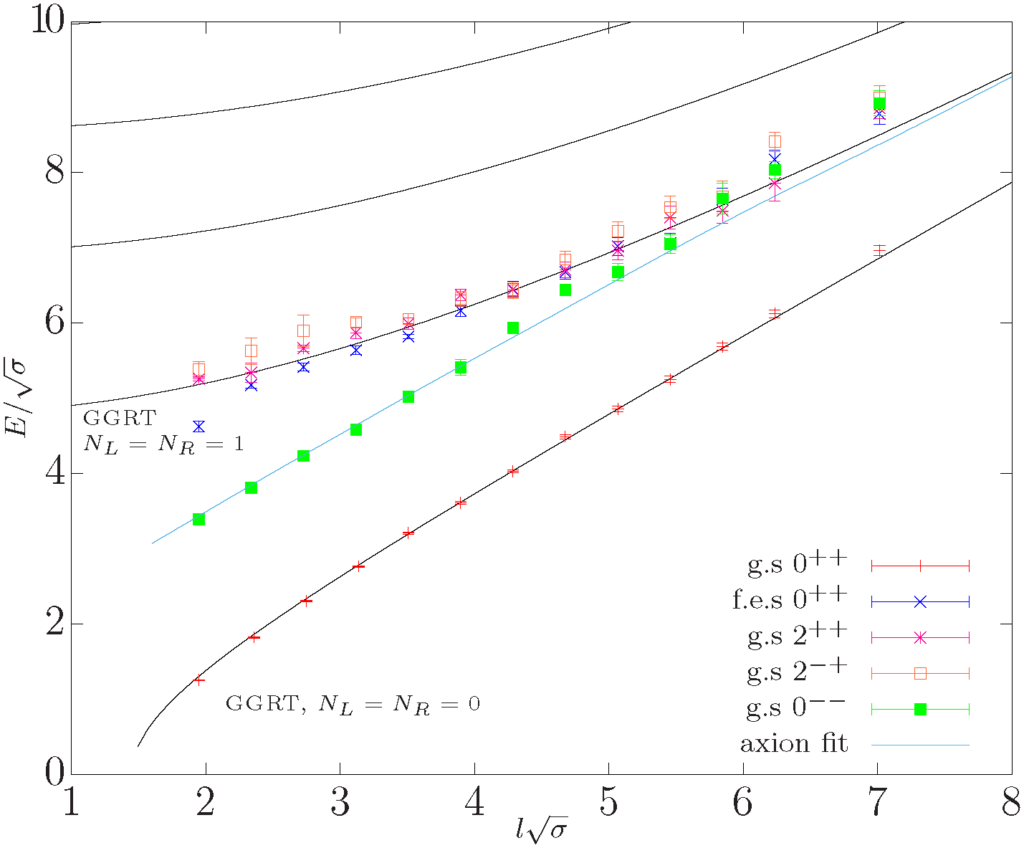
A characteristic feature of confinement is the formation of chromoelectric flux tubes, often called QCD strings, that can connect a quark with an antiquark. These strings have been observed in numerical lattice calculations, and they appear naturally in the dual description of certain confining gauge theories by higher-dimensional gravitational theories. The generalization of QCD from 3 to N colors, and the subsequent large N limit of gauge theories, offer a particularly good vantage point on the confining strings, since their splitting and joining becomes suppressed. As a result, a single flux tube becomes a consistent quantum system. In recent years, there has been significant progress towards understanding the dynamics of a long QCD string thanks to coordinated advances in analytical approaches and lattice simulations. More broadly, solving the large N QCD has been a long-standing dream of many theorists, towards which the collaboration will devote renewed effort. Several recent developments, ranging from fundamental theory, to numerical computation, to experimental discoveries, make this an opportune time to deepen our understanding of non-perturbative aspects of QCD and other strongly interacting gauge theories. All the available methods will be employed in working on these important problems. This will help create a broader and more versatile community of researchers working on confinement and QCD strings.

