Bringing people and ideas together to fund, conduct, and share transformative science.
Our grants advance knowledge and strengthen connections between science and society.
Discover the latest news, research, and updates.
We convene scientists, mathematicians, and thinkers to share ideas and explore new questions.
Founded by Jim and Marilyn Simons, we’re a private philanthropy advancing mathematics and basic science.
Work with us on the frontier of basic science research.
The Flatiron Institute is a research center that uses computational science to advance fields like physics, biology, and astronomy.
Search
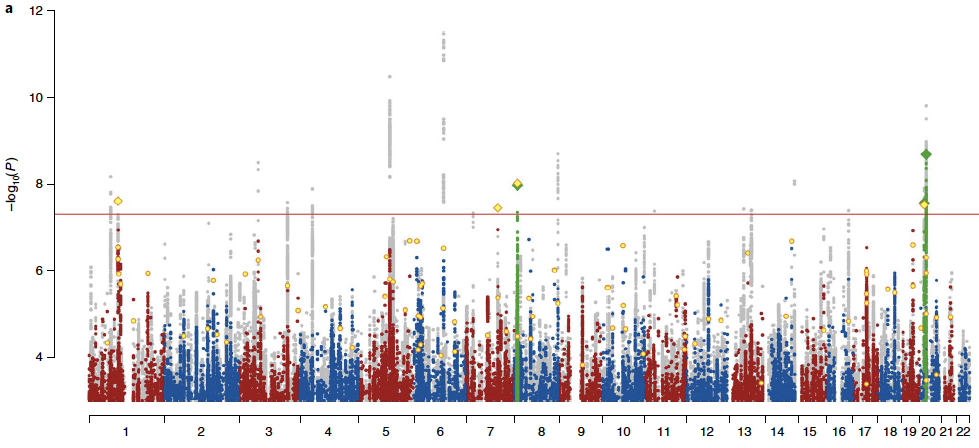
Mark Daly and colleagues report the results of a large genome-wide association meta-analysis of more than 18,000 individuals with ASD, including the newly genotyped Danish iPSYCH cohort.

SFARI Investigator
Although a substantial portion of the genetic risk of autism spectrum disorder (ASD) lies in common variation, the number of available samples has been too small to reliably identify individual variants that reach genome-wide levels of statistical significance. Genome-wide studies of schizophrenia have led the way in showing that a boost in statistical power can yield many robust associations and biological insights.
Now, SFARI Investigator Mark Daly, in collaboration with Anders Børglum and colleagues from the Danish iPSYCH project and the Psychiatric Genomics Consortium, has carried out a genome-wide association meta-analysis of 18,381 individuals with ASD and 27,969 controls and has identified five genome-wide significant loci. A combined analysis with traits and disorders for which there is some genetic overlap with ASD yielded an additional seven loci. Among the genes closest to the associated markers are KCNN2, a calcium-activated potassium channel; KMT2E, a histone methyltransferase; and PTBP2, a regulator of alternative splicing with key roles in axonogenesis.
In addition to highlighting individual loci, the authors also report a number of enrichment analyses using the data set as a whole. They find that ASD risk genes on the curated list from the SPARK consortium are enriched for association, providing an early clue that there may be significant overlap in the genes implicated by rare and common variation. In regard to overall polygenic risk, Daly and colleagues report the strongest signal in individuals diagnosed with Asperger syndrome, which also overlaps significantly with the polygenic signal for increased educational attainment, suggesting that individuals at the higher IQ end of the autism spectrum may have a larger contribution from common variants. Finally, individuals in the top decile for polygenic signal have about a threefold-increased risk compared to the bottom decile. This partitioning of risk should only increase as sample sizes grow.

