Bringing people and ideas together to fund, conduct, and share transformative science.
Our grants advance knowledge and strengthen connections between science and society.
Discover the latest news, research, and updates.
We convene scientists, mathematicians, and thinkers to share ideas and explore new questions.
Founded by Jim and Marilyn Simons, we’re a private philanthropy advancing mathematics and basic science.
Work with us on the frontier of basic science research.
The Flatiron Institute is a research center that uses computational science to advance fields like physics, biology, and astronomy.
Search
Quantum physicists at the Simons Foundation’s Flatiron Institute combine old math and new tools to tackle the problem of modeling particle distribution.
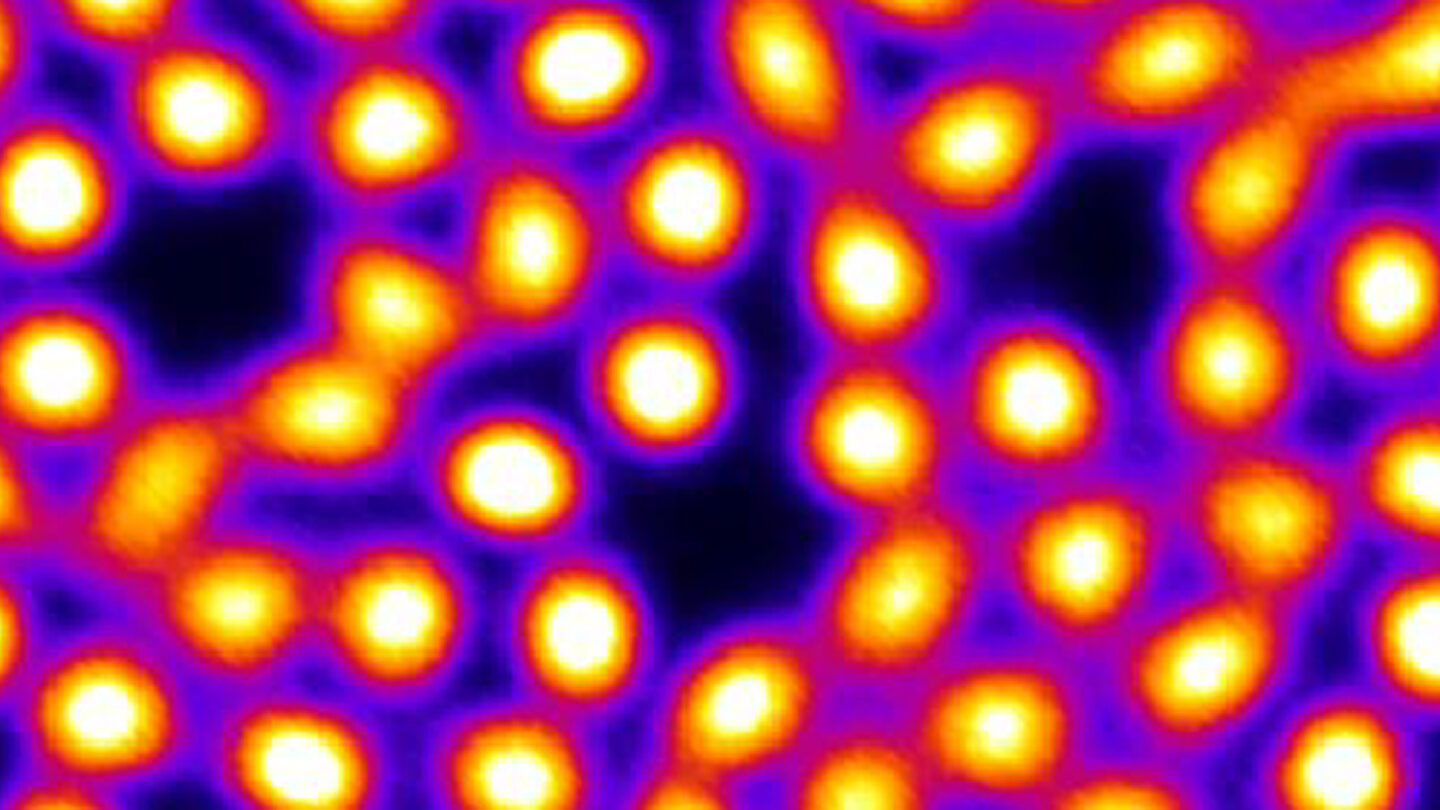
Miles Stoudenmire, a research scientist at the Simons Foundation’s Flatiron Institute, explores the collective motion of hundreds or thousands of quantum particles to glean more precise information about how they interact, move and become entangled with one another.
All those interacting particles create a daunting challenge: just storing the problem as you work on it requires a tremendous amount of storage space, not to mention computational effort. To overcome this hurdle, researchers like Stoudenmire are developing more efficient tools to make accurate predictions that can be tested against experiments.
Along with visiting student John Zima, Stoudenmire identified a less resource-intensive way to run the calculations. They slice time into segments. They take small steps to capture the system’s early stages, then progressively larger steps as the dynamics slow on their way to equilibrium. This approach produces accurate results thousands of times faster than previous methods.
In this video, Stoudenmire explains how speeding up these calculations helps researchers uncover the properties of quantum systems and why it is crucial to his work at the Flatiron Institute’s Center for Computational Quantum Physics.