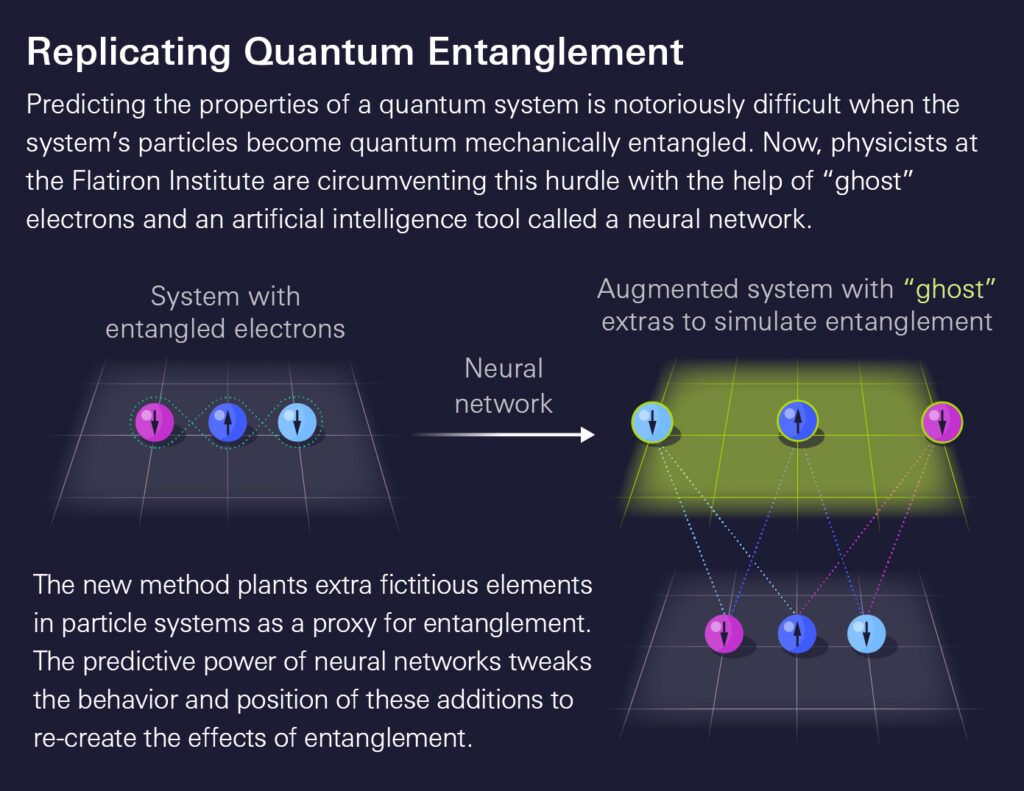
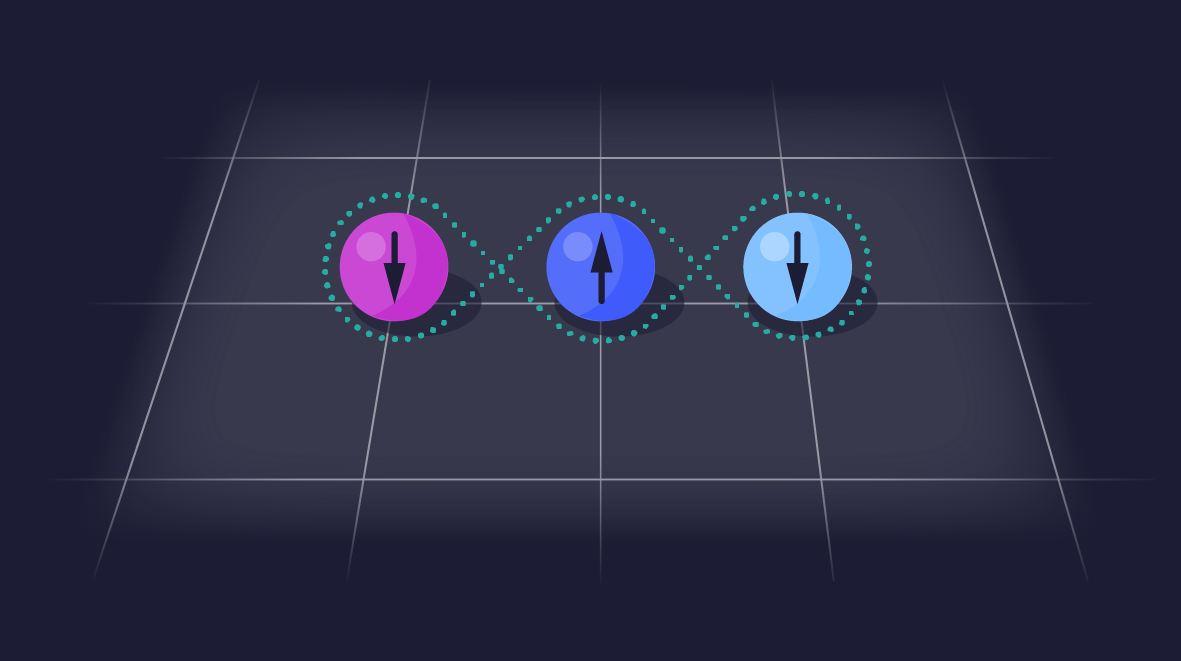
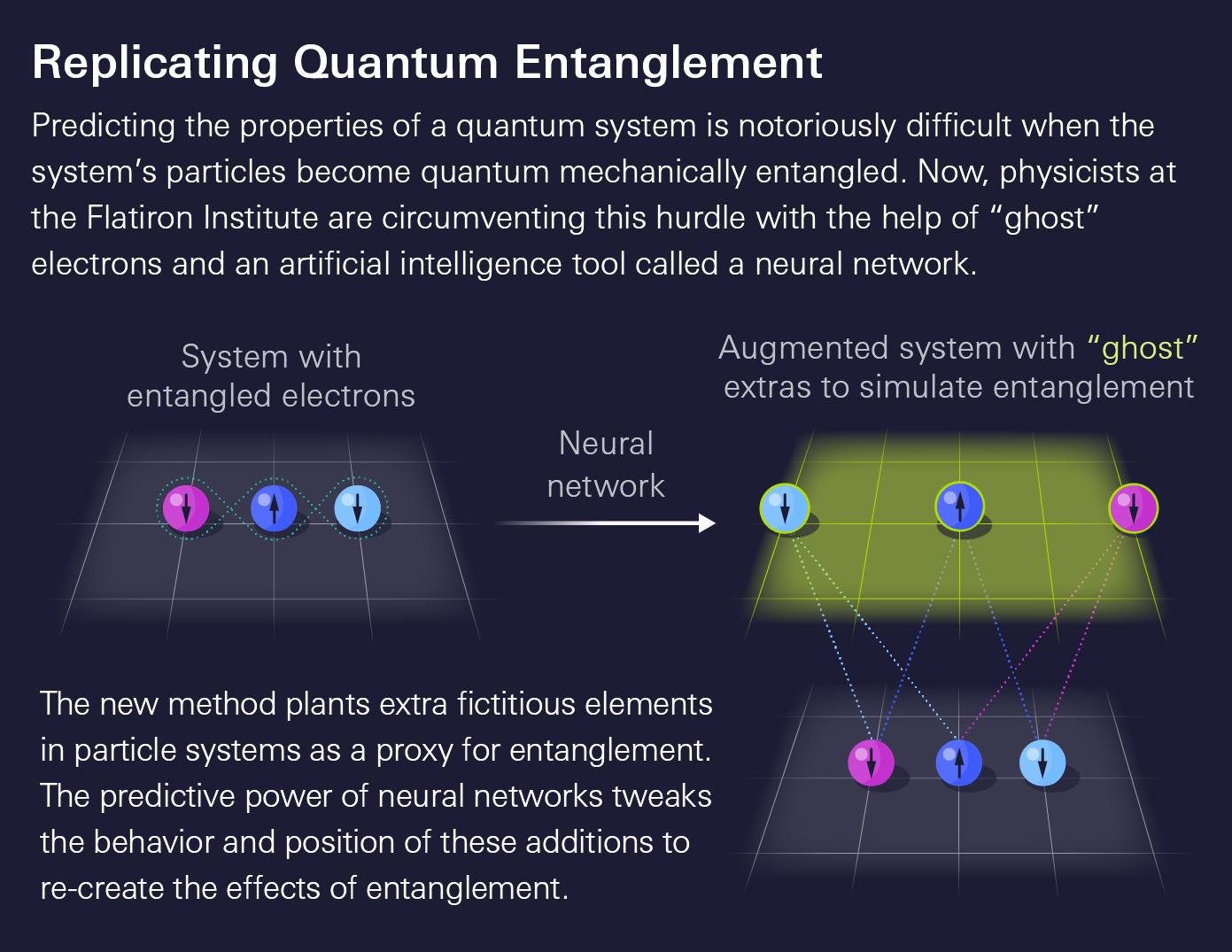
In the new paper, the physicists demonstrate that their approach matches or outclasses competing methods in simple quantum systems.
“We applied this to simple things as a test bed, but now we are taking this to the next step and trying this on molecules and other, more realistic problems,” says study co-author and CCQ director Antoine Georges. “This is a big deal because if you have a good way of getting the wave functions of complex molecules, you can do all sorts of things, like designing drugs and materials with specific properties.”
The long-term goal, Georges says, is to enable researchers to computationally predict the properties of a material or molecule without having to synthesize and test it in a lab. They might, for instance, be able to test a slew of different molecules for a desired pharmaceutical property with just a few clicks of a mouse. “Simulating big molecules is a big deal,” Georges says.
Robledo Moreno and Georges co-authored the paper with EPFL assistant professor of physics Giuseppe Carleo and CCQ research fellow James Stokes.
The new work is an evolution of a 2017 paper in Science by Carleo and Matthias Troyer, who is currently a technical fellow at Microsoft. That paper also combined neural networks with fictitious particles, but the added particles weren’t full-blown electrons. Instead, they just had one property known as spin.
“When I was [at the CCQ] in New York, I was obsessed with the idea of finding a version of neural network that would describe the way electrons behave, and I really wanted to find a generalization of the approach we introduced back in 2017,” Carleo says. “With this new work, we have eventually found an elegant way of having hidden particles that are not spins but electrons.”