Bringing people and ideas together to fund, conduct, and share transformative science.
Our grants advance knowledge and strengthen connections between science and society.
Discover the latest news, research, and updates.
We convene scientists, mathematicians, and thinkers to share ideas and explore new questions.
Founded by Jim and Marilyn Simons, we’re a private philanthropy advancing mathematics and basic science.
Work with us on the frontier of basic science research.
The Flatiron Institute is a research center that uses computational science to advance fields like physics, biology, and astronomy.
Search
In the book, the Fields Medalist introduces six core ideas that shaped the field of mathematics.
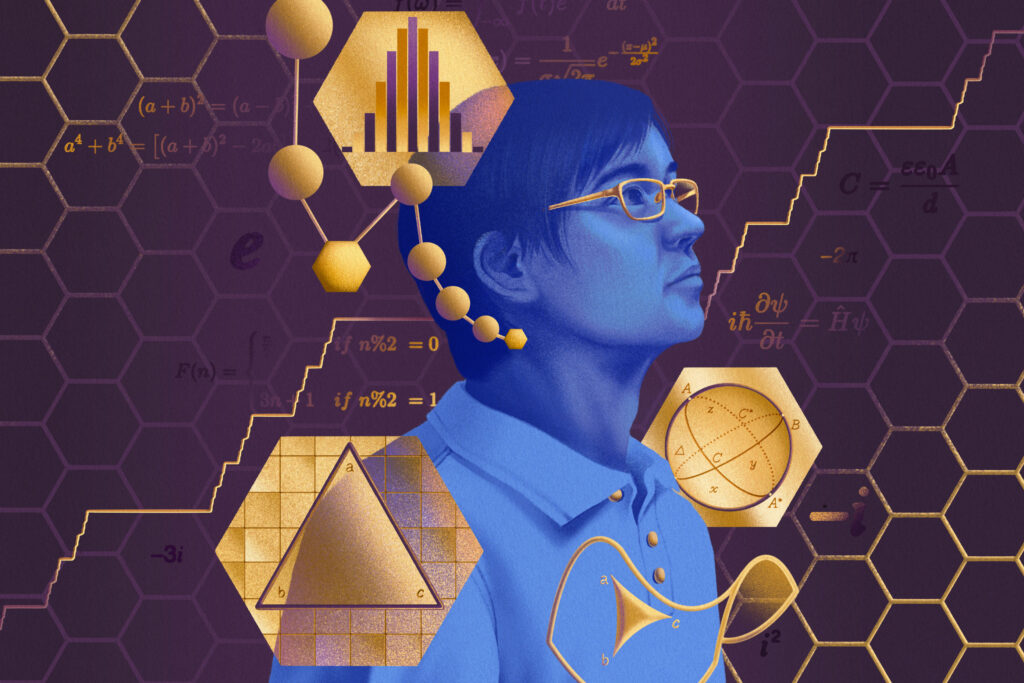
Terence Tao’s colleagues call him the “Mozart of math,” and the Fields Medalist and UCLA professor is probably the closest thing the field has to an international rock star. Now Tao is inviting everyone to discover the creativity and interconnectedness of math in his first book for a popular audience.
In Six Math Essentials, published today by Quanta Books, Tao takes readers on an exploration of six core ideas that have shaped mathematics: numbers, algebra, geometry, probability, analysis and dynamics.
“I have long felt that mathematicians do a lousy job of public outreach,” said Tao during an interview with Science Friday. “What I wanted to convey in my book was that the type of things that research mathematicians do these days, either in pure math or in applications to the real world, [is] still tied to the basic concepts that you already are exposed to as a child — numbers, shapes, time, change, big and small.”
Far more than just problem solving, Tao writes, math is fundamentally a mindset that has guided civilization to make sense of complexity, from antiquity to the modern world. Contrary to popular perception, math, he says, isn’t magic — it’s a powerful way of thinking that anyone can learn.
Reading the book is “like seeing soccer through Messi’s eyes,” wrote Ben Orlin, bestselling author of Math With Bad Drawings. “Six Math Essentials made me feel like a kid riding on the shoulders of the world’s smartest grown-up.”
Six Math Essentials is the second book from Quanta Books, a partnership imprint from the Simons Foundation and Farrar, Straus and Giroux.