SINEUPs: lncRNAs With the Potential To Upregulate Haploinsufficient Autism Risk Genes

Featuring
-

Marta Biagioli
SFARI Investigator
Bringing people and ideas together to fund, conduct, and share transformative science.
Our grants advance knowledge and strengthen connections between science and society.
Discover the latest news, research, and updates.
We convene scientists, mathematicians, and thinkers to share ideas and explore new questions.
Founded by Jim and Marilyn Simons, we’re a private philanthropy advancing mathematics and basic science.
Work with us on the frontier of basic science research.
The Flatiron Institute is a research center that uses computational science to advance fields like physics, biology, and astronomy.
Search
SFARI Investigator
Large-scale genetic studies have now uncovered more than 200 genes1,2,3 that can be linked to neurodevelopmental disorders (NDDs) or autism. Many of those genes are implicated through gene-damaging heterozygous de novo mutations that result in haploinsufficiency of the affected gene. Identifying such genes opens the door for the development of gene-specific therapeutics like gene replacement therapy. However, gene replacement therapy comes with many challenges, one of them being the risk of overexpression. Therefore, therapeutics that could result in the upregulation of the remaining healthy allele and do not interfere with endogenous regulatory mechanisms of gene expression would be ideal.
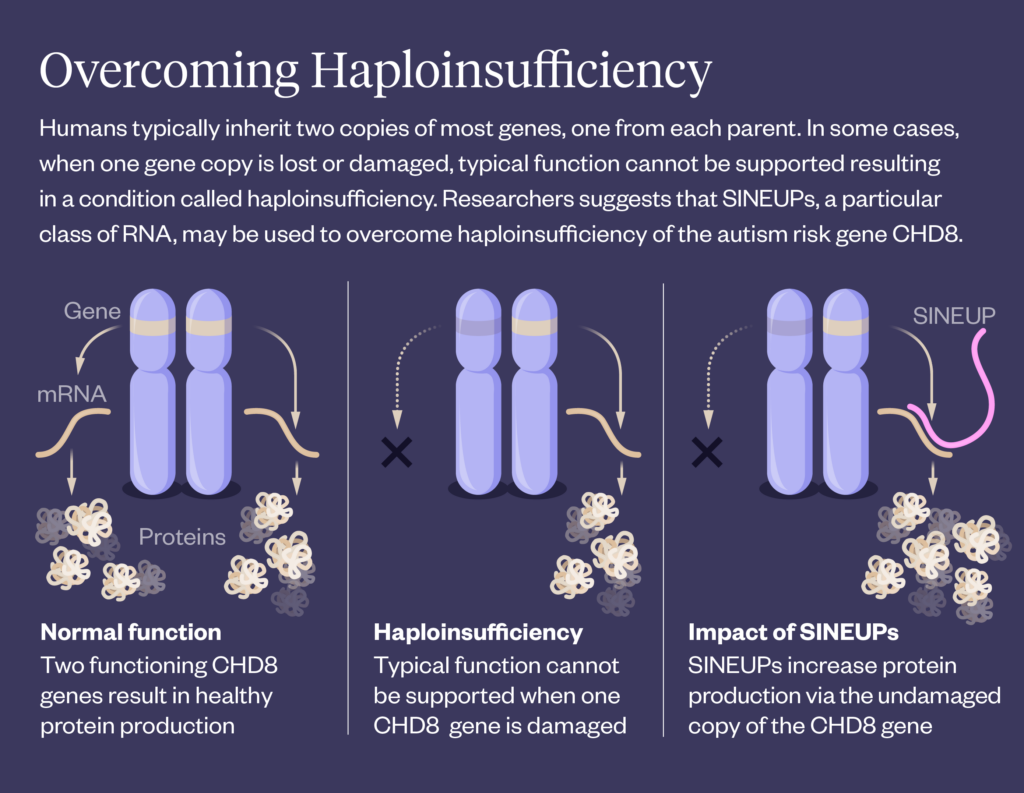
A new SFARI-supported study led by Marta Biagioli and colleagues suggests that SINEUPs, a particular class of long-non-coding (lnc) RNAs that upregulate translation of their target mRNAs4,5, may be used to overcome haploinsufficiency of the ASD risk gene CHD8 in multiple in vitro models as well as in vivo in zebrafish. SINEUPs are modular lncRNAs, consisting of a binding domain complementary to the mRNA they are targeting and an effector domain that mediates the upregulation of the target mRNA’s translation. Due to this modular structure, SINEUPs can, in principle, be designed for almost any mRNA.
Biagioli and colleagues designed SINEUPs targeting the long isoform of mouse, human and zebrafish CHD8 mRNA. In neural progenitor cells derived from human induced pluripotent stem cells (hiNPC) in which CHD8 was knocked down, a SINEUP delivered via electroporation resulted in a 1.8-fold upregulation of CHD8 protein levels. The team also found that molecular phenotypes (differential gene expression and altered H3K36me3 levels) previously associated with CHD8 haploinsufficiency were partially reversed in hiNPCs treated with SINEUPs. Importantly, they also achieved 2.1-fold upregulation of CHD8 in patient-derived fibroblasts carrying a frameshift mutation (c.6307_6310del) or a stop+frameshift (c.2485dupA).
To test if SINEUPs targeting CHD8 could be effective in vivo, the scientists turned toward an established zebrafish model of Chd8 haploinsufficiency, chd8p.Glu223*6,7, that presents with macrocephaly due to increased cell proliferation. They found that injection of a SINEUP targeting the zebrafish Chd8 mRNA into one-cell-stage embryos resulted in the full rescue of both phenotypes in 4.2 dpf zebrafish larvae. Yet another phenotype, reduced number of enteric neurons, was not rescued.
This study highlights SINEUPs as a potential gene targeting therapeutic with the ability to upregulate the expression of haploinsufficient NDD genes. Other investigators supported by SFARI (Jonathan Sebat, Joe Dougherty and Joseph Buxbaum) are exploring antisense oligonucleotides and small-molecule-mediated mechanisms with the same goal.

