T-Lymphocytes Target Astrocytes in the Postmortem Autism Brain
Featuring
-

Matthew Anderson
SFARI Investigator
Bringing people and ideas together to fund, conduct, and share transformative science.
Our grants advance knowledge and strengthen connections between science and society.
Discover the latest news, research, and updates.
We convene scientists, mathematicians, and thinkers to share ideas and explore new questions.
Founded by Jim and Marilyn Simons, we’re a private philanthropy advancing mathematics and basic science.
Work with us on the frontier of basic science research.
The Flatiron Institute is a research center that uses computational science to advance fields like physics, biology, and astronomy.
Search
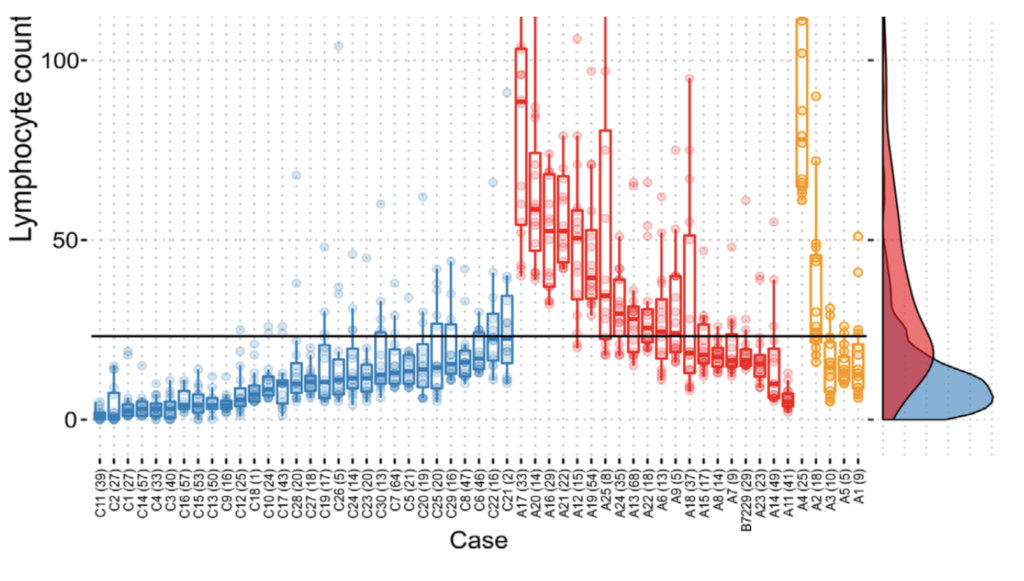
A study from Matthew Anderson and colleagues identified an excess of T-lymphocytes in the postmortem ASD brain, which are prominently associated with astrocytes.
SFARI Investigator
Although published studies of postmortem brains have implicated patterns of gene expression and cell types involved in the innate immune system as being associated with autism spectrum disorder (ASD) neuropathology, our understanding of neuroimmune functions in the disorder is far from complete. A new study now suggests the possible role of the T-lymphocytes of the adaptive immune system in ASD.
The new work was led by Matthew Anderson, director of the Boston node of Autism BrainNet. Anderson and colleagues examined the postmortem brains of 25 individuals with ASD and 30 individuals without ASD, many of which were acquired through the Autism BrainNet program. They reported a higher number of T-lymphocytes, as well as microscopic blebs in the perivascular space, in the brains of individuals with ASD compared to individuals without ASD. These blebs, which were commonly associated with astrocytes, are signs of cell injury and raise the possibility that there is an active immune response in the ASD brain that targets astrocytes.
This is the first time that such a neuropathological signature has been reported in ASD postmortem brain. In the absence of evidence for a particular infection, the authors suggest that the changes might reflect an autoimmune response. Pending replication in another set of postmortem brains, the data hold out the prospect of a blood-based biomarker that could be used to improve diagnosis and monitoring of living individuals with ASD.

