Targeting Somatosensory Over-Reactivity in Mouse Models of ASD
Featuring
-

David Ginty
SFARI Investigator
Bringing people and ideas together to fund, conduct, and share transformative science.
Our grants advance knowledge and strengthen connections between science and society.
Discover the latest news, research, and updates.
We convene scientists, mathematicians, and thinkers to share ideas and explore new questions.
Founded by Jim and Marilyn Simons, we’re a private philanthropy advancing mathematics and basic science.
Work with us on the frontier of basic science research.
The Flatiron Institute is a research center that uses computational science to advance fields like physics, biology, and astronomy.
Search
David Ginty and colleagues have identified mechanisms through which peripheral loss of ASD-associated genes affect behaviors in mice and identify a potential peripherally restricted therapy to treat tactile over-reactivity and select ASD-related behaviors.
SFARI Investigator
Published work supported in part by a SFARI Pilot Award to SFARI Investigator David Ginty suggests that abnormal tactile sensitivity in mouse models of ASD can be attributed to dysfunctional peripheral mechanosensory neurons, and that this aberrant sensitivity may contribute to the appearance of behaviors that are analogous to the core symptoms of ASD, including social impairments (Orefice et al., Cell, 2016).
Now, Ginty and colleagues follow up on this work by showing that this tactile oversensitivity appears in a range of ASD mouse models via distinct physiological mechanisms and that a peripherally restricted drug can improve both the tactile-related phenotypes and other behavioral abnormalities seen in these models.
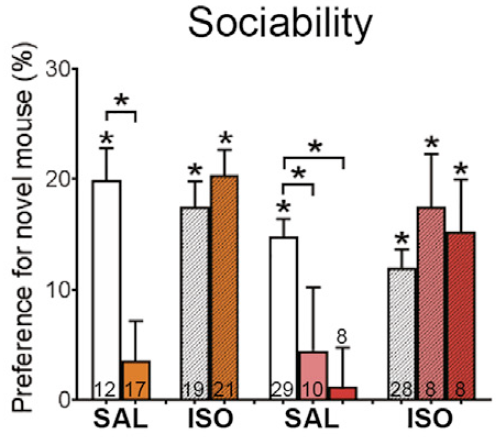
In the new work — partly funded by a SFARI Research Award — the team showed that deletion of one copy of Shank3 in cells below the neck or specifically in somatosensory neurons led to a range of changes in tactile sensitivity and social behaviors that had previously been reported in mice carrying mutations in Gabrb3 or Mecp2. Despite the common phenotypes, they showed that the tactile processing changes seen in Shank3 mutant mice can be attributed to reduced expression and function of HCN channels, a mechanism distinct from the GABAA receptor-mediated changes in presynaptic inhibition seen in the Gabrb3 and Mecp2 mutant mice.
Finally, Ginty and colleagues show that genetically restoring Shank3 or Mecp2 expression during a critical early-postnatal window is sufficient to rescue normal tactile reactivity and at least some social and anxiety-like behaviors. Moreover, treatment with a peripherally restricted GABAA receptor agonist called ‘isoguvacine’ ameliorates tactile oversensitivity, anxiety-like behaviors and abnormalities in social behaviors. These results hold the possibility of a treatment for both the core and allied symptoms of ASD that would avoid the undesirable side effects of drugs that act via the central nervous system.

