USP9X Mutation Defines a Neurodevelopmental Syndrome
Featuring
-

Michael Piper
SFARI Investigator
Bringing people and ideas together to fund, conduct, and share transformative science.
Our grants advance knowledge and strengthen connections between science and society.
Discover the latest news, research, and updates.
We convene scientists, mathematicians, and thinkers to share ideas and explore new questions.
Founded by Jim and Marilyn Simons, we’re a private philanthropy advancing mathematics and basic science.
Work with us on the frontier of basic science research.
The Flatiron Institute is a research center that uses computational science to advance fields like physics, biology, and astronomy.
Search
Michael Piper and colleagues confirmed and extended the association of USP9X loss-of-function mutations with a neurodevelopmental syndrome in both sexes, driven by changes in multiple signaling pathways.
SFARI Investigator
Loss-of-function mutations in USP9X, encoding a deubiquitylating enzyme, had previously been associated with a severe neurodevelopmental disorder in females. A new study identifies partial loss-of-function mutations in USP9X in males with a similar disorder and expands our understanding of its roles in regulating key neurodevelopmental signaling pathways and mouse behavior. A companion paper defines key substrates for its deubiquitylating activity and an important role in regulating dendritic spine density.
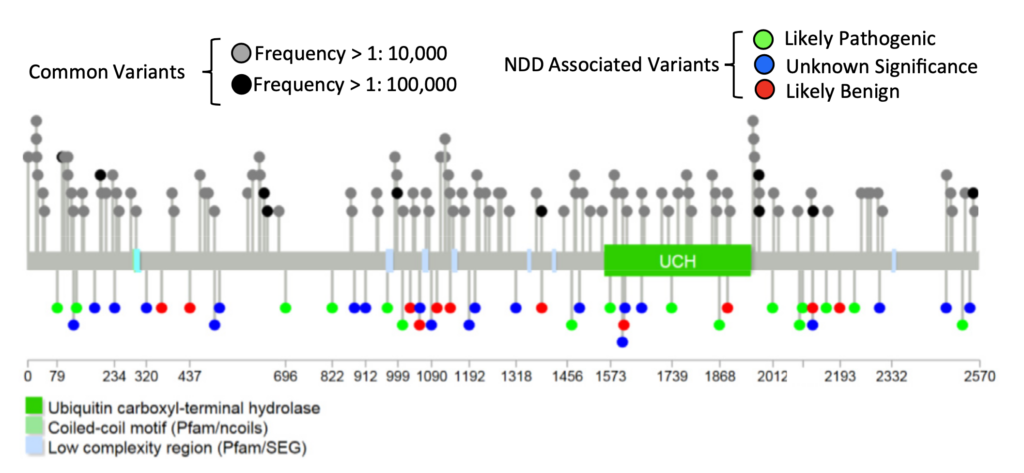
The first study, published in Biological Psychiatry, was supported in part by an Explorer Award to SFARI Investigator Michael Piper. The authors identified nine de novo and three maternally inherited mutations in USP9X in males with a neurodevelopmental syndrome and marshalled a range of evidence to suggest that they represent partial loss-of-function mutations that are responsible for the associated phenotypes. These phenotypes typically included developmental delay, autism, delayed or absent speech, motor difficulties and hypoplastic corpus callosum, among others. In line with previous data, they found several of the mutations to affect TGF beta, Wnt or mTOR signaling in fibroblast cell lines. Finally, the authors reported that mice lacking Usp9x in embryonic forebrain had severe deficits in hippocampal-dependent learning and memory.
Piper and colleagues contributed to a second study, led by the lab of Peter Penzes, which was published in Neuron. In this paper, the authors found a key role for Usp9x in mice in regulating levels of proteins harboring ankyrin-repeat domains (ANKRD), many of which are associated with autism risk. They showed that alterations in the levels of ANKRD proteins in mice led to persistent changes in dendritic spine density as well as hyperactivity. All told, data from the two papers highlight USP9X as a multifunctional protein associated with neurodevelopmental phenotypes in both sexes.

