About
Mock CANDELS Catalogs
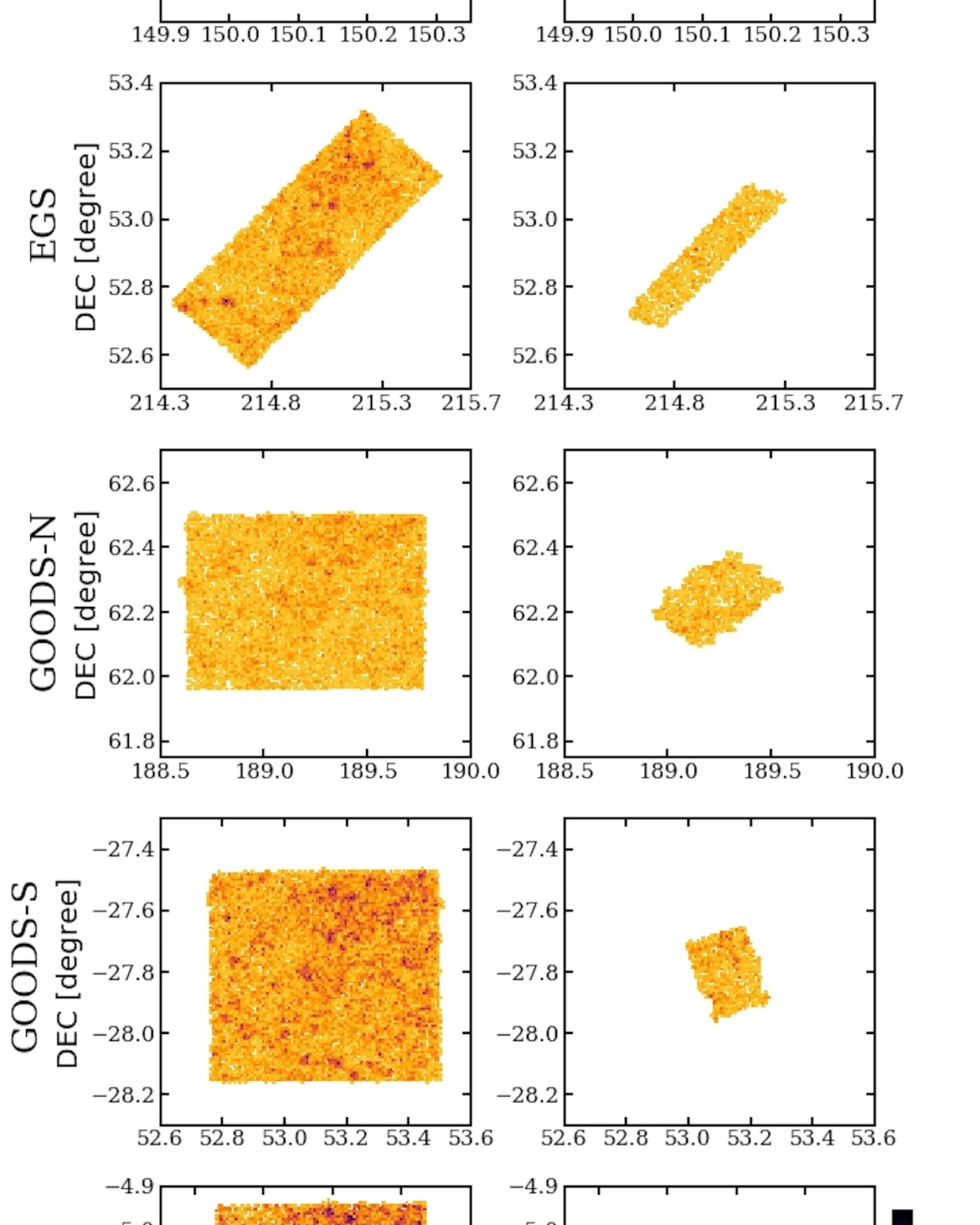
As part of the CANDELS program, the theory team created custom “mock CANDELS” catalogs. These were created by extracting the dark matter halos from a large cosmological simulation along the past lightcone corresponding to a field with the same geometry and sky location as one of the real CANDELS fields. These halos are then populated with galaxy properties using two different techniques: an empirical technique known as Sub-Halo Abundance Matching (using the UniverseMachine built by P. Behroozi & collaborators), and Semi-analytic Models of galaxy formation. Three sets of mock lightcone catalogs were produced, called UniverseMachine, Santa Cruz SAM (SC-SAM), and Lu-SAM.
In order to facilitate comparison between theoretical models and the CANDELS observations, we have created a set of curated “theory friendly” catalogs for the CANDELS observed quantities and physical properties derived from the observations.
Here we provide supplementary documentation for the mock catalogs and theory friendly catalogs, and access to the theory friendly catalogs and SC-SAM catalogs. Access the UniverseMachine CANDELS lightcones.
All catalogs can also be previewed, filtered, and downloaded.
References
For more information about CANDELS, theory friendly catalogs, and theoretical mock catalogs, see the following references.