Skip to content
Simons Foundation
Simons Foundation
Simons Foundation
Search
  • Bringing people and ideas together to fund, conduct, and share transformative science.

    In-House Research

    • Computational Astrophysics
    • Computational Biology
    • Computational Mathematics
    • Computational Neuroscience
    • Computational Quantum Physics
    • Computational Catalysis
    All Publications

    Research We Fund

    • Autism
    • Neuroscience
    • Mathematics & Physical Sciences
    • Ecology & Evolution
    • Plant Biology

    Public Engagement

    • Grantmaking
    • Media Initiatives
    • Public Events
    • Researcher Engagement
    • National Initiatives

    Resources

    • Computational Software
    • Computational Datasets
    • SFARI Base
    All Resources

    Simons Collaborations

    • Simons Collaboration on New Frontiers in Superconductivity
    • Simons Collaboration on Ecological Neuroscience
    • Simons Collaboration on Principles of Microbial Ecosystems
    All Collaborations
  • Our grants advance knowledge and strengthen connections between science and society.

    All Funding Opportunities

    Autism & Neuroscience

    • Fellows-to-Faculty
    • New Ideas
    • SFARI Conferences & Courses Awards
    • Shenoy Undergraduate Research Fellowship in Neuroscience

    Life Sciences

    • Simons Graduate Fellowships in Ecology & Evolution
    • Simons Postdoctoral Fellowships in Plant Biology
    • Synthetic Plant Biology
    • Simons Collaborations in Ecology & Evolution

    Science, Society & Culture

    • Science in Culture
    • Science in Community
    • STEM Pathways

    Mathematics & Physical Sciences

    • Scientific Software Research Faculty Award
    • Simons Collaborations in MPS
    • Simons Dissertation Fellowship
    • Simons Fellows in Mathematics
    • Targeted Grants to Institutes
    • Targeted Grants in MPS
    • Travel Support for Mathematicians

    Shared Programs

    • Pivot Fellowship
    • Simons Society of Fellows

    Resources for Applying

    • Open Funding Opportunities
    • Policies & Procedures
    • SAM FAQ and Instructional Videos
    • Past Funded Work
  • Discover the latest news, research, and updates.

    All News

    The Latest

    • Research News
    • Funding Announcements
    • Newsletter Sign Up

    For the Media

    • Press Releases
    • Media Relations
  • We convene scientists, mathematicians, and thinkers to share ideas and explore new questions.

    All Events

    Public Events

    • Presidential Lectures
    • Presents
    Attend an Event

    Flatiron Events Our in-house research institute hosts events for scientists and researchers.

    See All

    Past Events Find videos, presentations, and resources from our past events.

    See All
  • Founded by Jim and Marilyn Simons, we’re a private philanthropy advancing mathematics and basic science.

    About Us

    About

    • Our History
    • Annual Reports
    • Brand Guidelines
    • Visitor Information
    • Media Relations
    • Contact
    About Us

    People

    • Leadership
    • Board of Trustees
    • Researchers
    All People

    Careers

    • Working Here
    • Internship Opportunities
    • Undergraduate Students
    • Graduate Students
    • Postdoctoral Opportunities
    • Research Scientists
    Open Jobs
  • Flatiron Institute
  • Careers
    Search all
  • Funding
    Search all
  • Explore opportunities for...
    • Undergraduate students
    • Graduate students
    • Postdoctoral researchers
    • Research scientists
Simons Foundation

Filters

Type

Section

Person

Show 97 more Show less
Simons Foundation
  • Find a Person

Bringing people and ideas together to fund, conduct, and share transformative science.

Our grants advance knowledge and strengthen connections between science and society.

Discover the latest news, research, and updates.

  • All News
  • Research News
  • Funding Announcements
  • Newsletter Sign Up
  • Press Releases
  • Media Relations

We convene scientists, mathematicians, and thinkers to share ideas and explore new questions.

  • Events Calendar
  • Public Events
  • Presidential Lectures
  • Presents
  • Flatiron Events
  • Past Events

Founded by Jim and Marilyn Simons, we’re a private philanthropy advancing mathematics and basic science.

Work with us on the frontier of basic science research.

  • All Open Positions
  • Undergraduate Students
  • Graduate Students
  • Postdocs
  • Research Scientists

The Flatiron Institute is a research center that uses computational science to advance fields like physics, biology, and astronomy.

  • Explore Flatiron Institute
  • People
  • Careers
  • Publications
  • Software & Data
  • Computational Astrophysics
  • Computational Biology
  • Computational Mathematics
  • Computational Neuroscience
  • Computational Quantum Physics
  • Computational Catalysis
Flatiron Institute
  • Autism
  • Neuroscience
  • Mathematics
  • Ecology & Evolution
  • Plant Biology
  • Grantmaking
  • Media Initiatives
  • Public Events
  • Researcher Engagement
  • National Initiatives
  • Computational Software
  • Computational Datasets
  • SFARI Base
  • Publications
  • Simons Collaboration on New Frontiers in Superconductivity
  • Simons Collaboration on Ecological Neuroscience
  • Simons Collaboration on Principles of Microbial Ecosystems
All Collaborations
  • Policies & Procedures
  • Instructional Videos
  • Past Funded Work
  • Undergraduate Students
  • Graduate Students
  • Postdocs
  • Research Scientists
All Funding Opportunities
  • Fellows-to-Faculty
  • New Ideas
  • SFARI Conferences & Courses Awards
  • Shenoy Undergraduate Research Fellowship in Neuroscience
Autism & Neuroscience
  • Simons Graduate Fellowships in Ecology & Evolution
  • Simons Postdoctoral Fellowships in Plant Biology
  • Synthetic Plant Biology
  • Simons Collaborations in Ecology & Evolution
Life Sciences
  • Science in Culture
  • Science in Community
  • STEM Pathways
Science, Society & Culture
  • Scientific Software Research Faculty Award
  • Simons Collaborations in MPS
  • Simons Dissertation Fellowship in Mathematics
  • Simons Fellows in Mathematics
  • Targeted Grants to Institutes
  • Targeted Grants in Mathematics & Physical Sciences
  • Travel Support for Mathematicians
Mathematics & Physical Sciences
  • Pivot Fellowship
  • Simons Society of Fellows
  • Our History
  • Annual Reports
  • Visitor Information
  • Media Relations
  • Contact Us
About Us
  • Leadership
  • Board of Trustees
  • Researchers
Search All People
  • Working Here
  • Internship Opportunities
  • Undergraduate Students
  • Graduate Students
  • Postdoctoral Students
  • Research Scientists
All Open Positions

Centers

  • Computational Astrophysics
  • Computational Biology
  • Computational Mathematics
  • Computational Neuroscience
  • Computational Quantum Physics
  • Scientific Computing Core
  • Initiative for Computational Catalysis

Collaborative Projects

  • Foundation Models of Science
  • Simons Observatory
Flatiron Institute

Search

What are you looking for?

Filter Results

Search

What are you looking for?

Results update as you type and when you change filters.

Skip to results

Filters

Type

Section

Person

Show 97 more Show less

Filters

Featured

Dissecting mechanisms of hyperarousal in autism and related disorders using the Simons Sleep Project

Funded Work

Gravity Follows Newton’s and Einstein’s Rules, Even at Cosmic Scales

April 15, 2026

Scientists Capture Superconductivity’s ‘Dancing Pairs’ for First Time, Filling Gap in Decades-Old Theory

April 15, 2026

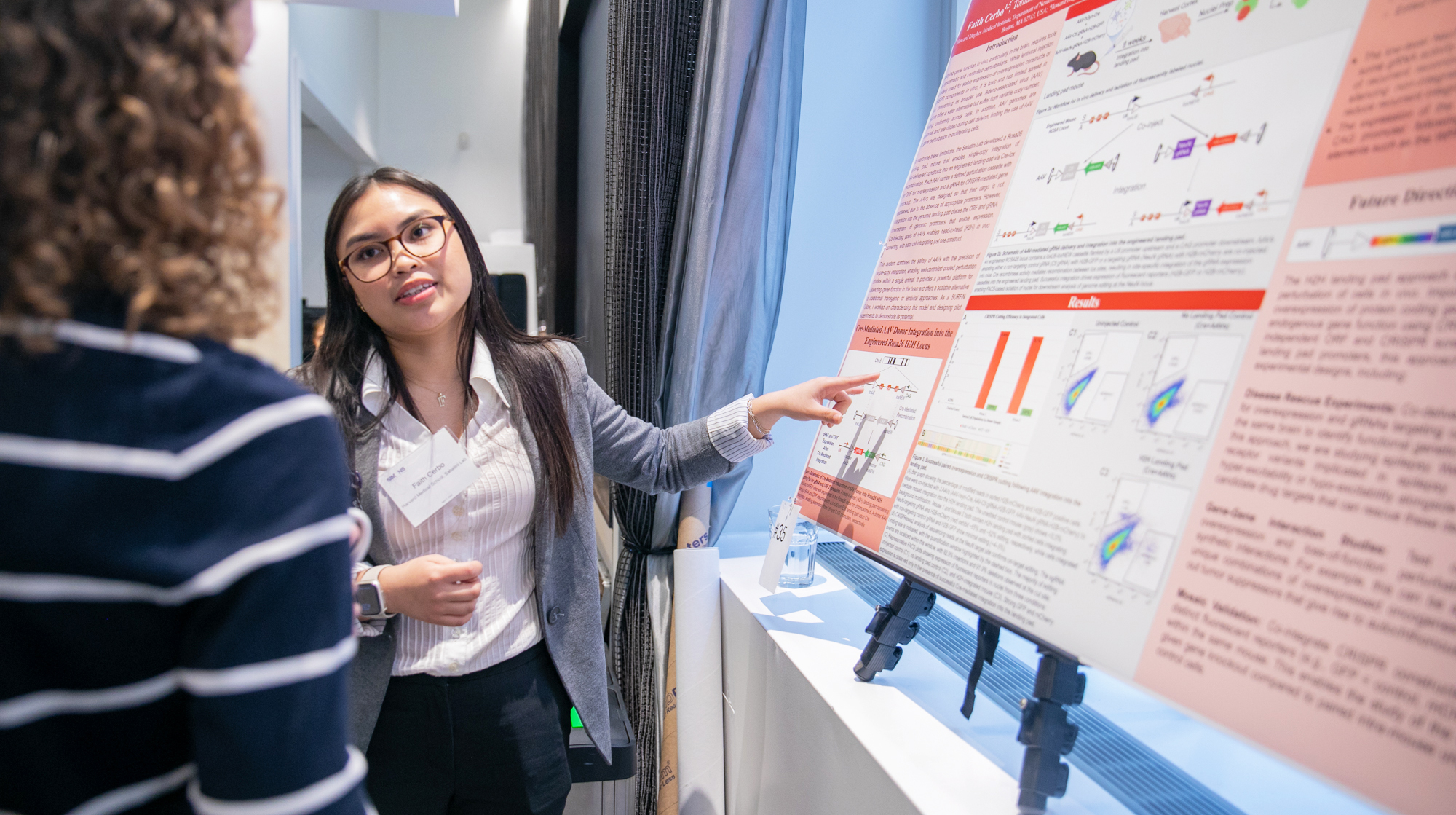
How SURFiN Fellowships Jump-Started These 3 Neuroscience Students’ STEM Careers

March 18, 2026

Topology and Complexity

November 19, 2014

Results

  1. Black hole spectroscopy: from theory to experiment

    Publication
    The "ringdown" radiation emitted by oscillating black holes has great scientific potential. By carefully predicting the frequencies and amplitudes of black hole quasinormal modes and comparing them with …
  2. Identifying Compact Chirping SMBHBs in LSST Using Bayesian Analysis

    Publication
    The Legacy Survey of Space and Time (LSST) is expected to observe up to \({\sim}100\) million quasars in the next decade. In this work, we show that …
  3. Hints of Spin-magnitude Correlations and a Rapidly Spinning Subpopulation of Binary Black Holes

    Publication
    The complex astrophysical processes leading to the formation of binary black holes and their eventual merger are imprinted on the spins of the individual black holes. We revisit …
  4. GW231123 ringdown: interpretation as multimodal Kerr signal

    Publication
    GW231123 is a short-duration, low-frequency gravitational wave signal consistent with a binary black hole coalescence and dominated by the merger-ringdown regime due to the high …
  5. Spinning into the Gap: Direct-horizon Collapse as the Origin of GW231123 from End-to-end General-relativistic Magnetohydrodynamic Simulations

    Publication
    GW231123, the most massive binary black hole (BH) merger observed to date, involves component BHs with masses inside the pair-instability mass gap and unusually high spins. This …
  6. Measuring spin precession from massive black hole binaries with gravitational waves: Insights from time-domain signal morphology

    Publication
    Robustly measuring binary black hole spins via gravitational waves is key to understanding these systems' astrophysical origins, but remains challenging -- especially for high-mass systems, whose signals are …
  7. Living on the edge: Testing for compact population features at the edges of parameter space

    Publication
    Many astrophysical population studies involve parameters that exist on a bounded domain, such as the dimensionless spins of black holes or the eccentricities of planetary orbits, both of …
  8. Gravitational-wave Parameter Estimation in Non-Gaussian Noise Using Score-based Likelihood Characterization

    Publication
    Gravitational-wave (GW) parameter estimation typically assumes that instrumental noise is Gaussian and stationary. Obvious departures from this idealization are typically handled on a case-by-case basis …
  9. Black hole spectroscopy for precessing binary black hole coalescences

    Publication
    The spectroscopic study of black hole quasinormal modes in gravitational-wave ringdown observations is hindered by our ignorance of which modes should dominate astrophysical signals for different binary …
  10. Analyzing black-hole ringdowns. II. Data conditioning

    Publication
    Time-series data from observations of black-hole ringdown gravitational waves are often analyzed in the time domain by using damped sinusoid models with acyclic boundary conditions. Data …
  11. Curvature Dependence of Gravitational-Wave Tests of General Relativity

    Publication
    High-energy extensions to general relativity modify the Einstein-Hilbert action with higher-order curvature corrections and theory-specific coupling constants. The order of these corrections imprints a …
  12. Physical Models for the Astrophysical Population of Black Holes: Application to the Bump in the Mass Distribution of Gravitational-wave Sources

    Publication
    Gravitational wave observations of binary black holes have revealed unexpected structure in the black hole mass distribution. Previous studies of the mass distribution employ physically-motivated phenomenological models …
  13. Differentiable and hardware-accelerated waveforms for gravitational wave data analysis

    Publication
    We propose the use of automatic differentiation through the programming framework jax for accelerating a variety of analysis tasks throughout gravitational wave (GW) science. Firstly, we demonstrate that …
  14. Multidimensional hierarchical tests of general relativity with gravitational waves

    Publication
    Tests of general relativity with gravitational waves typically introduce parameters for putative deviations and combine information from multiple events by characterizing the population distribution of these parameters through …
  15. Toward a self-consistent framework for measuring black hole ringdowns

    Publication
    The ringdown portion of a binary black hole merger consists of a sum of modes, each containing an infinite number of tones that are exponentially damped sinusoids. In …
  16. Birefringence tests of gravity with multimessenger binaries

    Publication
    Extensions to General Relativity (GR) allow the polarization of gravitational waves (GW) from astrophysical sources to suffer from amplitude and velocity birefringence, which respectively induce changes in the …
  17. The Directional Isotropy of LIGO–Virgo Binaries

    Publication
    We demonstrate how to constrain the degree of absolute alignment of the total angular momenta of LIGO–Virgo binary black holes, looking for a special direction in space …
  18. GW190521: Tracing imprints of spin-precession on the most massive black hole binary

    Publication
    GW190521 is a remarkable gravitational-wave signal on multiple fronts: its source is the most massive black hole binary identified to date and could have spins misaligned with …
  19. Impact of selection biases on tests of general relativity with gravitational-wave inspirals

    Publication
    Tests of general relativity with gravitational-wave observations from merging compact binaries continue to confirm Einstein's theory of gravity with increasing precision. However, these tests have so …
  20. All-sky search for continuous gravitational waves from isolated neutron stars using Advanced LIGO and Advanced Virgo O3 data

    Publication
    We present results of an all-sky search for continuous gravitational waves which can be produced by spinning neutron stars with an asymmetry around their rotation axis, using …
  21. A follow-up on intermediate-mass black hole candidates in the second LIGO–Virgo observing run with the Bayes Coherence Ratio

    Publication
    The detection of an intermediate-mass black hole population (102−106 M⊙) will provide clues to their formation environments (e.g., disks of active galactic nuclei, globular clusters …
  22. All-sky, all-frequency directional search for persistent gravitational-waves from Advanced LIGO's and Advanced Virgo's first three observing runs

    Publication
    We present the first results from an all-sky all-frequency (ASAF) search for an anisotropic stochastic gravitational-wave background using the data from the first three observing …
  23. All-sky search for gravitational wave emission from scalar boson clouds around spinning black holes in LIGO O3 data

    Publication
    This paper describes the first all-sky search for long-duration, quasi-monochromatic gravitational-wave signals emitted by ultralight scalar boson clouds around spinning black holes using data …
  24. A Standard Siren Cosmological Measurement from the Potential GW190521 Electromagnetic Counterpart ZTF19abanrhr

    Publication
    The identification of the electromagnetic counterpart candidate ZTF19abanrhr to the binary black hole merger GW190521 opens the possibility to infer cosmological parameters from this standard siren with a …
  25. All-sky search for short gravitational-wave bursts in the third Advanced LIGO and Advanced Virgo run

    Publication
    This paper presents the results of a search for generic short-duration gravitational-wave transients in data from the third observing run of Advanced LIGO and Advanced Virgo …
  26. All-sky search for long-duration gravitational-wave bursts in the third Advanced LIGO and Advanced Virgo run

    Publication
    After the detection of gravitational waves from compact binary coalescences, the search for transient gravitational-wave signals with less well-defined waveforms for which matched filtering is not …
  27. All-sky Search for Continuous Gravitational Waves from Isolated Neutron Stars in the Early O3 LIGO Data

    Publication
    We report on an all-sky search for continuous gravitational waves in the frequency band 20-2000,Hz and with a frequency time derivative in the range of …
  28. Analyzing black-hole ringdowns

    Publication
    A perturbed black hole rings down by emitting gravitational waves in tones with specific frequencies and durations. Such tones encode prized information about the geometry of the source …
  29. A guide to LIGO–Virgo detector noise and extraction of transient gravitational-wave signals

    Publication
    The LIGO Scientific Collaboration and the Virgo Collaboration have cataloged eleven confidently detected gravitational-wave events during the first two observing runs of the advanced detector era. All …
  30. Hierarchical test of general relativity with gravitational waves

    Publication
    We propose a hierarchical approach to testing general relativity with multiple gravitational wave detections. Unlike existing strategies, our method does not assume that parameters quantifying deviations from general …
  31. All-sky search for short gravitational-wave bursts in the second Advanced LIGO and Advanced Virgo run

    Publication
    We present the results of a search for short-duration gravitational-wave transients in the data from the second observing run of Advanced LIGO and Advanced Virgo. We …

About

  • About Us
  • History
  • Annual Reports
  • People
  • Visitor Information
  • Careers

Funding

  • Funding Opportunities
  • Funded Work
  • Simons Award Manager
  • Simons Foundation International
  • Policies & Procedures

Program Areas

  • Life Sciences
  • Autism & Neuroscience
  • Mathematics & Physical Sciences
  • Science, Society & Culture

Connect

  • Newsletters
  • Events
  • Contact us
  • Media Relations
  • Terms & Conditions
  • Privacy Policy
Simons Foundation
Bluesky Facebook Instagram YouTube X RSS Feed

Advancing Research in Basic 
Science and Mathematics

Customize your preferences

Your preferences have been saved.

Confirm your subscription by clicking the link in the email we sent.