Search
What are you looking for?
Featured

November 19, 2014
Results
-
PublicationCytoskeletal networks are the main actuators of cellular mechanics, and a foundational example for active matter physics. In cytoskeletal networks, motion is generated on small scales by filaments …
-
PublicationThe large-scale organization of the genome inside the cell nucleus is critical for the cell’s function. Chromatin – the functional form of DNA in cells – serves as …
-
PublicationEnsembles of particles rotating in a two-dimensional fluid can exhibit chaotic dynamics yet develop signatures of hidden order. Such "rotors" are found in the natural world spanning …
-
PublicationMotile cilia are slender, hair-like cellular appendages that spontaneously oscillate under the action of internal molecular motors and are typically found in dense arrays. These active filaments …
-
PublicationThe competition between thermal fluctuations and potential forces governs the stability of matter in equilibrium, in particular the proliferation and annihilation of topological defects. However, driving matter out …
-
PublicationIn cellular vortical flows, namely arrays of counterrotating vortices, short but flexible filaments can show simple random walks through their stretch-coil interactions with flow stagnation points. Here …
-
PublicationMotile cilia are slender, hair-like cellular appendages that spontaneously oscillate under the action of internal molecular motors and are typically found in dense arrays. These active filaments …
-
PublicationContinuum kinetic theories provide an important tool for the analysis and simulation of particle suspensions. When those particles are anisotropic, the addition of a particle orientation vector to …
-
PublicationCytoskeletal networks are the main actuators of cellular mechanics, and a foundational example for active matter physics. In cytoskeletal networks, motion is generated on small scales by filaments …
-
PublicationExperiments on autophoretic bimetallic nanorods propelling within a fuel of hydrogen peroxide show that tail-heavy swimmers preferentially orient upwards and ascend along inclined planes. We show that …
-
PublicationIn cellular vortical flows, short but flexible filaments can show simple random walks through their stretch-coil interactions with flow stagnation points. Here, we study the dynamics of …
-
PublicationIn cells, cytoskeletal filament networks are responsible for cell movement, growth, and division. Filaments in the cytoskeleton are driven and organized by crosslinking molecular motors. In reconstituted cytoskeletal …
-
PublicationActive fluids consume fuel at the microscopic scale, converting this energy into forces that can drive macroscopic motions over scales far larger than their microscopic constituents. In some …
-
PublicationThe competition between thermal fluctuations and potential forces is the foundation of our understanding of phase transitions and matter in equilibrium. Driving matter out of equilibrium allows for …
-
PublicationIn the cellular phenomena of cytoplasmic streaming, molecular motors carrying cargo along a network of microtubules entrain the surrounding fluid. The piconewton forces produced by individual motors are …
-
PublicationLiving matter moves, deforms, and organizes itself. In cells this is made possible by networks of polymer filaments and crosslinking molecules that connect filaments to each other and …
-
PublicationA classical problem in fluid mechanics is the motion of an axisymmetric vor-tex sheet evolving under the action of surface tension, surrounded by an invis-cid fluid …
-
PublicationIn cells, cytoskeletal filament networks are responsible for cell movement, growth, and division. Filaments in the cytoskeleton are driven and organized by crosslinking molecular motors. In reconstituted cytoskeletal …
-
PublicationThe spindle shows remarkable diversity, and changes in an integrated fashion, as cells vary over evolution. Here, we provide a mechanistic explanation for variations in the first mitotic …
-
PublicationThe evolution of landscapes, landforms, and other natural structures involves highly interactive physical and chemical processes that often lead to intriguing shapes and recurring motifs. Particularly intricate and …
-
PublicationLiving matter moves, deforms, and organizes itself. In cells this is made possible by networks of polymer filaments and crosslinking molecules that connect filaments to each other and …
-
PublicationWe describe a computational framework for simulating suspensions of rigid particles in Newtonian Stokes flow. One central building block is a collision-resolution algorithm that overcomes the numerical …
-
PublicationFish schools and bird flocks exhibit complex collective dynamics whose self-organization principles are largely unknown. The influence of hydrodynamics on such collectives has been relatively unexplored theoretically …
-
PublicationWe explore the behavior of micron-scale autophoretic Janus (Au / Pt) rods, having various Au / Pt length ratios, swimming near a wall in an imposed background flow. We …
-
PublicationWe show that rotating membrane inclusions can crystallize due to combined hydrodynamic and steric interactions. Alone, steric repulsion of unconfined particles, even with thermal fluctuations, does not lead …
-
PublicationIn simple fluids, such as water, invariance under parity and time-reversal symmetry imposes that the rotation of constituent ‘atoms’ is determined by the flow and that viscous …
-
PublicationCell biology has its beginnings in the first observations of cells through primitive microscopes and in the formulation of cell theory, which postulates that cells are the fundamental …
-
PublicationCytoskeletal networks are foundational examples of active matter and central to self-organized structures in the cell. In vivo, these networks are active and densely crosslinked. Relating their …
-
PublicationThe organization of microtubules in spindles is complex and not fully understood. Here we report on current advances in generating 3D reconstructions of staged spindles by serial-section …
-
PublicationWe examine the interactions between actively rotating proteins moving in a membrane. Experimental evidence suggests that such rotor proteins, like the ATP synthases of the inner mitochondrial membrane …
-
PublicationIn this work, we provide a solution to the problem of computing collision stress in particle-tracking simulations. First, a formulation for the collision stress between particles is …
-
PublicationMany subcellular structures contain large numbers of cytoskeletal filaments. Such assemblies underlie much of cell division, motility, signaling, metabolism, and growth. Thus, understanding cell biology requires understanding the …
-
PublicationAn important class of fluid-structure problems involve the dynamics of ordered arrays of immersed, flexible fibers. While specialized numerical methods have been developed to study fluid-fiber …
-
PublicationThe dynamics and deformations of immersed flexible fibers are at the heart of important industrial and biological processes, induce peculiar mechanical and transport properties in the fluids that …
-
PublicationIn suspensions of microorganisms, pattern formation can arise from the interplay of chemotaxis and the fluid flows collectively generated by the organisms themselves. Here we investigate the resulting …
-
PublicationThe 3D spatiotemporal organization of the human genome inside the cell nucleus remains a major open question in cellular biology. In the time between two cell divisions, chromatin …
-
PublicationAchieving macroscopic directed migration of microscale swimmers in a fluid is an important step towards utilizing their autonomous motion. It has been experimentally shown that directed motion can …
-
PublicationWe study how a suspended liquid film is deformed by an external flow en route to forming a bubble through experiments and a model. We identify a family …
-
PublicationIt is well-known that by placing judiciously chosen image point forces and doublets to the Stokeslet above a flat wall, the no-slip boundary condition can be …
-
PublicationAbstract Spindles are self-organized microtubule-based structures that segregate chromosomes during cell division. The mass of the spindle is controlled by the balance between microtubule turnover and …
-
PublicationWe investigate the dynamics of hydrodynamically interacting motile and non-motile stress-generating swimmers or particles as they invade a surrounding viscous fluid. Colonies of aligned pusher particles …
-
PublicationIt is well-known that by placing judiciously chosen image point forces and doublets to the Stokeslet above a flat wall, the no-slip boundary condition can be …
-
PublicationCilia and flagella are essential building blocks for biological fluid transport and locomotion at the micrometre scale. They often beat in synchrony and may transition between different synchronization … -
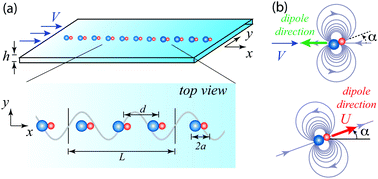
PublicationOne-dimensional crystals of passively-driven particles in microfluidic channels exhibit collective vibrational modes reminiscent of acoustic ‘phonons’. These phonons are induced by the long-range hydrodynamic interactions … -
PublicationAn important but missing component in the application of the kernel independent fast multipole method (KIFMM) is the capability for flexibly and efficiently imposing singly, doubly, and triply …
-
PublicationThe cellular cytoskeleton is an active material, driven out of equilibrium by molecular motor proteins. It is not understood how the collective behaviors of cytoskeletal networks emerge from …
-
PublicationWe explore theoretically the aerodynamics of a recently fabricated jellyfish-like flying machine (Ristroph & Childress, J. R. Soc. Interface, vol. 11 (92), 2014, 20130992). This experimental device achieves …
-
PublicationThe mitotic spindle ensures the faithful segregation of chromosomes. Here we combine the first large-scale serial electron tomography of whole mitotic spindles in early C. elegans embryos …