Skip to content
Simons Foundation
Simons Foundation
Simons Foundation
Search
  • Bringing people and ideas together to fund, conduct, and share transformative science.

    In-House Research

    • Computational Astrophysics
    • Computational Biology
    • Computational Mathematics
    • Computational Neuroscience
    • Computational Quantum Physics
    • Computational Catalysis
    All Publications

    Research We Fund

    • Autism
    • Neuroscience
    • Mathematics & Physical Sciences
    • Ecology & Evolution
    • Plant Biology

    Public Engagement

    • Grantmaking
    • Media Initiatives
    • Public Events
    • Researcher Engagement
    • National Initiatives

    Resources

    • Computational Software
    • Computational Datasets
    • SFARI Base
    All Resources

    Simons Collaborations

    • Simons Collaboration on New Frontiers in Superconductivity
    • Simons Collaboration on Ecological Neuroscience
    • Simons Collaboration on Principles of Microbial Ecosystems
    All Collaborations
  • Our grants advance knowledge and strengthen connections between science and society.

    All Funding Opportunities

    Autism & Neuroscience

    • Fellows-to-Faculty
    • New Ideas
    • SFARI Conferences & Courses Awards
    • Shenoy Undergraduate Research Fellowship in Neuroscience

    Life Sciences

    • Simons Graduate Fellowships in Ecology & Evolution
    • Simons Postdoctoral Fellowships in Plant Biology
    • Synthetic Plant Biology
    • Simons Collaborations in Ecology & Evolution

    Science, Society & Culture

    • Science in Culture
    • Science in Community
    • STEM Pathways

    Mathematics & Physical Sciences

    • Scientific Software Research Faculty Award
    • Simons Collaborations in MPS
    • Simons Dissertation Fellowship
    • Simons Fellows in Mathematics
    • Targeted Grants to Institutes
    • Targeted Grants in MPS
    • Travel Support for Mathematicians

    Shared Programs

    • Pivot Fellowship
    • Simons Society of Fellows

    Resources for Applying

    • Open Funding Opportunities
    • Policies & Procedures
    • SAM FAQ and Instructional Videos
    • Past Funded Work
  • Discover the latest news, research, and updates.

    All News

    The Latest

    • Research News
    • Funding Announcements
    • Newsletter Sign Up

    For the Media

    • Press Releases
    • Media Relations
  • We convene scientists, mathematicians, and thinkers to share ideas and explore new questions.

    All Events

    Public Events

    • Presidential Lectures
    • Presents
    Attend an Event

    Flatiron Events Our in-house research institute hosts events for scientists and researchers.

    See All

    Past Events Find videos, presentations, and resources from our past events.

    See All
  • Founded by Jim and Marilyn Simons, we’re a private philanthropy advancing mathematics and basic science.

    About Us

    About

    • Our History
    • Annual Reports
    • Brand Guidelines
    • Visitor Information
    • Media Relations
    • Contact
    About Us

    People

    • Leadership
    • Board of Trustees
    • Researchers
    All People

    Careers

    • Working Here
    • Internship Opportunities
    • Undergraduate Students
    • Graduate Students
    • Postdoctoral Opportunities
    • Research Scientists
    Open Jobs
  • Flatiron Institute
  • Careers
    Search all
  • Funding
    Search all
  • Explore opportunities for...
    • Undergraduate students
    • Graduate students
    • Postdoctoral researchers
    • Research scientists
Simons Foundation

Filters

Type

Section

Person

Show 97 more Show less
Simons Foundation
  • Find a Person

Bringing people and ideas together to fund, conduct, and share transformative science.

Our grants advance knowledge and strengthen connections between science and society.

Discover the latest news, research, and updates.

  • All News
  • Research News
  • Funding Announcements
  • Newsletter Sign Up
  • Press Releases
  • Media Relations

We convene scientists, mathematicians, and thinkers to share ideas and explore new questions.

  • Events Calendar
  • Public Events
  • Presidential Lectures
  • Presents
  • Flatiron Events
  • Past Events

Founded by Jim and Marilyn Simons, we’re a private philanthropy advancing mathematics and basic science.

Work with us on the frontier of basic science research.

  • All Open Positions
  • Undergraduate Students
  • Graduate Students
  • Postdocs
  • Research Scientists

The Flatiron Institute is a research center that uses computational science to advance fields like physics, biology, and astronomy.

  • Explore Flatiron Institute
  • People
  • Careers
  • Publications
  • Software & Data
  • Computational Astrophysics
  • Computational Biology
  • Computational Mathematics
  • Computational Neuroscience
  • Computational Quantum Physics
  • Computational Catalysis
Flatiron Institute
  • Autism
  • Neuroscience
  • Mathematics
  • Ecology & Evolution
  • Plant Biology
  • Grantmaking
  • Media Initiatives
  • Public Events
  • Researcher Engagement
  • National Initiatives
  • Computational Software
  • Computational Datasets
  • SFARI Base
  • Publications
  • Simons Collaboration on New Frontiers in Superconductivity
  • Simons Collaboration on Ecological Neuroscience
  • Simons Collaboration on Principles of Microbial Ecosystems
All Collaborations
  • Policies & Procedures
  • Instructional Videos
  • Past Funded Work
  • Undergraduate Students
  • Graduate Students
  • Postdocs
  • Research Scientists
All Funding Opportunities
  • Fellows-to-Faculty
  • New Ideas
  • SFARI Conferences & Courses Awards
  • Shenoy Undergraduate Research Fellowship in Neuroscience
Autism & Neuroscience
  • Simons Graduate Fellowships in Ecology & Evolution
  • Simons Postdoctoral Fellowships in Plant Biology
  • Synthetic Plant Biology
  • Simons Collaborations in Ecology & Evolution
Life Sciences
  • Science in Culture
  • Science in Community
  • STEM Pathways
Science, Society & Culture
  • Scientific Software Research Faculty Award
  • Simons Collaborations in MPS
  • Simons Dissertation Fellowship in Mathematics
  • Simons Fellows in Mathematics
  • Targeted Grants to Institutes
  • Targeted Grants in Mathematics & Physical Sciences
  • Travel Support for Mathematicians
Mathematics & Physical Sciences
  • Pivot Fellowship
  • Simons Society of Fellows
  • Our History
  • Annual Reports
  • Visitor Information
  • Media Relations
  • Contact Us
About Us
  • Leadership
  • Board of Trustees
  • Researchers
Search All People
  • Working Here
  • Internship Opportunities
  • Undergraduate Students
  • Graduate Students
  • Postdoctoral Students
  • Research Scientists
All Open Positions

Centers

  • Computational Astrophysics
  • Computational Biology
  • Computational Mathematics
  • Computational Neuroscience
  • Computational Quantum Physics
  • Scientific Computing Core
  • Initiative for Computational Catalysis

Collaborative Projects

  • Foundation Models of Science
  • Simons Observatory
Flatiron Institute

Search

What are you looking for?

Filter Results

Search

What are you looking for?

Results update as you type and when you change filters.

Skip to results

Filters

Type

Section

Person

Show 97 more Show less

Filters

Featured

Dissecting mechanisms of hyperarousal in autism and related disorders using the Simons Sleep Project

Funded Work

Gravity Follows Newton’s and Einstein’s Rules, Even at Cosmic Scales

April 15, 2026

Scientists Capture Superconductivity’s ‘Dancing Pairs’ for First Time, Filling Gap in Decades-Old Theory

April 15, 2026

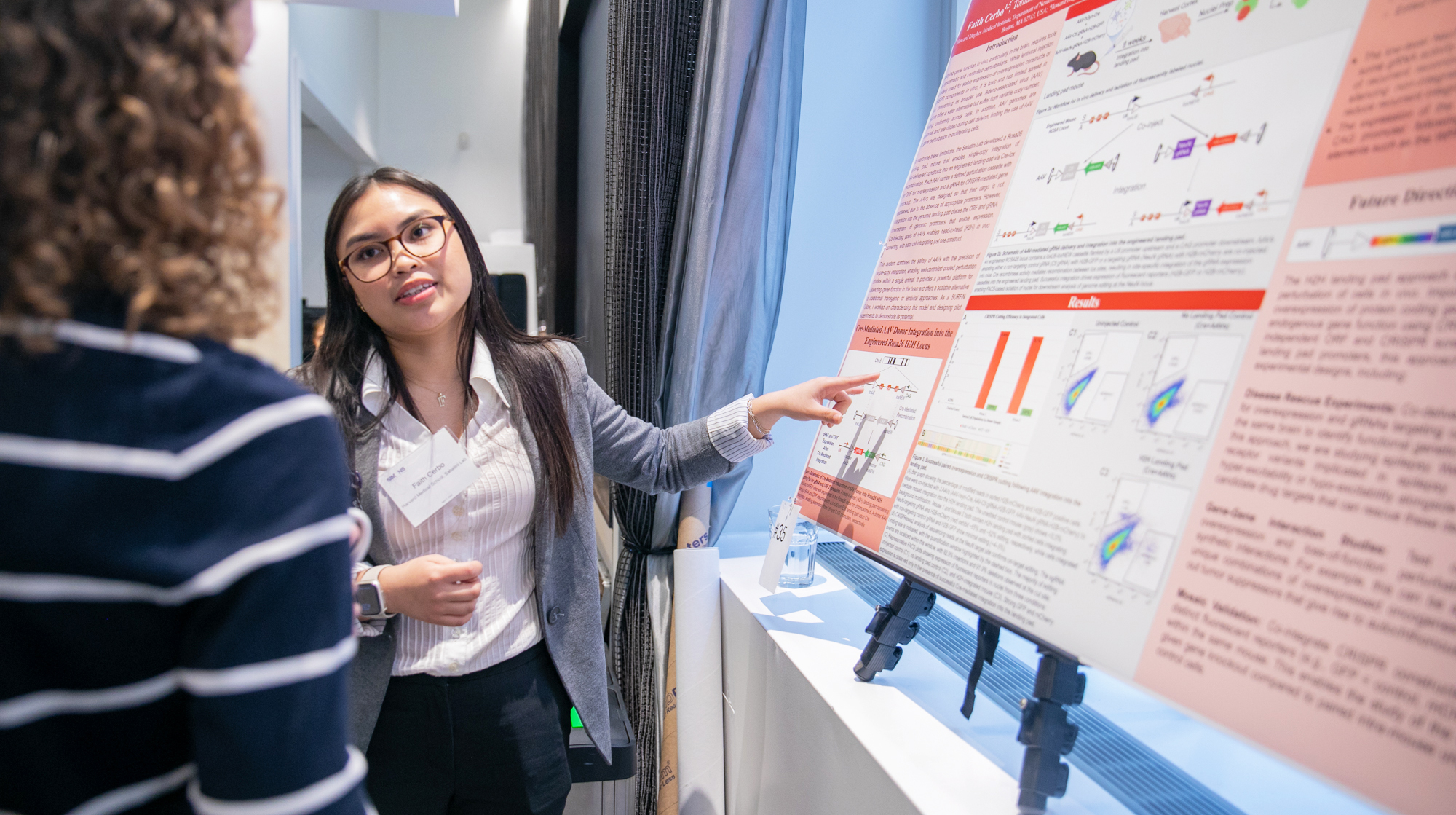
How SURFiN Fellowships Jump-Started These 3 Neuroscience Students’ STEM Careers

March 18, 2026

Topology and Complexity

November 19, 2014

Results

  1. One Latent to Fit Them All: A Unified Representation of Baryonic Feedback on Matter Distribution

    Publication
    Accurate and parsimonious quantification of baryonic feedback on matter distribution is of crucial importance for understanding both cosmology and galaxy formation from observational data. This is, however, challenging …
  2. Field-level emulation of cosmic structure formation with cosmology and redshift dependence

    Publication
    We present a field-level emulator for large-scale structure, capturing the cosmology dependence and the time evolution of cosmic structure formation. The emulator maps linear displacement fields …
  3. Differentiable Cosmological Simulation with the Adjoint Method

    Publication
    Rapid advances in deep learning have brought not only myriad powerful neural networks, but also breakthroughs that benefit established scientific research. In particular, automatic differentiation (AD) tools and …
  4. Particle Clustering in Turbulence: Prediction of Spatial and Statistical Properties with Deep Learning

    Publication
    We investigate the utility of deep learning for modeling the clustering of particles that are aerodynamically coupled to turbulent fluids. Using a Lagrangian particle module within the Athena …
  5. pmwd: A Differentiable Cosmological Particle-Mesh N-body Library

    Publication
    The formation of the large-scale structure, the evolution and distribution of galaxies, quasars, and dark matter on cosmological scales, requires numerical simulations. Differentiable simulations provide gradients of …
  6. Differentiable Cosmological Simulation with Adjoint Method

    Publication
    Rapid advances in deep learning have brought not only myriad powerful neural networks, but also breakthroughs that benefit established scientific research. In particular, automatic differentiation (AD) tools and …
  7. Simple lessons from complex learning: what a neural network model learns about cosmic structure formation

    Publication
    We train a neural network model to predict the full phase space evolution of cosmological N-body simulations. Its success implies that the neural network model is accurately …
  8. Field Level Neural Network Emulator for Cosmological N-body Simulations

    Publication
    We build a field level emulator for cosmic structure formation that is accurate in the nonlinear regime. Our emulator consists of two convolutional neural networks trained to output …
  9. AI-assisted superresolution cosmological simulations – II. Halo substructures, velocities, and higher order statistics

    Publication
    In this work, we expand and test the capabilities of our recently developed super-resolution (SR) model to generate high-resolution (HR) realizations of the full phase-space …
  10. AI-assisted super-resolution cosmological simulations

    Publication
    Cosmological simulations of galaxy formation are limited by finite computational resources. We draw from the ongoing rapid advances in Artificial Intelligence (specifically Deep Learning) to address this problem …
  11. AI-assisted superresolution cosmological simulations

    Publication
    Cosmological simulations of galaxy formation are limited by finite computational resources. We draw from the ongoing rapid advances in Artificial Intelligence (specifically Deep Learning) to address this problem …
  12. AI-assisted super-resolution cosmological simulations II: Halo substructures, velocities and higher order statistics

    Publication
  13. Learning the Evolution of the Universe in N-body Simulations

    Publication
    Understanding the physics of large cosmological surveys down to small (nonlinear) scales will significantly improve our knowledge of the Universe. Large N-body simulations have been built to …
  14. Fast and Accurate Non-Linear Predictions of Universes with Deep Learning

    Publication
    Cosmologists aim to model the evolution of initially low amplitude Gaussian density fluctuations into the highly non-linear "cosmic web" of galaxies and clusters. They aim to compare …
  15. Constraining the Halo Mass of Damped Lyα Absorption Systems (DLAs) at z=2-3.5 using the Quasar-CMB Lensing Cross-correlation

    Publication
    We study the cross correlation of damped Ly\(alpha\) systems (DLAs) and their background quasars, using the most updated DLA catalog and the Planck 2018 CMB lensing convergence …
  16. The CAMELS project: Cosmology and Astrophysics with MachinE Learning Simulations

    Publication
    We present the Cosmology and Astrophysics with MachinE Learning Simulations --CAMELS-- project. CAMELS is a suite of 4,233 cosmological simulations of …
  17. The Quijote Simulations

    Publication
    The Quijote simulations are a set of 44,100 full N-body simulations spanning more than 7000 cosmological models in the …
  18. Measurement of Void Bias Using Separate Universe Simulations

    Publication
    Cosmic voids are biased tracers of the large-scale structure of the universe. Separate universe simulations (SUS) enable accurate measurements of this biasing relation by implementing the peak …
  19. Cosmological simulation in tides: power spectrum and halo shape responses, and shape assembly bias

    Publication
    The well-developed separate universe technique enables accurate calibration of the response of any observable to an isotropic long-wavelength density fluctuation. The large-scale environment also hosts …
  20. Rotation method for accelerating multiple-spherical Bessel function integrals against a numerical source function

    Publication
    A common problem in cosmology is to integrate the product of two or more spherical Bessel functions (sBFs) with different configuration-space arguments against the power spectrum or …

About

  • About Us
  • History
  • Annual Reports
  • People
  • Visitor Information
  • Careers

Funding

  • Funding Opportunities
  • Funded Work
  • Simons Award Manager
  • Simons Foundation International
  • Policies & Procedures

Program Areas

  • Life Sciences
  • Autism & Neuroscience
  • Mathematics & Physical Sciences
  • Science, Society & Culture

Connect

  • Newsletters
  • Events
  • Contact us
  • Media Relations
  • Terms & Conditions
  • Privacy Policy
Simons Foundation
Bluesky Facebook Instagram YouTube X RSS Feed

Advancing Research in Basic 
Science and Mathematics

Customize your preferences

Your preferences have been saved.

Confirm your subscription by clicking the link in the email we sent.