Simons Foundation Hosts Pivot Fellowship Annual Meeting
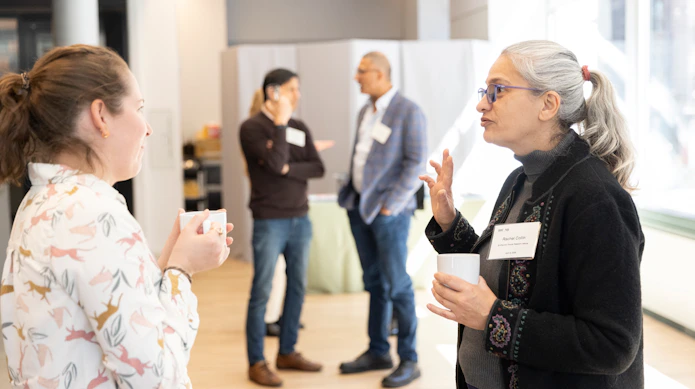
The Simons Foundation’s Pivot Fellowship program held its annual meeting on April 8, 2026. Simons Foundation President David Spergel opened the meeting, highlighting the foundation’s mission and the need for more truly transformative science, which the Pivot Fellowships aim to support. He commended the bravery and curiosity of the fellows and their mentors for immersing themselves in new fields and blurring the boundaries between disciplines. Alyssa Picchini Schaffer, the Simons Foundation’s vice president for neuroscience collaborations, welcomed attendees and invited introductions from those who would not be speaking.
Knocking on the Quantum Door: Towards a Predictive Theory of Universality
Axel Saenz Rodriguez, Assistant Professor, Oregon State University
Introduced by Eric Corwin, Professor, University of Oregon, and Oksana Ostroverkhov, Professor, Oregon State University
Axel Saenz Rodriguez was introduced by his Pivot mentors, physicists Oksana Ostroverkhov and Eric Corwin. Ostroverkhov works on interdisciplinary projects involving organic materials and two-dimensional quantum materials, while Corwin studies problems in statistical and condensed matter physics, with a focus on glass and jamming transitions and extreme diffusion. They explained that the field of spintronics uses the spin of electrons to transmit information. Magnonics, a subfield, uses spin waves. Spin-wave-based devices don’t generate heat and could enable ultrafast devices, but they are limited by spin waves’ quick decay. Two-dimensional quantum magnetic materials may let spin waves travel farther, and Saenz Rodriguez’s fellowship focused on developing quantum field theory to predict the properties of these materials.
Saenz Rodriguez described how, before pivoting to computational and experimental condensed matter physics, he used pure mathematics to analyze complex systems. Then he explained the need for new materials to enable next-generation computing technologies. With complementary metal-oxide semiconductors, the scaling down of these technologies is approaching its limit, as heat transfer becomes too damaging and costly to control. Quantum materials, which could offer faster processing, no resistive heating and stable memory, are a potential solution. However, theoretic descriptions are needed to guide material design, and because the complexity of quantum systems grows exponentially as their size increases, they are extremely difficult to simulate.
Saenz Rodriguez aims to address this problem with theories that take advantage of universality and emergence. His approach is to develop universal theories that describe quantum phenomena by distilling systems to their essential features, building toy models, analyzing emerging phenomena and using the model to make experimental predictions. He has studied how applying a magnet field changes spin waves in chromium sulfur bromide, a two-dimensional magnetic semiconductor, when it is excited with light. By building a toy model of the material, he derived a formula that predicts how spin wave frequencies change with the strength of the magnetic field.
From Matter Waves to Waves That Matter: Using Quantum Ideas to Characterize Atmospheric Waves
Alan Dorsey, Professor, University of Georgia
Introduced by Brad Marston, Professor, Brown University
Physicist Brad Marston described his current work, including a plasma experiment and a climate mitigation project. He explained how the mathematics of topology connect the Hall effect, in which a magnetic field reflects electrical current, with coastal Kelvin waves, with both exhibiting the same kind of edge-wave physics. Then he introduced his mentee, Alan Dorsey.
Dorsey described the curiosity and desire to address societal problems that drove him to pivot from theoretical condensed matter into geophysical fluid dynamics and climate science. He explained how the math, minimal modeling and computation that he used in his past work are relevant to atmospheric and oceanic problems.
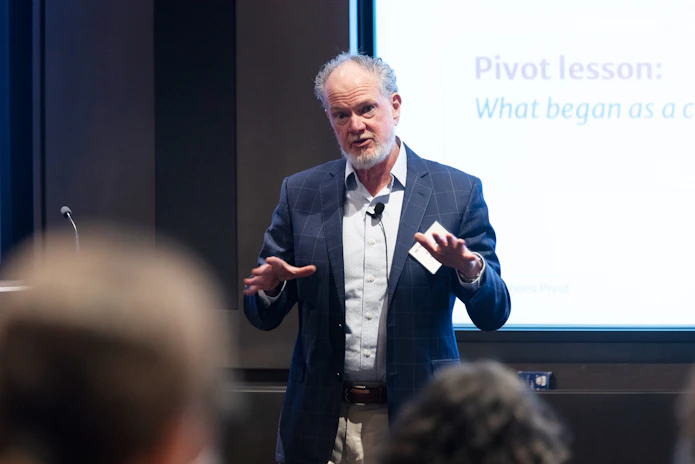
Dorsey then introduced the importance of equatorial waves, which are central to climate phenomena like the Madden–Julian oscillation and the quasi-biennial oscillation. He explained that the equator acts as a waveguide because Earth’s Coriolis force vanishes there. He has studied these waves using the rotating shallow‑water model, a simplified description of a thin fluid layer on a rotating planet. He explained that its equations can be represented as a three‑band problem with two inertia gravity wave bands and a geostrophic band, likening this to the band structure for a spin-1 particle.
The wave modes have topological properties similar to those seen in quantum Hall systems. According to the bulk edge correspondence, they are expected to have edge modes similar to skipping orbits around the edge of a quantum Hall bar. This framework predicts robust edge waves corresponding to Kelvin and Yanai waves trapped near the equator. Dorsey also highlighted ongoing work on quantum geometry of these bands and Rossby wave packets, as well as plans to connect his theoretical insights to atmospheric data.
Seeing Coastal Ecosystems Through Data: Toward a Quantitative Taxonomy of Coastal Ecosystems
Wally Fulweiler, Professor, Boston University
Introduced by Mark Crovella, Professor, Boston University
Computer and data scientist Mark Crovella described his work, which currently focuses on understanding the internals and alignment of language models to improve their safety and controllability. He highlighted the interdisciplinary nature of Boston University’s Computing & Data Sciences unit and then introduced his Pivot mentee, Wally Fulweiler, and their work together using data‑driven methods to build a new taxonomy of coastal ecosystems.
Fulweiler began her talk with examples of how new methods of classification have deepened understanding throughout the history of science. She then introduced the importance of coastal ecosystems, emphasizing that they are powerful hotspots for carbon storage, nitrogen cycling and nutrient filtration. Coastal ecosystems are currently classified largely according to their physical or geological features, which can be ambiguously defined. Fulweiler argued that these classifications have little correlation these ecosystems’ effects on global greenhouse gases or nutrient availability, which can vary significantly.
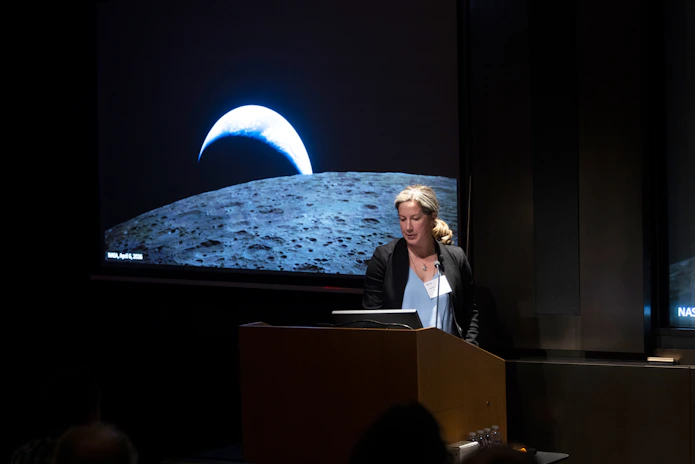
Using data from the National Estuarine Research Reserve System, Fulweiler and colleagues used water quality variables such as inorganic nitrogen and phosphorous, nitrogen to phosphorus ratios, and chlorophyll concentrations to cluster 122 sites in 29 estuaries. They found that the sites fell into four distinct biogeochemical groups. These groups are not geographically distinct and do not align with current classifications, providing a novel way to understand coastal ecosystems.
Fulweiler also discussed efforts to improve data extraction and allow more efficient data synthesis for improved understanding with an open pipeline that extracts data from PDFs and similar documents. She described how she and her colleagues have used open-source and open-weight large language models to reduce hallucinations and generate confidence scores, emphasizing her team’s commitment to making science more accessible.
ImmunoAI: Exploring How the Adaptive Immune System Solves Fundamental Machine Learning Problems
Saket Navlakha, Associate Professor, Cold Spring Harbor Laboratory
Introduced by Hannah Meyer, Assistant Professor, Cold Spring Harbor Laboratory
Biologist Hannah Meyer described her background in molecular and computational biology and her current work investigating how the thymus teaches T cells to tolerate the body’s own tissues. She described the challenge that T cells face in learning to discriminate self from non-self based on the limited set of peptides they are exposed to in the thymus, likening this to discrimination and generalization tasks that are commonly handled by AI, and introduced the work of her mentee, Saket Navlakha.
Navlakha described the adaptive immune system as a machine learning system that needs to discriminate self versus non-self, use memory of past infections to avoid future infections and continually learn to detect evolving pathogens. During his Pivot fellowship, he applied machine learning frameworks to learn about how T cells avoid attacking healthy cells. He described how T cell receptors interact with peptides displayed on MHC molecules and how T cells that react to self peptides are eliminated in the thymus. He estimated that there are about 425,000 MHC-binding self peptides in the body and each T cell encounters only about 20,000 to 200,000 of these during its training period in the thymus, so generalization is required to avoid autoimmunity.
Framing this as the kind of generalization task faced by many machine learning algorithms, he explained two conditions that make generalization possible. First, Navlakha and colleagues found good correlation between the peptides T cells see in the thymus and the peptides that exist in the periphery, with respect to identity and abundance. Second, he showed how cross reactivity of T cell receptors, which allows a T cell to recognize a cluster of similar peptides, allows for the elimination of self-reactive T cells even when the self peptide and the T cell receptor are not an exact match. His modeling indicates that exposing T cells to 5 to 15 percent of the peptides in the thymus during training can reduce autoimmunity damage in the periphery by almost 90 percent. Navlakha showed how the model can be used to predict targets of autoimmune disease.
Econophysiology
Suckjoon Jun, Professor, University of California, San Diego
Introduced by Alberto Bisin, Professor, New York University
Economist Alberto Bisin explained his background in mathematical economics and equilibrium dynamics, highlighting how he has used models to understand the role of prices in a competitive economy. Much of his works intersects with other fields such as political science, sociology, anthropology and biology, including modeling the dynamics of culture and institutions. He introduced his mentee, Suckjoon Jun, acknowledging that working together required the two to overcome the challenges of collaborating across disciplines, including differences in culture and technical language.
Jun, a physicist and quantitative biologist, explained how he became interested in economics after noticing parallels between classic economic theory and physiologists’ observations about resource allocation in cells. His Pivot project aimed to explore this relationship more deeply and establish whether analytic methods used in economics can be applied to biological systems. Jun described economics as dealing with decision-making processes under constraints, and illustrated how economic theory can explain counterintuitive outcomes. He pointed out that cells, like agents in economic systems, must make choices under scarcity.
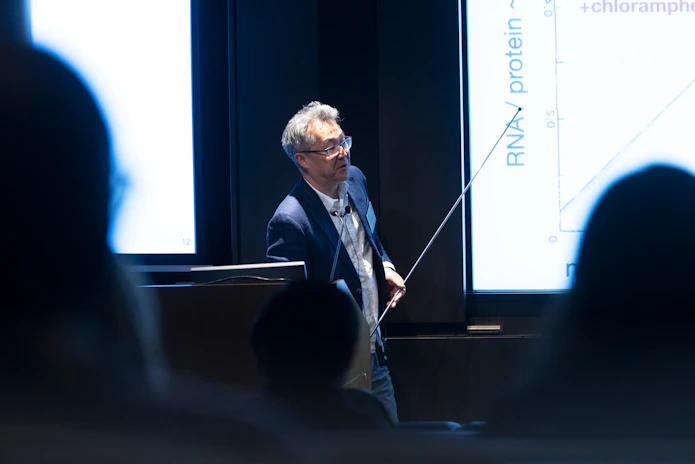
From Subjective Feelings to Brain Mechanisms: Drawing Lessons from Temperature to Advance the Science of Mood
Nicole Rust, Professor, University of Pennsylvania
Introduced by Yael Niv, Professor, Princeton University
Nicole Rust was introduced by her Pivot mentor, neuroscientist Yael Niv, who discussed the lack of quantitative diagnostic tools for psychiatry and how computational cognitive neuroscience is useful for understanding mental health conditions and improving the ways they are treated. Niv explained how she transitioned her lab from studying learning and decision making to using computational modeling to study mental health, highlighting her team’s work investigating mood.
Rust, a electrophysiologist who has studied vision and memory in nonhuman primates, has pivoted toward research more directly aimed at treating psychiatric conditions. She is focusing on the challenge of understanding mood. She described mood as a continuous feeling that represents a running average of good and bad experiences and modulates motivation and decision making. She explained the challenge in studying subjective experience and the lack of methods for reliably measuring mood in humans or animals. Relating the way 16th-century scientists began trying to measure temperature, she proposed that epistemic iteration — a process in which imperfect measures are iteratively refined — is needed to break through a fundamental problem: Measurements are needed to gain understanding of mood, but mood is not understood well enough to know how to measure it.
Rust is using a cross-species approach to figure out how to measure mood in the brain. Beginning with subjective reports collected while humans play a gambling game, she is building models of how mood is shaped by players’ wins and losses. She uses this model to estimate monkeys’ moods as they play the same game. As expected, animals are more likely to take risks in the game when their estimated happiness is high. By monitoring neuronal activity, Rust has identified neurons whose activity correlates with estimated happiness in the insula of the monkeys’ brains, a region previously linked to mood in humans. She suggests that activation in this part of the brain is a mood thermometer, which her team is using to build a dynamical systems model of how mood works in the brain.
Dust, Porosity and Planet Formation: A Pivot From Materials Science to Astrophysics
Linus Labik, Professor, Kwame Nkrumah University of Science and Technology
Introduced by Melvin Hoare, Professor, University of Leeds
Astrophysicist Melvin Hoare spoke about how he uses radio telescopes to study how stars form from collapsed clouds of gas and dust. He explained how the size and wavelength of the Square Kilometer Array, a large radio telescope being built in Africa, will make it possible to image protoplanetary disks and study how planets form. Hoare, who leads the Development in Africa with Radio Astronomy project, which is training radio astronomers in eight African countries, then introduced his Pivot mentee, Linus Labik.
Labik began by explaining how cosmology is thought about in Ghanaian culture and his transition into astrophysics from materials science, where he studied porous minerals called zeolites. His work seeks to explain how the dust in protoplanetary disks overcomes physical barriers to form planets. He explained that submicron dust grains orbiting a young star stick to one another through van der Waals forces, but as aggregates get bigger, several barriers limit their growth. Once they reach millimeter and centimeter sizes, collisions cause grains to rebound instead of stick (the bouncing barrier). Once grains reach 10 to 30 centimeters, collisions tend to break aggregates apart (the fragmentation barrier). And as dust aggregates grow larger, they decouple from the gas that orbits a star, spiraling inward (the radial drift barrier).
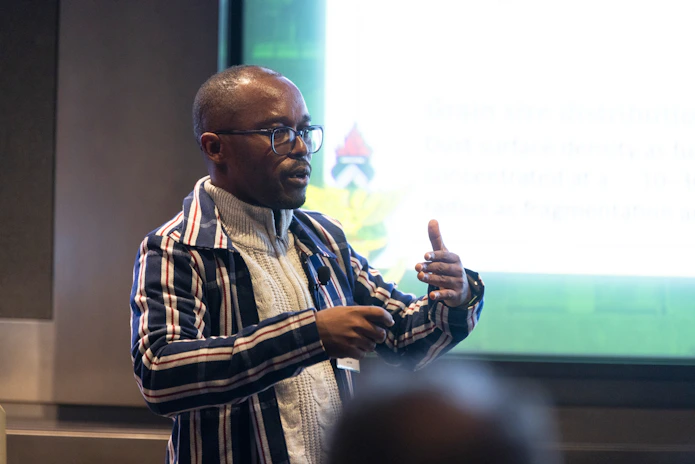
Dust grains’ ability to overcome these barriers is impacted by their porosity, which Labik argued is oversimplified in many astrophysical models. It is typically treated as fixed, when instead it must evolve dynamically as grains collide, compress, and fragment. Using tools like DustPy, MCFOST and CASA, Labik modeled the microphysics of dust particles and simulated how this process would be observed through light telescope arrays. He showed how this modeling identifies the fragmentation barrier. In newer models, he is incorporating dynamic changes in porosity, in which porosity, grain size, velocity and collision outcomes feed back on each other. He will use data from the Square Kilometer Array to refine these models for a better understanding of planet formation.
A Martian('s) View of Interstellar Objects in Our Solar System
James Wray, Professor, Georgia Institute of Technology
Introduced by Karen Meech, Astronomer, University of Hawaii
Astrobiologist Karen Meech, who has studied comets in our solar system, explained how these bodies can reveal insights into how solar systems form. She highlighted the value of interdisciplinary work in astrobiology, citing the discovery of high boron levels on Mars and plans to investigate the origins of Earth’s water, before introducing her Pivot mentee, James Wray.
Wray described his pivot from studying mineralogy on the surface of Mars to studying interstellar objects. He highlighted how studying bodies outside our solar system could offer insight into the physics and chemistry of planet formation, and the opportunity presented by the recent discovery of the first interstellar objects passing through our solar system. He explained features that set the first two interstellar objects, 1I/‘Oumuamua and 2I/Borisov, apart from solar system comets, such as shape and chemical composition.
A third interstellar object, 3I/ATLAS, was discovered during Wray’s Pivot fellowship. He contributed to early work analyzing the object’s orbit and noted that its high velocity might indicate that the object is unusually old. He described his spectroscopic characterization of 3I/ATLAS using data from telescopes on earth. These showed that 3I/ATLAS is redder than previous interstellar objects and highly enriched in carbon dioxide and certain metals. Its isotope ratios are outside the range seen in solar system comets.
Wray and colleagues obtained four higher resolution images of 3I/ATLAS from the HiRISE telescope on Mars Reconnaissance Orbiter, with the goal of discerning the size of the comet’s nucleus and tracking variations in its brightness. Reconstruction of the images to correct for spacecraft jitter is underway. Other Mars-orbiting spacecraft have contributed additional data, including imaging and measurements of water production. Wray concluded by highlighting the value of coordinating multi‑mission responses for transient targets and noting future plans for studies of 3I/ATLAS, 2I/Borisov, and still-to-be-discovered interstellar objects.


