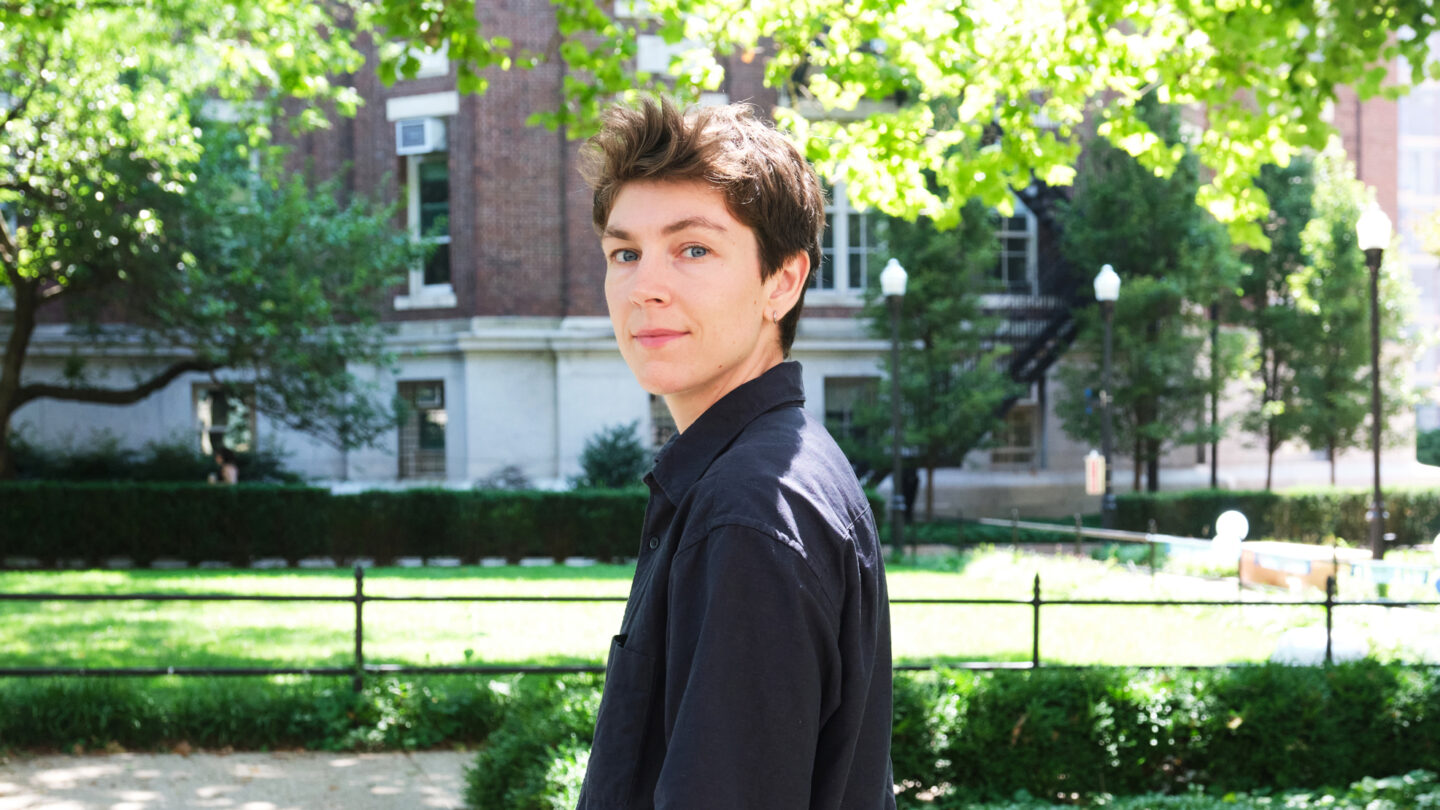
Tim Austin, associate professor of mathematics at New York University’s Courant Institute of Mathematical Sciences, conducts research on analysis, probability and ergodic theory. He is currently one of fourteen principal investigators in the Simons Collaboration on Algorithms and Geometry, a collaboration that aims to bring mathematicians and theoretical computer scientists together to address fundamental questions at the interface of their disciplines.
Austin, who received his undergraduate degree in mathematics from the University of Cambridge and his Ph.D. from the University of California, Los Angeles, works most deeply in ergodic theory, a branch of dynamical systems research relating to theoretical probability and geometry. “I’m very much a pure mathematician,” he says. “I like to think about questions and structures in math for their own sake.”
Austin’s recent results have related to classifying highly abstract dynamical systems. “In ergodic theory, a central challenge is to classify such systems. This can seem hopeless because the systems are far too broad, and there are too many of them. But you can make some kind of partial classification.”
There is a family of such systems that arise out of models of random walks in random sceneries, but it has been largely unknown whether any two systems were equivalent, meaning that one could be simulated using the other. One thing Austin works on is finding ways of proving that some systems are non-equivalent by identifying characteristic features that must be the same if the two systems were truly equivalent.
“I think that my role as a pure mathematician in the Simons Collaboration on Algorithms and Geometry is to try and understand what kinds of questions and phenomena computer scientists care about, and to see whether anything I know is similar to their work and might be applicable to it,” Austin says.
“This is the first time I’ve tried to branch seriously into things that aren’t just pure math. In the end, this collaboration might make my work more important to a non-scientific audience. It’s not clear how it’s going to go yet, but it would be very exciting to find another area of science where I actually have something to say.”