Bringing people and ideas together to fund, conduct, and share transformative science.
Our grants advance knowledge and strengthen connections between science and society.
Discover the latest news, research, and updates.
We convene scientists, mathematicians, and thinkers to share ideas and explore new questions.
Founded by Jim and Marilyn Simons, we’re a private philanthropy advancing mathematics and basic science.
Work with us on the frontier of basic science research.
The Flatiron Institute is a research center that uses computational science to advance fields like physics, biology, and astronomy.
Search
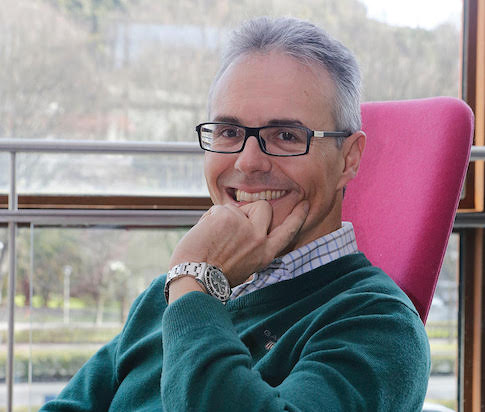
The Simons Foundation is pleased to announce the appointment of Angel Rubio as distinguished research scientist at the Center for Computational Quantum Physics (CCQ) at the foundation’s Flatiron Institute.
Rubio is managing director of the Max Planck Institute for the Structure and Dynamics of Matter in Hamburg, Germany, and director of its theory department. He is distinguished professor of physics at the University of the Basque Country in San Sebastián, Spain, and professor of physics at the University of Hamburg. He is one of the founders of the European Theoretical Spectroscopy Facility and originator of the widely used ab initio open-source project, Octopus.
His work has been recognized by numerous fellowships and awards, including the 2016 Medal of the Spanish Royal Physical Society, the 2014 Premio Rey Jaime I Prize for Basic Research, the 2006 DuPont Prize in Nanotechnology, the 2005 Friedrich Wilhelm Bessel Research Award of the Humboldt Foundation and two European Research Council Advanced Grants in 2011 and 2016. He is a fellow of the American Physical Society (2004), the American Association for Advancement of Science (AAAS) (2010), a member of the Academia Europaea (2016) and, since 2014, a foreign associate member of the U.S. National Academy of Sciences.
Rubio will spend part of the year at the Flatiron Institute, collaborating on research on the electronic, structural and non-equilibrium dynamical properties of quantum many-body systems, and helping to develop the scientific agenda of the CCQ.
Updated October 6, 2017, to better reflect the time Rubio will spend at the Flatiron Institute

