What does it mean to compute something? Fingers play the calculator keys; humming servers plow through algorithms. To compute is to calculate, to generate a solution, to predict an outcome from a distilled set of variables determined to be meaningful to the problem. We can compute the path of a comet, the metabolism of a drug, and traffic patterns through a city. But what about the development of an organism, from an egg to an embryo to a full-fledged organism? Does development lend itself to computation?
This was the question posed by the eminent developmental biologist Lewis Wolpert in a 1994 essay in Science magazine. “Will the egg be computable?” he wrote. And this is the question driving the research in the newly formed developmental dynamics group within the Flatiron Institute’s Center for Computational Biology. Embryonic development is reproducible, within and across many species, and the patterns we see are the result of algorithms, says Stanislav Shvartsman, who leads the group. In the same way astronomers use the initial conditions of the Big Bang to predict the emergence of large-scale structures in the universe, developmental biologists should, in theory, be able to use the initial conditions of an embryo to predict how an organism might look. “Maybe not the precise position of every hair follicle, but at least the beginning of the emergence of complexity,” says Shvartsman.
Computing development requires vast amounts of data, made possible by high-throughput genomic and imaging studies in model organisms with developmental trajectories similar to those of humans. Focusing on the fruit fly, Shvartsman’s group not only observes embryos as they develop, but also perturbs them. “Directed perturbations allow us to study specific things. These perturbations sometimes happen in nature, when something goes wrong and leads to a developmental problem,” says Shvartsman.
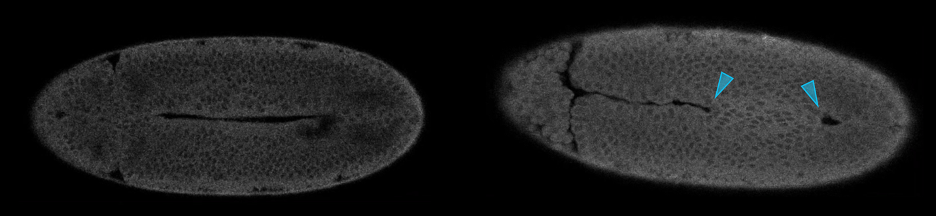
Sarah McFann, a doctoral student in Shvartsman’s group at Princeton University, uses targeted blue light to perturb fruit fly embryos undergoing gastrulation, in which lava-like flows of cells cover the embryo surface as furrows and indentations begin to section off the locations of the head, gut and muscles. “It’s a critical time because it’s so complicated,” says Shvartsman. McFann uses the blue light to manipulate the signaling of a molecule critical to development, extracellular signaling kinase (ERK), turning it on and off. “Mutations in the ERK signaling pathway cause abnormal development and cancers, but we don’t know the mechanism, that is, how small changes on the molecule level cascade into large effects on the organism level,” says McFann. “Manipulating the signaling helps us understand when and where a mutant ERK signal would cause the most damage.”