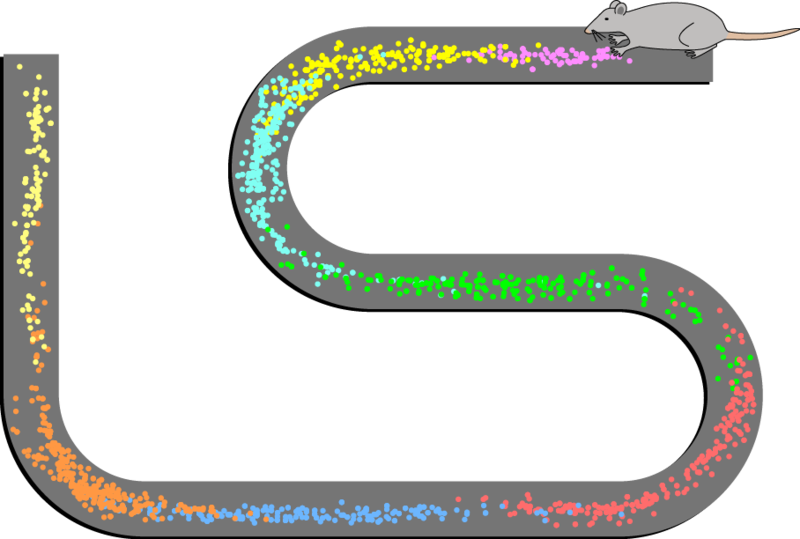
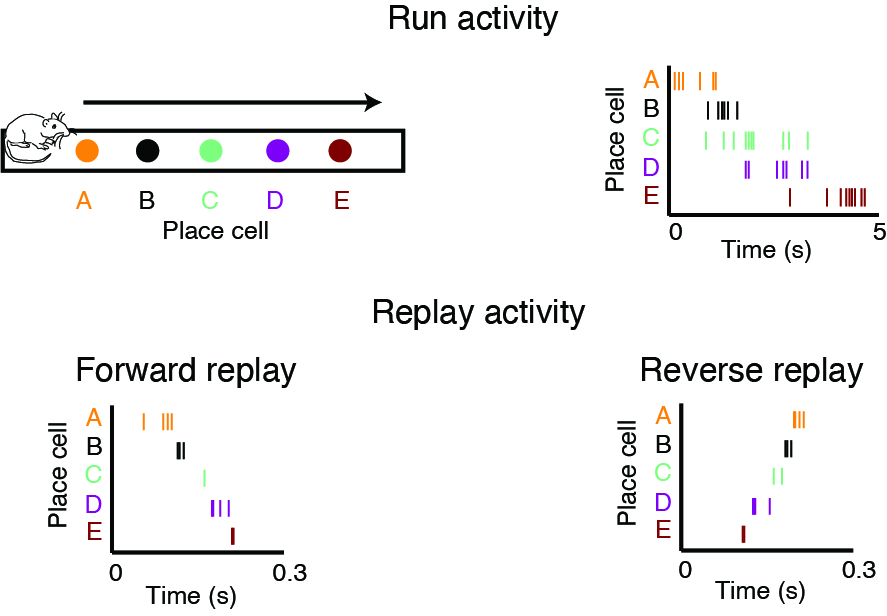
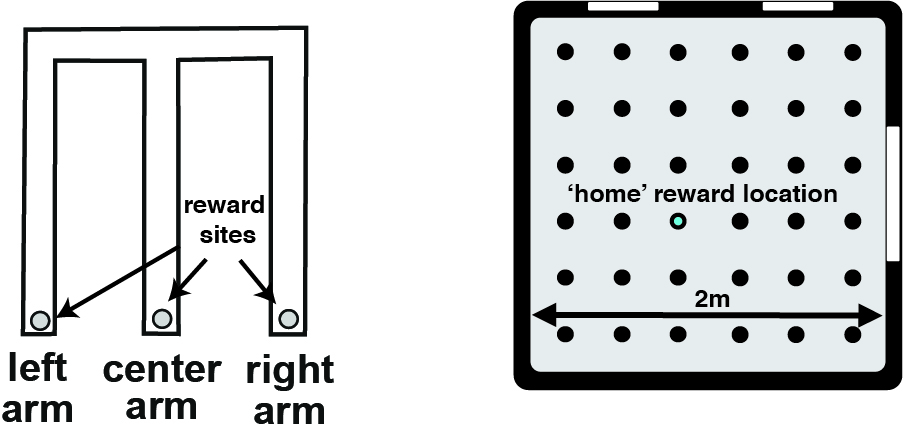
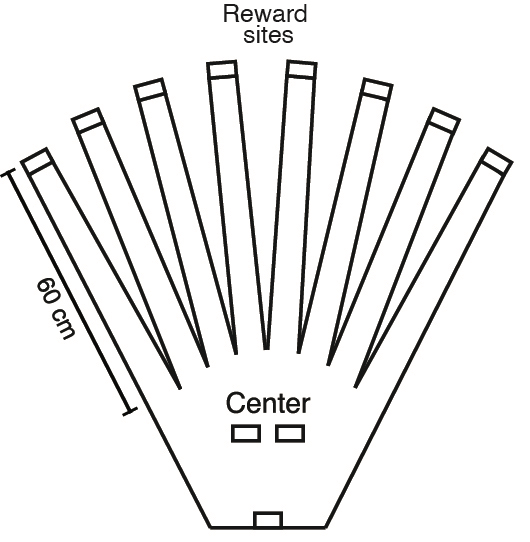
Rats had to learn and remember which one of eight arms in the maze offered a reward and continue to visit this arm to receive a reward. After a series of successive rewards, the goal arm changed and the rat needed to begin searching again. This allowed researchers to link replay events with locations the rat had just visited or was about to visit and to multiple locations where the reward had been reliably delivered in the recent past.
To their surprise, Gillespie’s results offered little to support a role for replay in planning immediate future trajectories: Replay events before navigation were unreliably related to the animal’s forthcoming movement. Instead, replay events were more likely to represent trajectories that had been reliably rewarded in the recent and slightly distant past. As the rat more reliably navigated toward a newly rewarded arm, replay events of this new reliable reward site became more common.
But before the rat reliably learned the new reward location, and even well after the new location was learned, the most common replay event reflected the route to the previous reliably rewarded arm, strongly supporting replay’s role in memory, not planning. “Replay toward the previous reward location continued for 10 to 20 trials, even though the animal was absolutely doing something else,” says Frank.
“It was really striking to us that this is what replay was representing because [the previously rewarded goal arm] is not a location that would be useful in terms of optimizing the rat’s future behavior,” Gillespie says. “You can imagine, in more of an ethological setting, storing representations of places that have historically been useful might be a good thing to do.”
What comes next?
Gillespie’s results are surprising and strongly call into question replay’s role in planning immediate future navigation. Instead, the results support a view that replay constantly ‘refreshes’ the memories of important recently visited locations so that new experiences don’t immediately overwrite them. However, this does not mean that replay has no role in upcoming behaviors.
“We think that the reason replay can be useful for memory-guided behavior is because it’s providing you with a well-stored representation of what happened in the past that can later be used,” says Gillespie. In other words, a well-maintained memory of past events will almost certainly be helpful for guiding future actions, even if the memory and the plan for the future do not involve the same neural activity.
Although Gillespie’s results strongly favor memory, further research is needed to sort through some remaining discrepancies. For example, Pfeiffer found that replay supported planning during so-called ‘error trials,’ when the rat did not immediately navigate to the reliable reward location, which diverges from Gillespie’s findings. “Even when the rat, in theory, wants to go back to the home site, if the replay goes somewhere else the rat is more likely to follow that replay,” says Pfeiffer. However, Pfeiffer acknowledges that more direct evidence is necessary. “Whether it is because replay events actually guided the rat back or because the replay event just took the quickest path back and that’s what the rat did, we can’t show causality there,” he says.
For Frank, these results can be explained in light of Gillespie’s results but require further investigation to be sure. “Maybe what replay is doing is reactivating some previous goal location, in the case of these error trials,” perhaps biasing the animal’s movements toward these old reward locations, says Frank. “But we think that the reactivation itself is not the planning process, it’s a map updating process. And to be clear, that’s our working hypothesis, but we have not demonstrated that yet.”
An alternative possibility is that replay’s function switches between memory and planning, depending on the task. “It wouldn’t surprise me if both memory and planning are possible, and, depending on the specific requirements for the rat, there might be a slight bias for one or the other,” says Pfeiffer. Buzsáki acknowledges that Gillespie’s paradigm favors past replay events, but he says that future experiments are necessary to fully understand their function. “We can’t deny that in other situations, there are other replays,” says Buzsáki, referring to work such as his own and Pfeiffer’s that doesn’t fully agree with Gillespie’s findings. “If I learned anything over the years about the hippocampus, it is this: A minor change to the experimental design can bring about enormous changes in the hippocampus. And we don’t always understand what that minor change is.”