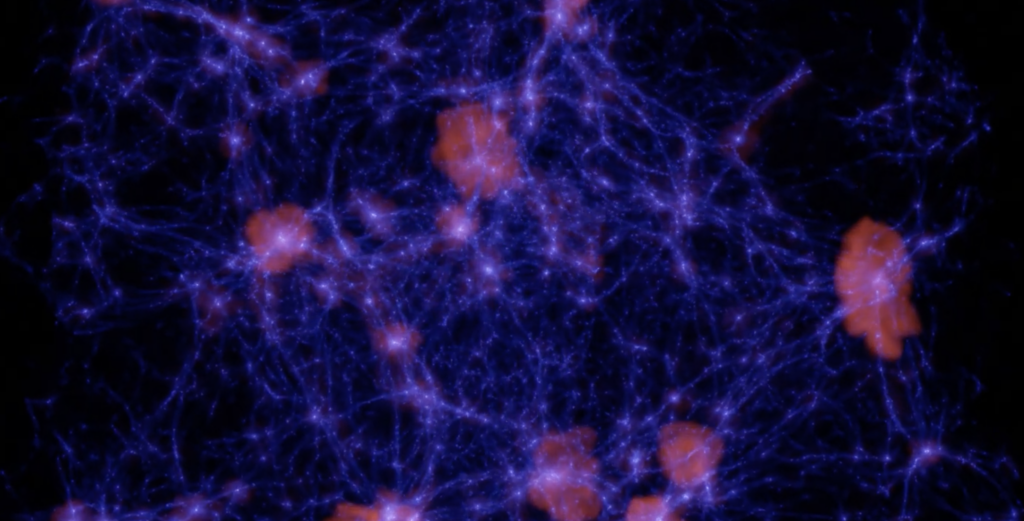
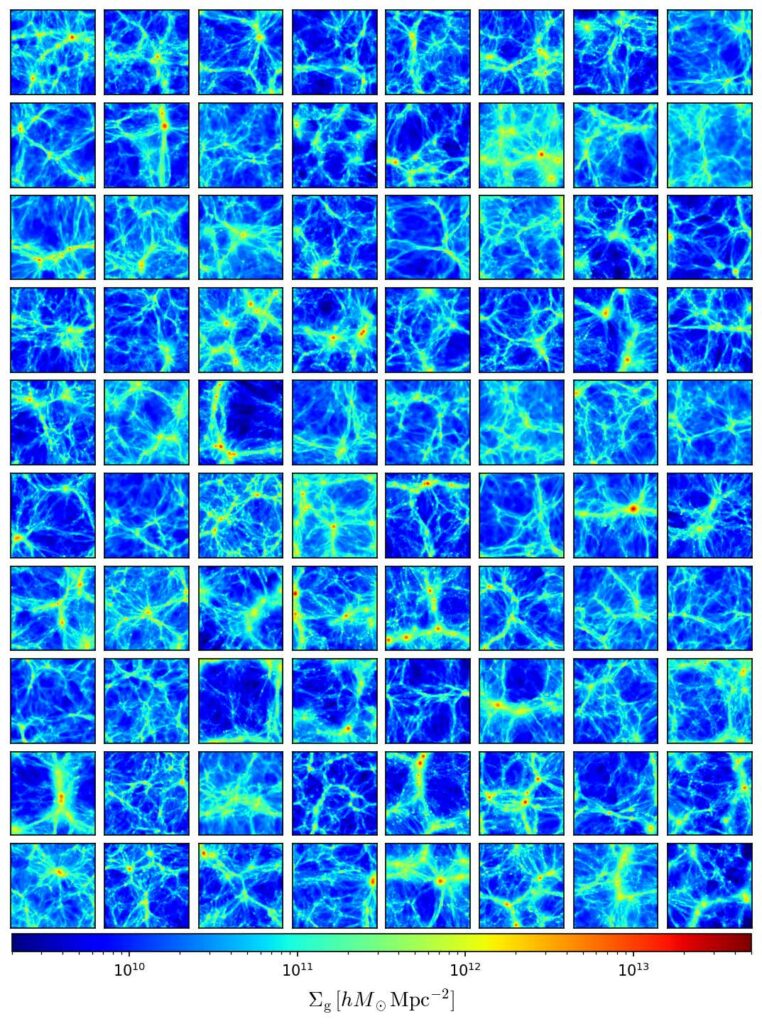
Meanwhile, Villaescusa-Navarro headed an effort to use the CAMELS data to estimate the value of two parameters that govern the fundamental properties of the universe: what fraction of the universe is matter, and how evenly mass is distributed throughout the cosmos. First, he and his colleagues used CAMELS to generate maps such as the distribution of dark matter, gas and different properties of stars. Then, using the maps, they trained a machine-learning tool called a neural network to predict the values of the two parameters.
“This is the same kind of algorithm used to tell the difference between a cat and a dog from the pixels of an image,” says Genel, who co-authored the paper. “The human eye can’t determine how much dark matter there is in a simulation, but a neural network can do that.”
The results showed the promise of leveraging CAMELS to precisely estimate such parameters in the future based on new observations of the universe, says Villaescusa-Navarro.
“These papers have done all this science that is very different from each other,” Villaescusa-Navarro says. “You can use the CAMELS data to weigh our own galaxy, use the signatures of mysterious fast radio bursts to learn about cosmology and astrophysics, or learn universal properties of subhalos” — smaller clumps of dark matter contained in larger dark matter halos.
“It’s exciting to see what other new discoveries this will enable,” he says.