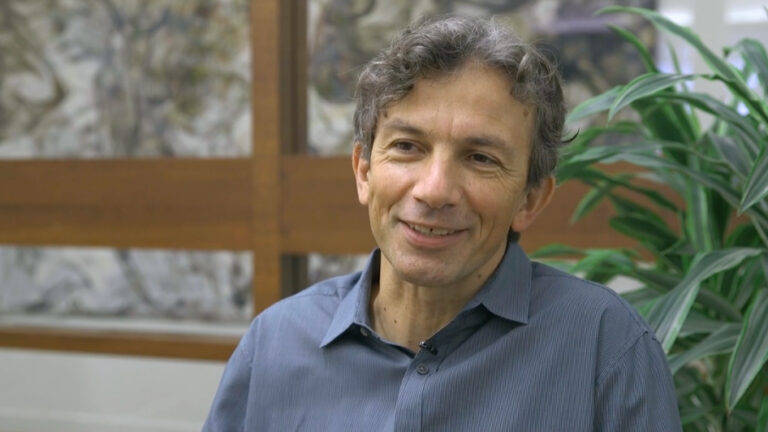
Watch: Suzanne Staggs and the Signatures of the Primordial Universe
Featuring
-
Suzanne Staggs
Co-Director, Simons Observatory
Bringing people and ideas together to fund, conduct, and share transformative science.
Our grants advance knowledge and strengthen connections between science and society.
Discover the latest news, research, and updates.
We convene scientists, mathematicians, and thinkers to share ideas and explore new questions.
Founded by Jim and Marilyn Simons, we’re a private philanthropy advancing mathematics and basic science.
Work with us on the frontier of basic science research.
The Flatiron Institute is a research center that uses computational science to advance fields like physics, biology, and astronomy.
Search
Suzanne Staggs, a physicist at Princeton University and founding member of the Simons Observatory, describes what cosmic microwave background (CMB) radiation can reveal about the early universe.
Co-Director, Simons Observatory
Suzanne Staggs is currently the Henry deWolf Smyth Professor of Physics at Princeton University, after having served as a Hubble Fellow at the University of Chicago for two years. She is a founding member of the Simons Observatory. Staggs received her Ph.D. in physics from Princeton University in 1993, and her B.A. in physics from Rice University in 1987. She is currently on the Astronomy and Astrophysics Advisory Committee of the National Science Foundation (NSF) and a fellow of the American Physical Society.
Staggs’ research focus is the experimental study of the cosmic microwave background (CMB) radiation, including precise measurements of its electromagnetic spectrum and thus its blackbody temperature, and exploration of its polarization properties and fine-scale angular anisotropies. Her present CMB work focuses on searching for the signature in the CMB polarization of gravity waves from an inflationary epoch in the primordial universe, and in using the CMB as a backlight to probe the growth of gravitationally bound structures in the last 13 billion years. This growth depends on such fundamental quantities as the nature of dark energy and the mass of the neutrino.