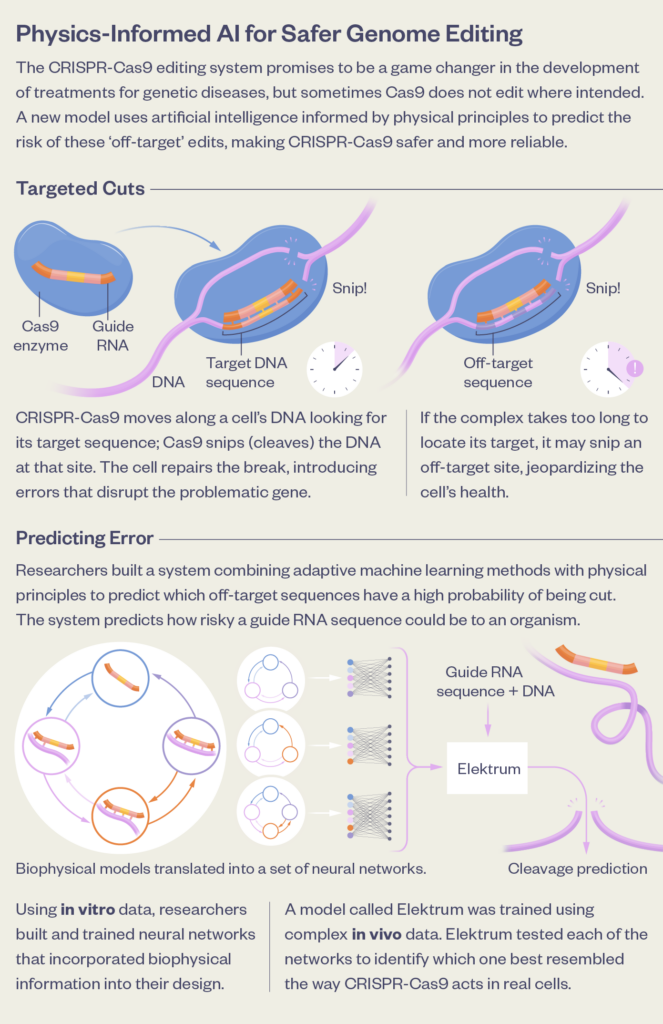
CRISPR technology was adapted from a natural immune system in bacteria that detects and destroys viruses called bacteriophages that infect the bacteria. The editing system is made up of two components: a guide RNA that contains about 20 nucleotide ‘letters’ designed to match with a particular target genetic sequence, and the Cas9 enzyme that cuts DNA. The two form a complex that binds a cell’s DNA and then slides and hops along it looking for the guide RNA’s complementary sequence. The complex searches the DNA by unzipping the double helix’s two strands and comparing nucleotides. Once it finds a sufficiently similar sequence, the complex cuts the DNA at that site.
The match doesn’t have to be perfect, which is useful for bacteria. A flexible CRISPR system gives the microbes some wiggle room to detect slightly different strains of bacteriophages with different genomes. However, that sequence flexibility can be a problem for researchers trying to make specific edits to a cell’s genome. If the complex finds another spot in the genome that matches most of its 20 nucleotides, it may cut there instead of at the designated site, potentially creating harmful mutations.
So researchers developing CRISPR systems for different applications — particularly human therapies — need to be able to calculate the chances that a given complex of Cas9 and guide RNA will make off-target cuts. Biotech companies scan organisms’ genomes for potential unintended sequences that could match their products’ guide RNAs and have even developed machine learning algorithms to better identify these sites. And regulatory agencies evaluating CRISPR therapies, such as for sickle cell treatment, have required researchers to screen their guide RNAs against large databases of human genomes to ensure the therapy’s safety in diverse populations.
However, not all machine learning algorithms work well when used in datasets other than the ones they were trained on. Different organisms, for instance, may have different numbers of potential sites that would match a given guide RNA sequence. And even within an organism, the condition of the DNA can vary widely from cell to cell — the guide RNA’s ideal target site might be blocked by another protein already bound to the DNA, for instance. This problem has greatly hindered the development of methods to confidently predict where and when CRISPR therapies will edit DNA.
Scientists can calculate these kinds of probabilities in vitro by putting the CRISPR/Cas9 complex in a tube with DNA and measuring how Cas9 interacts with various sequences. However, determining how time plays into these equations is challenging to do in vivo without killing the cells. With that in mind, Zhang, Lamson, Shelley and Troyanskaya set out to develop a more complete model to predict how CRISPR/Cas9 would work in any system or context by merging biophysical knowledge with machine learning techniques.
First, they turned to datasets that have carefully quantified CRISPR’s kinetics in vitro, incorporating factors such as the amount of time it spends unzipping DNA versus cutting it, or how the structural variations of DNA affect which sites are cut. Using these data, they built a set of machine learning models they call kinetically interpretable neural networks (KINNs). The novelty of KINNs is that they incorporate biophysically relevant kinetic equations into their structure. Once trained to determine how an enzyme will act in a controlled in vitro scenario, they can predict how enzymes will behave in more complex scenarios since the same physics must apply.
But in real life, cells are much more complicated than the in vitro systems these models were trained to predict. So the researchers built a second machine learning algorithm called Elektrum, which they trained using the complex, messy in vivo data that research teams have gathered from studying CRISPR-Cas9 effects in real cells. “There’s so many unknown unknowns,” Lamson says. “That’s why we have needed these really large models in the past to make predictions.”
To train the model, the researchers feed a guide RNA sequence into Elektrum. The program tests six different KINNs to see which one best fits the way the CRISPR complex will act in living cells. By combining this KINN with other parameters that it optimizes, it models which DNA sequences are most likely to be cut in that scenario.