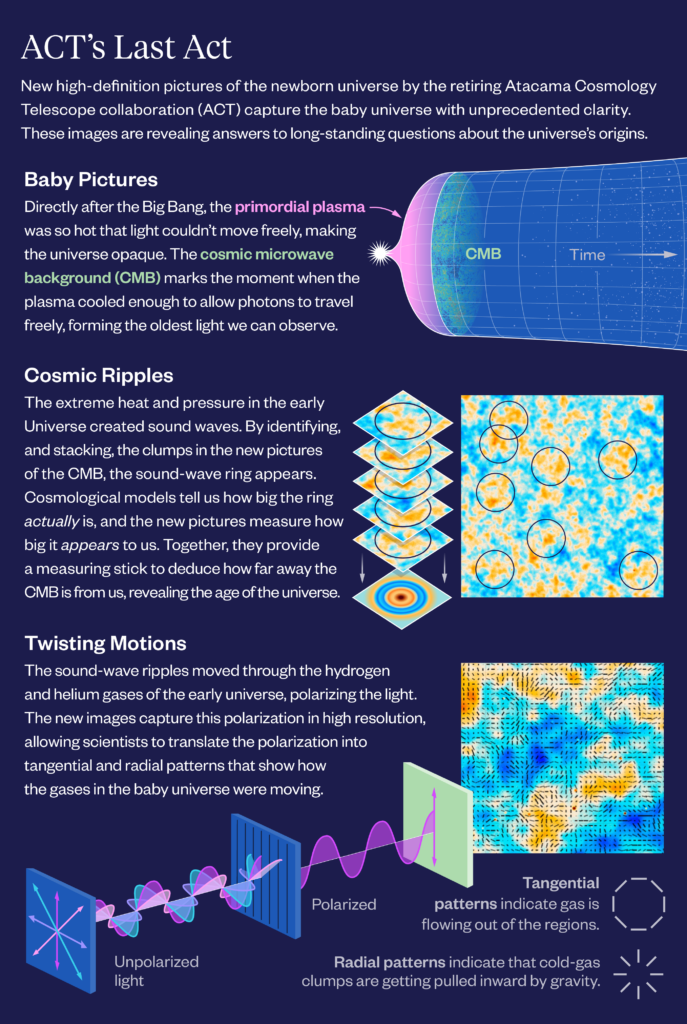
In the light, “we are seeing the first steps towards making the earliest stars and galaxies,” says Suzanne Staggs, director of ACT and the Henry deWolf Smyth Professor of Physics at Princeton University. “And we’re not just seeing light and dark, we’re seeing the polarization of light in high resolution.” That polarization provides crucial information about what happened during the universe’s first moments and how the cosmos has evolved since.
The new pictures of the CMB offer higher resolution than those made more than a decade ago by the Planck space-based telescope. “ACT measures the intensity and polarization of the light at five times the resolution of Planck and with around three times the sensitivity,” says Sigurd Naess, a researcher at the University of Oslo and lead author of the new papers related to the project. That detail enabled scientists to learn more about the cosmos, such as providing more precise measurements of the universe’s age.
The ACT collaboration’s dedication to open science has been an inspiration to the field, says ACT scientist Simone Aiola, a researcher at the Flatiron Institute’s Center for Computational Astrophysics in New York City. “ACT is one of the few ground-based experiments that has really committed to releasing as much of its data as it could.”
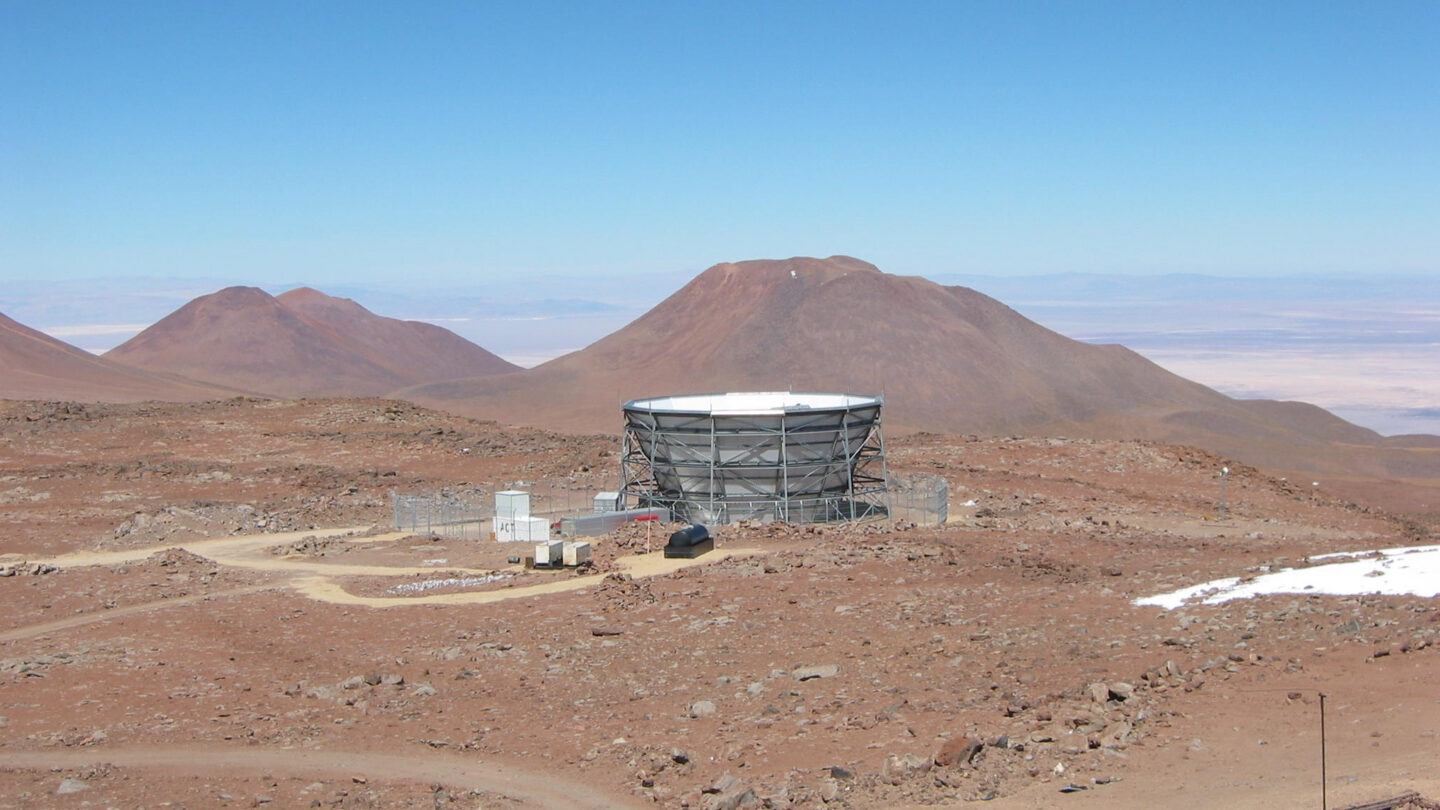
With the ACT project winding down, the scientific community is now excitedly looking to the Simons Observatory, which sits on the same site in Chile where ACT was based. Last year, the Simons Observatory began collecting some of the most precise measurements ever made of the CMB. With that level of precision, scientists hope to learn more about the universe and its history, such as what happened in the minuscule fraction of a second that followed the Big Bang.
“ACT demonstrated that you can do cosmology from Chile with high-resolution telescopes that capture really big patches of the sky,” Aiola says. “ACT was incredibly successful, and the Simons Observatory will do that even better.”
With ACT now winding down, the project’s researchers reflect on the unprecedented view of the universe their work has provided freely and openly to the scientific community. “We can see right back through cosmic history,” says Jo Dunkley, the Joseph Henry Professor of Physics and Astrophysical Sciences at Princeton University and the ACT analysis leader. “From our own Milky Way, out past distant galaxies hosting vast black holes and huge galaxy clusters, all the way to that time of infancy.”