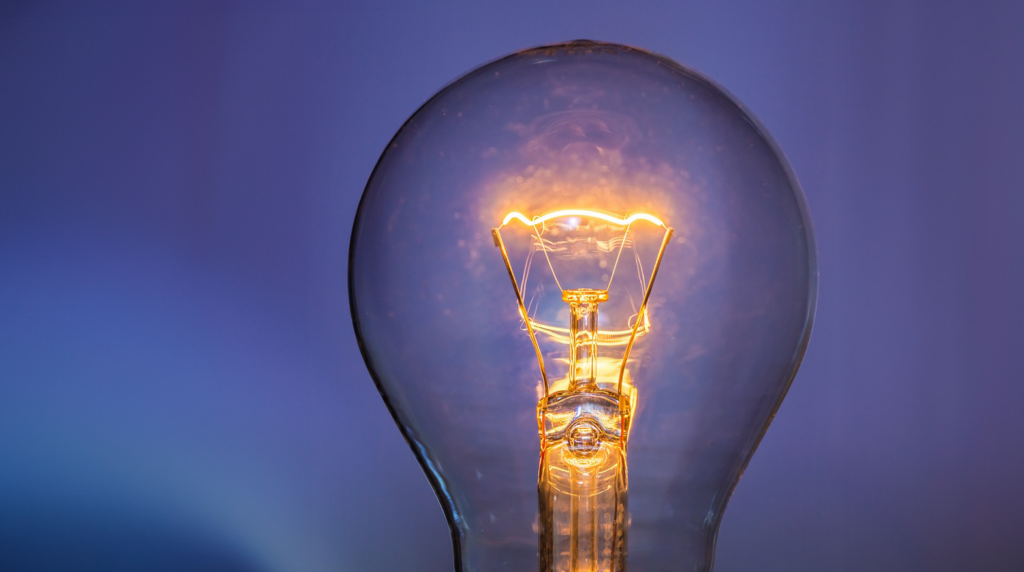
When you picture a lightbulb, you probably imagine the type of incandescent lightbulb Thomas Edison created nearly 150 years ago. These bulbs are shockingly inefficient. Only around five percent of the energy used is turned into visible light, with the rest wasted as heat. That’s so inefficient that using the bulbs to bake cookies in an Easy-Bake Oven is a more economical use of energy than using them to light your home.
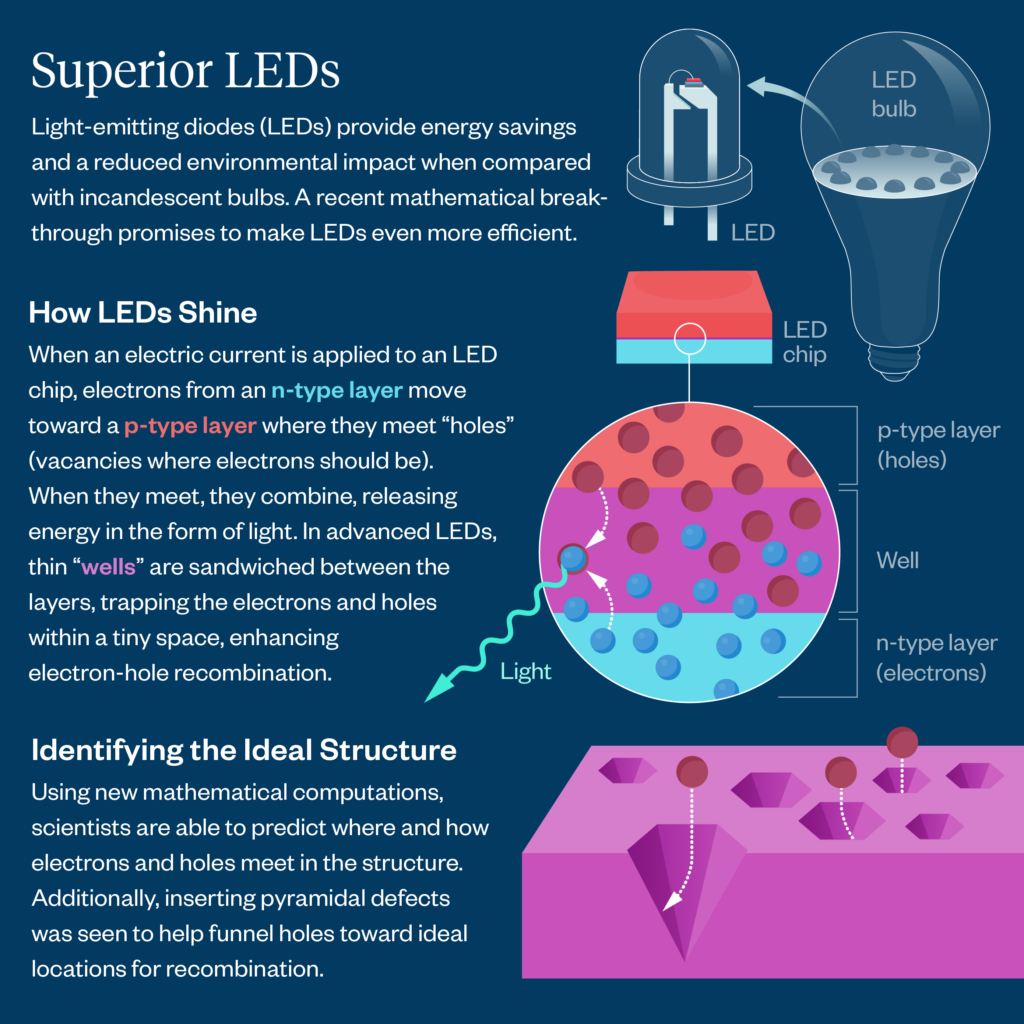
Over the last few years, incandescent bulbs have been gradually phased out in favor of LED lights, which use just one-tenth as much energy to produce the same amount of light. In 2018 alone, the swap to LEDs saved American households an estimated $14.7 billion on their energy bills. By 2035, the cumulative savings are expected to reach $890 billion.
The incredible power efficiency of modern LEDs is owed in no small part to recent breakthroughs in pure mathematics. Unlike applied mathematics, pure mathematics doesn’t have an application in mind — it’s fundamental research for the sake of generating new mathematical knowledge. In 2012, mathematician Svitlana Mayboroda and physicist Marcel Filoche published a landmark research paper on the mathematics of waves. They presented a mathematical object they invented called the landscape function. This function predicts how waves — such as soundwaves — behave in environments that don’t have a uniform structure.
The work addressed one of the field’s biggest problems, which had confounded researchers since the 1950s. What Mayboroda and Filoche didn’t know at the time was just how revolutionary and widely applicable their landscape function would be.
“We did not start the work thinking about producing more efficient LEDs,” says Mayboroda, a professor at the University of Minnesota in Minneapolis and at ETH Zurich. “But once you discover a powerful concept in mathematics, you can go and apply it everywhere.”
In 2018, Mayboroda became the founding director of the Simons Collaboration on Localization of Waves. This collaboration, funded by the Simons Foundation, continued building on Mayboroda and Filoche’s work on the landscape function to see how far it could go. “We went from the far end of pure mathematics to the far end of experimental physics and material engineering,” says Mayboroda.
In just a few years, the landscape function became instrumental in the design of materials used in the layers of an LED that produce light. Thanks to this concept, physicists can use computers to calculate how well a given material works rather than going through endless trial and error fabricating and testing different options. Before the landscape function, the required computations took prohibitively long, says collaboration principal investigator Jim Speck.
“It’s a game changer in computational efficiency,” says Speck, a professor of material sciences at the University of California, Santa Barbara. “It’s a factor of 1,000 times faster. Thanks to the landscape function, something that we couldn’t do, except in special cases, becomes very feasible.”