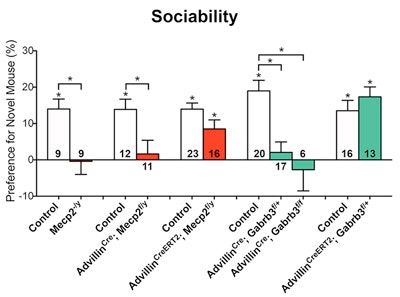
Our sensory systems help us to navigate our physical world. Aberrant reactivity to sensory stimuli, including tactile stimuli, are frequently observed in individuals with autism spectrum disorders (ASDs). SFARI Investigator David Ginty and his colleagues have shown that peripheral sensory processing issues contribute to autism-like behaviors in mice. They found that mice harboring mutations in ASD risk genes (MeCP2, GABRB3, SHANK3 or FMR1) have altered tactile discrimination and hypersensitivity to gentle touch. Mice lacking MeCP2 or GABRB3 selectively in peripheral sensory neurons also show aberrant tactile sensitivity. Interestingly, mice in which these genes were deleted from sensory neurons during development, but not in adulthood, exhibit behavioral deficits that recapitulate some of the phenotypes associated with ASDs, including anxiety-like behavior and decreased social interactions. These findings suggest that impairments in peripheral sensory systems during critical developmental windows may contribute to behavioral deficits in ASDs.

