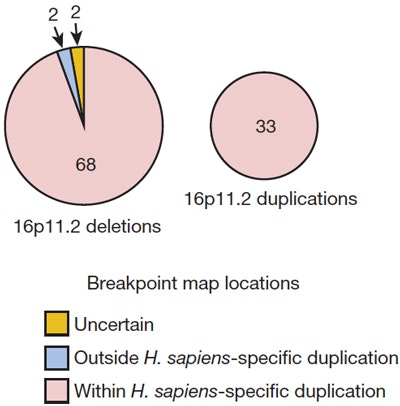
Recurrent copy number variation (CNV) at chromosomal region 16p11.2 accounts for approximately 1 percent of autism cases. Rearrangements in this region are mediated by a complex set of segmental duplications, many of which arose recently during human evolution. To reconstruct the evolutionary history of the chromosome 16p11.2 region, SFARI Investigator Evan Eichler and his colleagues compared genomic data from humans (both modern and archaic humans), archaic hominins and nonhuman primates. The researchers found that a 95-kilobase-pair segment containing the bola family member 2 gene (BOLA2) is duplicated exclusively in Homo sapiens. The team also used whole-genome sequence data and molecular inversion probe assays to localize breakpoints in 152 individuals carrying 16p11.2 duplications or deletions. They found that more than 96 percent of the disease-causing rearrangement breakpoints map within the H. sapiens-specific duplication containing BOLA2. Thus, while the selective duplication of this chromosomal region likely provided some evolutionary advantages, it also predisposed humans to recurrent rearrangements associated with neurodevelopmental disorders.

