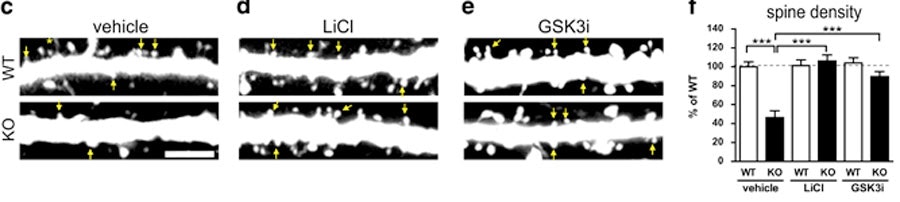
Human genomic studies have suggested an overlap between risk genes for autism spectrum disorder (ASD), schizophrenia and bipolar disorder. One of the biological pathways that is thought to link these disorders is the Wnt/beta-catenin signaling cascade. The DIX domain containing 1 (DIXDC1) protein, which is an intracellular Wnt/beta-catenin signaling pathway protein, is of additional interest since it interacts with DISC1, a risk gene for multiple psychiatric and neurodevelopmental disorders. In the current study, SFARI Investigator Benjamin Cheyette found that individuals with ASD, schizophrenia or bipolar disorder are more likely to exhibit rare inherited sequence-disrupting single nucleotide variants in DIXDC1 compared with unaffected individuals. Further, through studies in DIXDC1 knockout mice, Cheyette has provided evidence that disruptions to DIXDC1-mediated Wnt/beta-catenin signaling result in cellular alterations and behavioral abnormalities, including reduced dendritic spines, anxiety-like behaviors, and deficits in social behaviors. Correction of Wnt/beta-catenin signaling through administration of either lithium or a GSK3 inhibitor rescued the neuronal and behavioral phenotypes in these mice. Combined, these data suggest that DIXDC1 may serve as a molecular link between ASD, schizophrenia and bipolar disorder, and further highlight the important role that disruptions to the Wnt/beta-catenin signaling pathway play in these disorders.