Bringing people and ideas together to fund, conduct, and share transformative science.
Our grants advance knowledge and strengthen connections between science and society.
Discover the latest news, research, and updates.
We convene scientists, mathematicians, and thinkers to share ideas and explore new questions.
Founded by Jim and Marilyn Simons, we’re a private philanthropy advancing mathematics and basic science.
Work with us on the frontier of basic science research.
The Flatiron Institute is a research center that uses computational science to advance fields like physics, biology, and astronomy.
Search
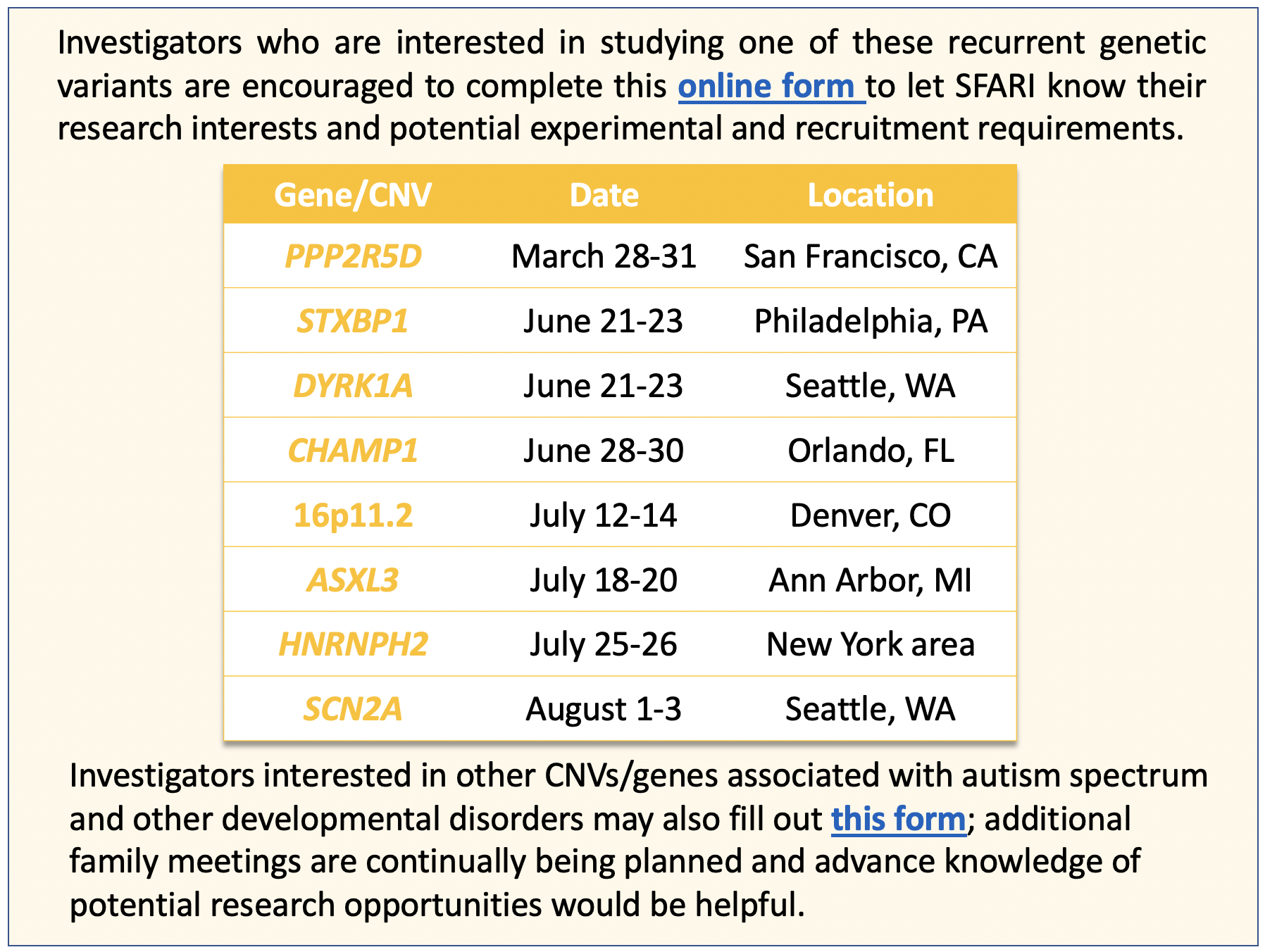
Family-organized groups are planning a number of meetings in 2019 for individuals with rare genetic neurodevelopmental conditions, including those due to 16p11.2 copy number variants and mutations in ASXL3, CHAMP1, DYRK1A, HNRNPH2, PPP2R5D, SCN2A and STXBP1 single genes. SFARI can help facilitate research opportunities at these meetings by connecting investigators with families.
Families of children with neurodevelopmental genetic conditions periodically organize meetings to help connect with others sharing the same genetic condition. Last November, SFARI announced six meetings that are being organized by family groups who have partnered with the Simons Variation in Individuals Project (Simons VIP) to host their registry and natural history information. These meetings are focused on individuals with 16p11.2 copy number variants (CNVs) and variants in ASXL3, PACS1, PPP2R5D, SCN2A and STXBP1 genes. Three additional meetings — focused on CHAMP1, DYRK1A and HNRNPH2 — are now being planned for summer 2019.
Because these genetic disorders are rare, family meetings provide a unique occasion for researchers to connect with and study in the same venue a relatively large number of individuals (typically 5–40) with the same condition that come from all over the world with their relatives (who, in most cases, are unaffected). Opportunities for research at these meetings are manifold and include, though are not limited to, acquiring behavioral data, recording scalp electroencephalogram (EEG) activity and collecting biospecimens (e.g., blood, saliva or skin cells) that can be used for genetic analyses or induced pluripotent stem cell (iPSC) line generation.
While these meetings are organized by the families (and are usually not sponsored by SFARI), SFARI staff are often present and can help facilitate research opportunities.
Investigators who are interested in studying one of the genetic variants mentioned above or would just like to attend or speak at the meetings are encouraged to complete this online form. A SFARI staff member will follow up each request with additional information.

