Substantial Role for Biallelic Mutations in Autism Risk, Particularly in Females
Featuring
-
Timothy Yu
SFARI Investigator
Bringing people and ideas together to fund, conduct, and share transformative science.
Our grants advance knowledge and strengthen connections between science and society.
Discover the latest news, research, and updates.
We convene scientists, mathematicians, and thinkers to share ideas and explore new questions.
Founded by Jim and Marilyn Simons, we’re a private philanthropy advancing mathematics and basic science.
Work with us on the frontier of basic science research.
The Flatiron Institute is a research center that uses computational science to advance fields like physics, biology, and astronomy.
Search
Timothy Yu and colleagues analyzed exome sequencing data to estimate that recessive mutations contribute to approximately 5 percent of all cases of autism, including 10 percent of females.
SFARI Investigator
Although most risk gene discovery efforts in autism have focused on de novo loss-of-function mutations that act in a dominant fashion, biallelic recessive mutations have also been identified in a subset of affected individuals. These mutations have been found in families enriched for inherited causes due to consanguinity (Yu et al., Neuron, 2013) and those that are not (Lim et al., Neuron, 2013).
Now, SFARI Investigator Timothy Yu and colleagues in the Autism Sequencing Consortium have analyzed exome sequences of more than 2,300 probands and more than 5,800 unaffected individuals to identify an expanded role for recessive mutations.
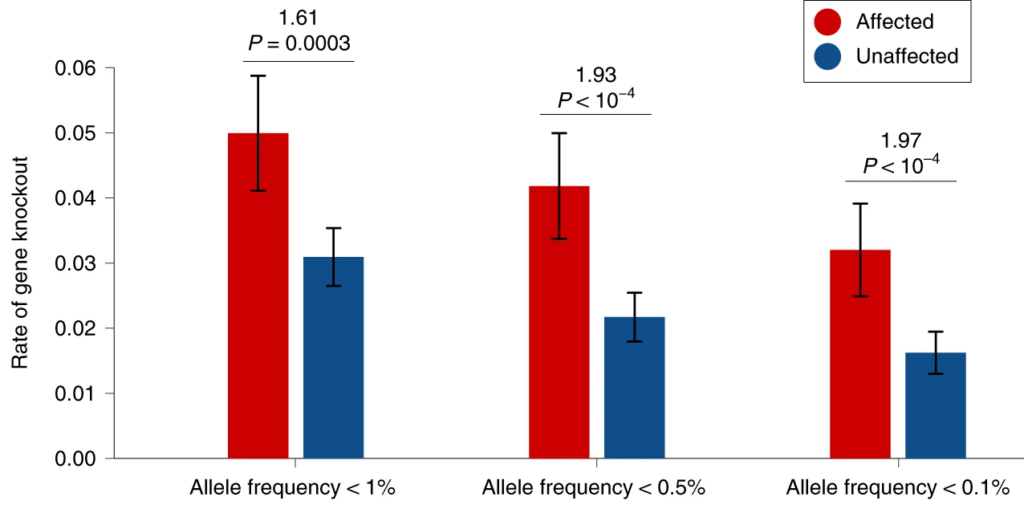
In the new work, partly funded by a SFARI Pilot Award, Yu and colleagues catalogued all loss-of-function (i.e., stop codon introduction and splice site mutations) and damaging missense mutations, and identified a significantly increased burden of biallelic mutations in both classes, especially for genes that are not hit by such mutations in the general population. Based on the ascertainment differential between cases and controls, they estimate that such recessive mutations contribute to approximately 5 percent of all cases, including a striking 10 percent of females, consistent with a female protective/male susceptibility effect in autism.
Although it was difficult with the current sample size to implicate individual genes harboring biallelic missense mutations, several of the genes with biallelic loss-of-function mutations have previously been associated with clinically relevant neurodevelopmental phenotypes. It will be of particular interest to determine if the risk genes implicated by recessive mutation have distinct or overlapping biological roles with those implicated by haploinsufficiency.

