Brief Treatment With Statin Yields Long-Term Benefit in Rat Model of Fragile X Syndrome
Featuring
-

Peter Kind
SFARI Investigator
Bringing people and ideas together to fund, conduct, and share transformative science.
Our grants advance knowledge and strengthen connections between science and society.
Discover the latest news, research, and updates.
We convene scientists, mathematicians, and thinkers to share ideas and explore new questions.
Founded by Jim and Marilyn Simons, we’re a private philanthropy advancing mathematics and basic science.
Work with us on the frontier of basic science research.
The Flatiron Institute is a research center that uses computational science to advance fields like physics, biology, and astronomy.
Search
Peter Kind and colleagues show that brief treatment with lovastatin results in sustained correction of physiological and behavioral deficits in a rat model of fragile X syndrome.
SFARI Investigator
The mGluR theory of fragile X syndrome (FXS) posits that exaggerated protein synthesis can account for many of the features of the disorder (Bear et al., Trends Neurosci., 2004). This theory has led to the testing of treatments that impinge on several aspects of mGluR-dependent signaling, in an attempt to normalize levels of protein synthesis. Despite a number of successes in rodent models, it remains unclear how early and how long such a treatment would have to be administered in order to be effective.
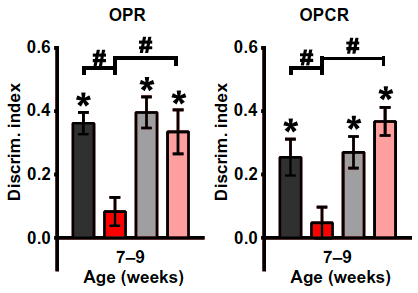
Now, SFARI Investigator Peter Kind and colleagues have shown that a brief, early treatment with lovastatin — a commonly used drug that lowers cholesterol levels — can result in sustained improvement of associative memory in a rat model of FXS.
In the new work, partly funded by an award to establish the Simons Initiative for the Developing Brain at the University of Edinburgh, the team chose to test lovastatin owing to its ability to inhibit the ERK signaling pathway and thereby correct protein synthesis. The team found that delivery of lovastatin via the rats’ laboratory chow for five weeks, beginning at four weeks of age, prevents the emergence of deficits in two different object-recognition paradigms. The effects of lovastatin on behavior were sustained until at least 23 weeks of age (the last time point the investigators tested). At the cellular and molecular levels, lovastatin also corrected FXS-associated alterations in protein synthesis and synaptic plasticity.
These findings provide additional support for the ongoing clinical trials of lovastatin in FXS and raise the prospect of additional trials in other forms of autism that are associated with dysregulated ERK signaling (Vithayathil et al., Prog. Brain Res., 2018).

