Aberrant Neocortical Connectivity in Shank3 Mutant Mice
Featuring
-

Alessandro Gozzi
SFARI Investigator
Bringing people and ideas together to fund, conduct, and share transformative science.
Our grants advance knowledge and strengthen connections between science and society.
Discover the latest news, research, and updates.
We convene scientists, mathematicians, and thinkers to share ideas and explore new questions.
Founded by Jim and Marilyn Simons, we’re a private philanthropy advancing mathematics and basic science.
Work with us on the frontier of basic science research.
The Flatiron Institute is a research center that uses computational science to advance fields like physics, biology, and astronomy.
Search
Alessandro Gozzi and colleagues found that Shank3-deficient mice have disrupted frontocortical functional connectivity, which is associated with impaired communication and social behaviors.
SFARI Investigator
Since its discovery as a strong genetic risk factor for autism, the synaptic scaffolding protein Shank3 has been studied in multiple mouse models. While much of this work has focused on the role of Shank3 in corticostriatal connectivity, our understanding of the impact of Shank3 mutations on large-scale connectivity is far from complete.
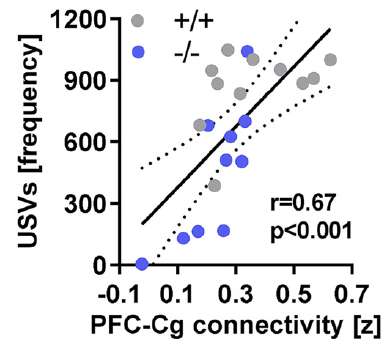
Now, SFARI Investigator Alessandro Gozzi and colleagues have shown that homozygous Shank3 mutant mice have robust reductions in long-range and local connectivity in prefrontal cortical areas, which are tightly linked to socio-communicative deficits.
In the new work — partly funded by a SFARI Pilot Award and a previous SFARI Explorer Award — the team used resting state functional magnetic resonance imaging (fMRI) to show long-range desynchronization between prefrontal regions and other long-range cortical targets. They also report desynchronization between the basal ganglia and anterior cingulate cortex and decreased interhemispheric connectivity between striatal regions. These disruptions in connectivity also correlated with observed changes in anogenital sniffing and ultrasonic vocalizations.
All told, the results suggest that Shank3 deficiency leads to selective desynchronization of association and integrative cortical regions, providing another example of an ASD genetic risk factor showing common patterns of prefrontal hypoconnectivity. The data are also broadly consistent with another recent study that implicated the anterior cingulate cortex as a key mediator of the social deficits seen in Shank3 mutant mice (Guo et al., Nat. Neurosci., 2019).

