C. elegans Screen for ASD Risk Gene–Associated Phenotypes
Featuring
-
Kurt Haas
SFARI Investigator
-

Paul Pavlidis
SFARI Investigator
-

Catharine Rankin
SFARI Investigator
Bringing people and ideas together to fund, conduct, and share transformative science.
Our grants advance knowledge and strengthen connections between science and society.
Discover the latest news, research, and updates.
We convene scientists, mathematicians, and thinkers to share ideas and explore new questions.
Founded by Jim and Marilyn Simons, we’re a private philanthropy advancing mathematics and basic science.
Work with us on the frontier of basic science research.
The Flatiron Institute is a research center that uses computational science to advance fields like physics, biology, and astronomy.
Search
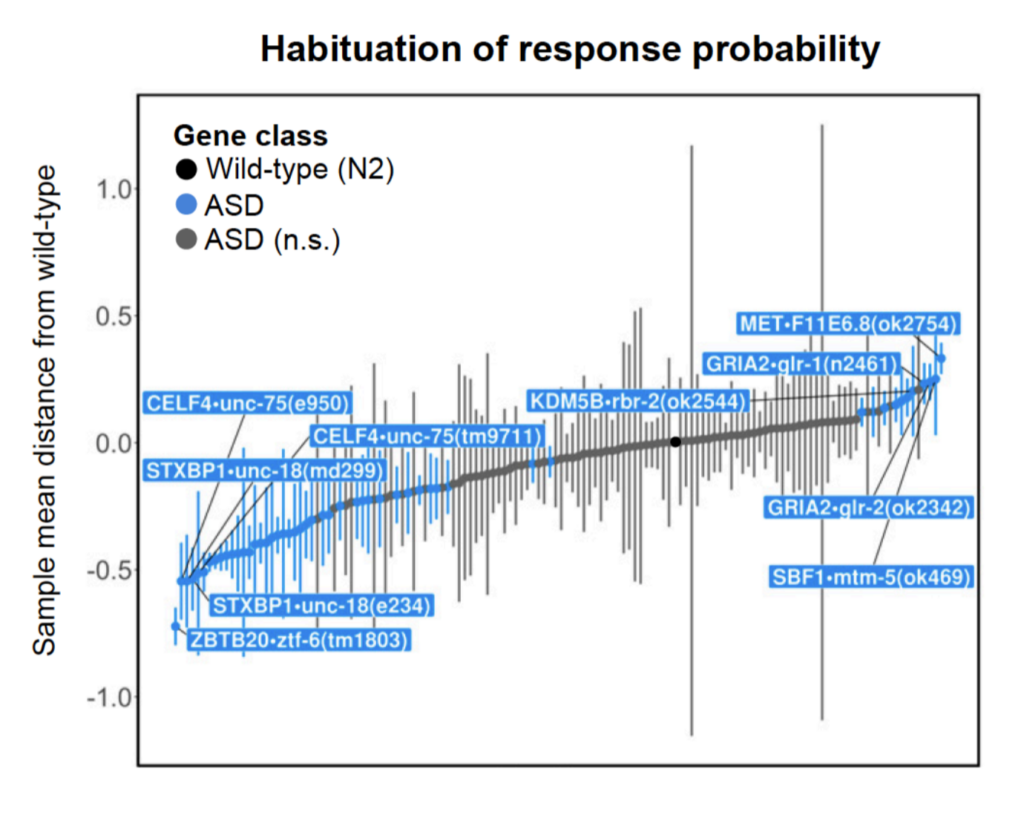
Catharine Rankin, Kurt Haas, Paul Pavlidis and colleagues used machine vision to find that mutations linked to ASD risk genes are associated with changes in habituation of response probability in C. elegans
SFARI Investigator
SFARI Investigator
SFARI Investigator
For many years, the nematode Caenorhabditis elegans has provided a powerful platform to rapidly assign functions to human genes for which they harbor orthologs. A previous study of C. elegans, funded by the SFARI Functional Screen of Autism-Associated Variants program, identified a number of associated phenotypes for a subset of genes linked to autism spectrum disorder (ASD). A new screen now reveals that changes in habituation learning are strikingly common in nematodes carrying mutations in C. elegans orthologs of ASD risk genes.
The new study was supported in part by another such targeted award and a Research Award to SFARI Investigators Catharine Rankin, Kurt Haas, and Paul Pavlidis, who work in a mini-consortium to study the functional effects of missense and other ASD-associated mutations in a range of model organisms. Rankin, Haas, Pavlidis and their collaborators used their machine vision system to rapidly quantify the effects of mutations in nearly 100 orthologs of ASD risk genes on 26 phenotypes in C. elegans. They found that a substantial number of these mutations had specific effects on the habituation of response probability to a tactile stimulus, which in most instances resulted in impaired habituation. In follow-up experiments, they used the same paradigm to test the functionality of specific missense mutations observed in people with ASD and were also able to test for epistatic interactions between genes that had effects on the same phenotype.
In addition to identifying habituation as an ASD-associated phenotype deserving more attention in future studies, the authors also applied the auxin-inducible degradation system to test for the ability of adult re-expression of risk genes to rescue phenotypes observed upon developmental loss of their gene products. The partially successful rescue of neuroligin-associated phenotypes suggests that this C. elegans–based model may be useful as an initial screen for genes whose critical roles are not solely developmental.

