Shank3 Is Necessary for Homeostatic Plasticity
Featuring
-

Gina Turrigiano
SFARI Investigator
Bringing people and ideas together to fund, conduct, and share transformative science.
Our grants advance knowledge and strengthen connections between science and society.
Discover the latest news, research, and updates.
We convene scientists, mathematicians, and thinkers to share ideas and explore new questions.
Founded by Jim and Marilyn Simons, we’re a private philanthropy advancing mathematics and basic science.
Work with us on the frontier of basic science research.
The Flatiron Institute is a research center that uses computational science to advance fields like physics, biology, and astronomy.
Search
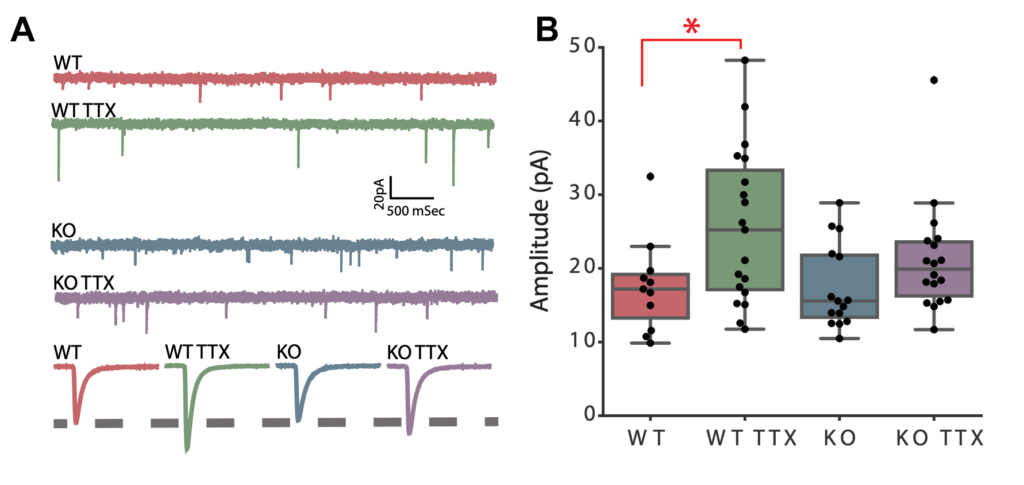
Gina Turrigiano and colleagues showed that loss of Shank3 disrupts homeostatic plasticity and that this deficit can be rescued by the mood-stabilizing drug lithium (Li+).
SFARI Investigator
Mutations in the synaptic scaffolding protein Shank3 cause circuit dysfunction in many brain regions. A new paper reports that loss of Shank3 disrupts homeostatic plasticity in cortical neurons and that this deficit can be rescued by the mood-stabilizing drug lithium (Li+).
The work was supported in part by a Research Award to SFARI Investigator Gina Turrigiano. The researchers studied cultures of rat cortical neurons in which Shank3 was knocked down with RNA interference (RNAi) in a small subset of neurons. Treatment with tetrodotoxin (TTX) to block spiking for 24 hours led to an overall increase in synaptic strength in wildtype neurons, as expected. However, this ‘scaling up’ was absent in Shank3 knockdown neurons, despite no change in basal synaptic strength in mutant neurons, suggesting a specific, cell-autonomous effect. Shank3 knockdown neurons also failed to show the increase in intrinsic excitability in response to TTX treatment seen in wildtype neurons. Based on some case reports suggesting efficacy of Li+ in people with shankopathies, Turrigiano and her colleagues treated the rat cortical cultures with Li+. This treatment rescued the deficits in both synaptic and intrinsic homeostatic plasticity in Shank3 knockdown neurons. A specific inhibitor of GSK3 (which Li+ is known to inhibit) similarly rescued synaptic scaling in Shank3 knockdown neurons.
The researchers next used multielectrode arrays to record spiking activity of neurons in primary visual cortex (V1) of mice before and after monocular deprivation, which is known to cause in wildtype mice an initial drop in firing rate followed by a homeostatic restoration of activity, biased toward responsiveness to the intact eye. Following monocular deprivation, Shank3b knockout mice showed the expected decrease in firing rate in V1 but did not show a recovery of activity or a homeostatic increase in responsiveness to the intact eye.
The results of this study show that loss of Shank3 function disrupts multiple forms of homeostatic plasticity in vitro and in vivo. In vitro, these deficits could be ameliorated by treatment with Li+, likely acting through its inhibition of GSK3. Some questions remain, including whether Li+ can rescue homeostatic plasticity deficits in vivo and whether similar changes in homeostatic plasticity are seen in other monogenic forms of ASD.

