Foxp1 and the Striatum
Featuring
-

Genevieve Konopka
SFARI Investigator
Bringing people and ideas together to fund, conduct, and share transformative science.
Our grants advance knowledge and strengthen connections between science and society.
Discover the latest news, research, and updates.
We convene scientists, mathematicians, and thinkers to share ideas and explore new questions.
Founded by Jim and Marilyn Simons, we’re a private philanthropy advancing mathematics and basic science.
Work with us on the frontier of basic science research.
The Flatiron Institute is a research center that uses computational science to advance fields like physics, biology, and astronomy.
Search
Genevieve Konopka and colleagues reported important roles for Foxp1 in particular subclasses of the spiny projection neurons in the striatum, with downstream effects on striatal-dependent circuits and behaviors.
SFARI Investigator
A number of reports have established important roles for the transcription factor Foxp1 in the development of the striatum. A new study applies single-cell RNA-sequencing approaches to mice lacking Foxp1 in subsets of striatal cells to shed new light on its precise functions in this region of the brain and in the origins of autism spectrum disorder (ASD) and intellectual disability.
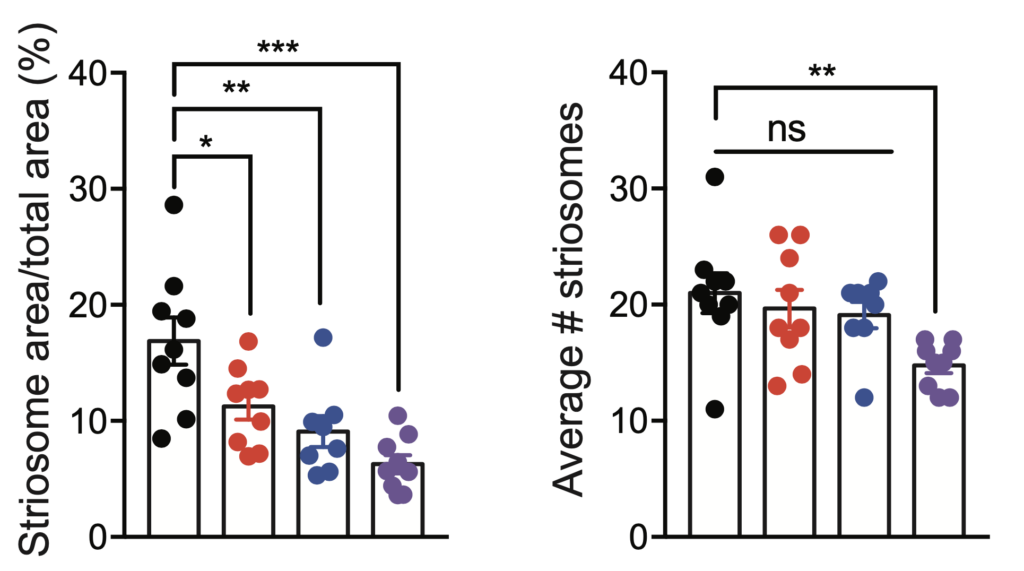
The new work was supported in part by both a Pilot Award and a Research Award to SFARI Investigator Genevieve Konopka. By characterizing the transcriptomes of mice lacking Foxp1 in single cells expressing dopamine receptor 1 (D1) or 2 (D2), Konopka and colleagues were able to establish at least a few of its essential roles at the cellular, structural, functional and behavioral levels. Notably, they found a substantial reduction of spiny projection neurons of the indirect pathway (iSPNs) in Foxp1 heterozygous D2 cells, as well as an increase in a distinct subpopulation of SPNs called ‘eccentric’ (Saunders et al., Cell, 2018). They also found a reduced distribution of iSPNs to the striosomes and an enrichment for other ASD risk genes in the list of differentially expressed genes in iSPNs that lack one copy of Foxp1. At the functional level, they uncovered projection deficits to the external globus pallidus. Finally, mice heterozygous for Foxp1 in iSPNs showed deficits in motor learning, activity and cued fear conditioning.
Given that the striatum has been implicated in ASD repeatedly, this study suggests that one productive avenue of research could be to focus on a Foxp1-dependent network in iSPNs and in striatopallidal circuitry.

