Listening to:
Alumni Spotlight: Christopher Lam
0:00
/
0:00
Bringing people and ideas together to fund, conduct, and share transformative science.
Our grants advance knowledge and strengthen connections between science and society.
Discover the latest news, research, and updates.
We convene scientists, mathematicians, and thinkers to share ideas and explore new questions.
Founded by Jim and Marilyn Simons, we’re a private philanthropy advancing mathematics and basic science.
Work with us on the frontier of basic science research.
The Flatiron Institute is a research center that uses computational science to advance fields like physics, biology, and astronomy.
Search
A former Flatiron Institute pre-doctoral fellow, Lam now works on the Nancy Grace Roman Space Telescope.
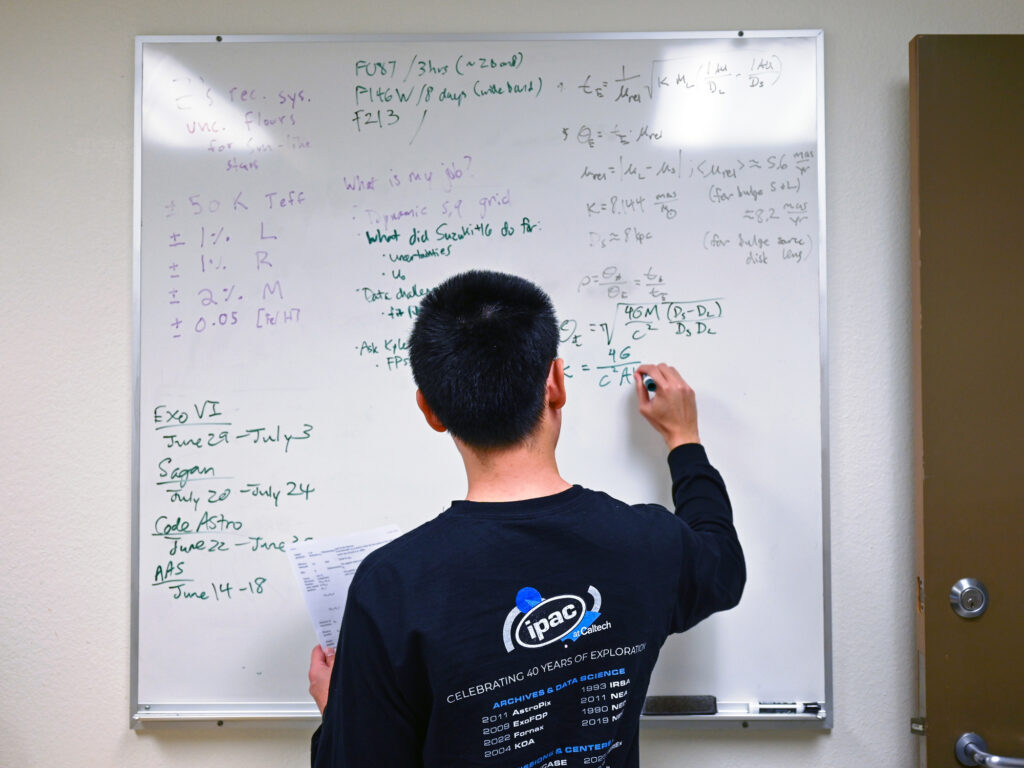
Astrophysicist Christopher Lam joined the Simons Foundation’s Flatiron Institute in 2022 for a one-year pre-doctoral fellowship in the Center for Computational Astrophysics (CCA). While at CCA, he built a Python library called gaspery that uses Fisher Information to optimize the scheduling of radial velocity follow-up observations for exoplanet systems. He is an NSF Graduate Research Fellow and runs a STEM cohort for first-generation and low-income college students called the Alliance for the Low-Income & First-Generation Narrative (AL1GN).
We recently caught up with Lam to ask him what he’s been up to as he’s continued his career.
The Flatiron Institute works to develop the next generation of computational scientists. Interested in joining us? See our careers page. Flatiron Institute alumni can also keep in touch by joining our alumni network.
I am now a postdoc at the Infrared Processing and Analysis Center and the California Institute of Technology (Caltech), working on the microlensing exoplanet occurrence rate pipeline for the Nancy Grace Roman Space Telescope.
My biggest takeaway was the impact of hospitality on producing a simultaneously nurturing and stimulating working environment. While most other academic environments can’t replicate the efforts of the large and amazing hospitality staff at the Flatiron Institute, my experience there shaped how I bring myself to the workplace and informed what I want to see in my scientific working environment. Basically, it gave me higher standards!
I went to Heidelberg, Germany, last month for a conference on microlensing, and it felt like stepping into a magical land! Also, I’m learning microlensing after working on identifying exoplanets through transiting and, through the CCA, radial velocity. That also feels like learning magic.
I have so many! Either the after-school book club that the CCA pre-docs shared with some of our friends at the Center for Computational Neuroscience, or the holiday party at the American Museum of Natural History.