This ongoing project provides physically motivated predictions for the properties and demographics of galaxies and quasars forming across cosmic time.
About
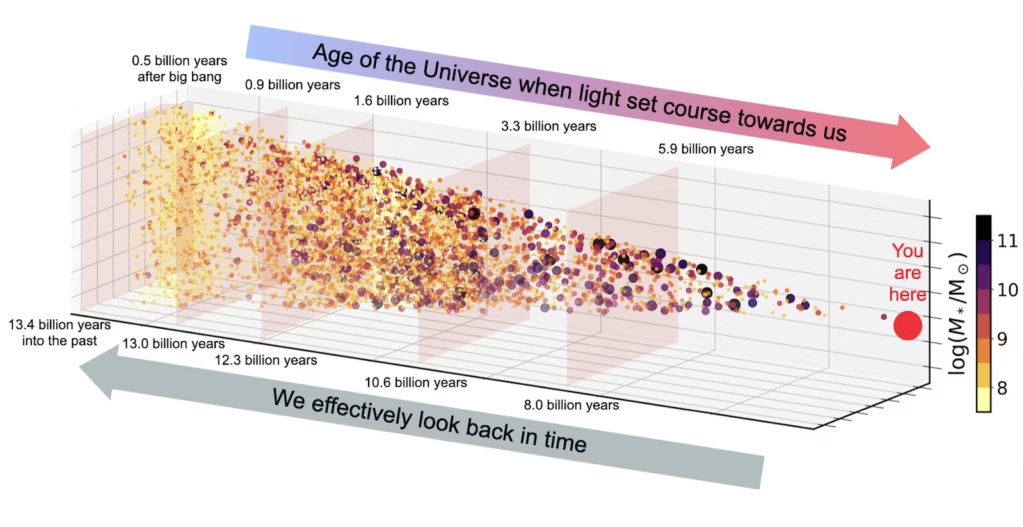
Simulated Lightcones
Data Access
Publications
| JWST I | Yung et al. 2019a | MNRAS 483, 2983 |
| JWST II | Yung et al. 2019b | MNRAS 490, 2879 |
| JWST III | Yung et al. 2020a | MNRAS 494, 1002 |
| JWST IV | Yung et al. 2020b | MNRAS 496, 4574 |
| JWST V | Yung et al. 2021 | MNRAS 508, 2706 |
| JWST VI | Yung et al. 2022 | MNRAS 515, 5416 |
| Roman | Yung et al. 2023 | MNRAS 519, 1578 |
Team Members
| Name | Affiliation |
|---|---|
| Aaron Yung | NASA/GSFC |
| Steve Finkelstein | UT Austin |
| Gergö Popping | ESO |
| Harry Ferguson | STScI |
| Aparna Venkatesan | USF |
| Micaela Bagley | UT Austin |
| Rachel Somerville | Flatiron/CCA |
| Jon Gardner | NASA/GSFC |
| Romeel Dave | Edinburgh |
| Peter Behroozi | Arizona |
| Michaela Hirschmann | EPFL |
Collaborators
More Resources
Access theory friendly catalogs and theoretical mock catalogs for the Cosmic Assembly Near-infrared Deep Extragalactic Survey (CANDELS).